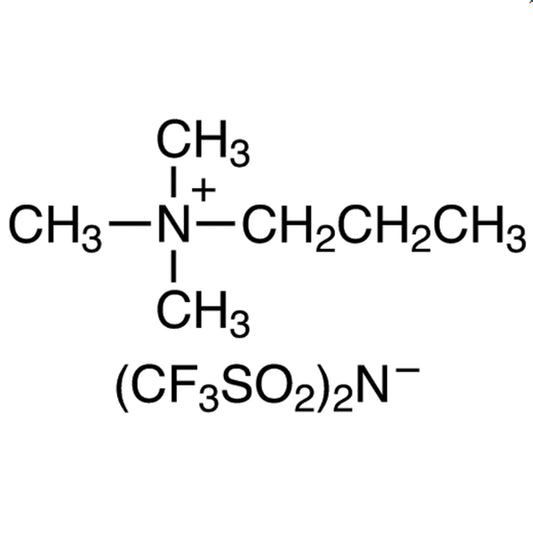
TCI M2098 1-Methyl-1-propylpyrrolidinium Bis(trifluoromethanesulfonyl)imide is a room-temperature ionic liquid built from a quaternary pyrrolidinium cation paired with the bis(trifluoromethanesulfonyl)imide anion, commonly abbreviated as TFSI. This combination produces a salt that remains liquid at ambient temperature without any added solvent, which means a single material can serve simultaneously as a reaction medium and as an electrolyte. In laboratory work the compound is widely used in energy storage research, electrochemistry, and green chemistry programmes, where it replaces volatile organic solvents that have long been a source of fire risk and emissions.
The properties that make this salt a preferred choice begin with its wide electrochemical window, its extremely low vapour pressure, and its non-flammable character. The TFSI anion carries a delocalised charge and behaves hydrophobically, so the salt resists water uptake far better than ionic liquids based on halide anions, while at the same time lowering viscosity and raising ionic conductivity. The pyrrolidinium cation is fully saturated and carries no acidic proton, which gives it better cathodic stability than imidazolium cations and makes the material suitable for pairing with reactive metal electrodes.
In Indonesian laboratories this material typically appears in university and institutional research groups working on batteries, supercapacitors, and electrodeposition, as well as in analytical and synthetic groups exploring solvent alternatives. Because it is supplied as a ready-to-use liquid, it integrates directly into glovebox workflows and three-electrode cell studies without a preparation step, and it is handled in the same controlled-atmosphere conditions already established for electrolyte research.
TCI brochures (PDF)
- Ionic Liquids for Battery Research 2026-04-13 · p. 2
- Ionic Liquids 2026-06-08 · p. 11
- Quaternary Ammonium Salts 2025-11-10 · p. 10
Related TCI products
- TCI B2851 223437-11-4 1-Butyl-1-methylpyrrolidinium Bis(trifluoromethanesulfonyl)imide
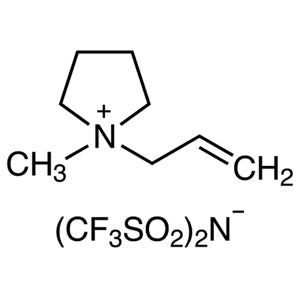
- TCI A3089 1059624-23-5 1-Allyl-1-methylpyrrolidinium Bis(trifluoromethanesulfonyl)imide
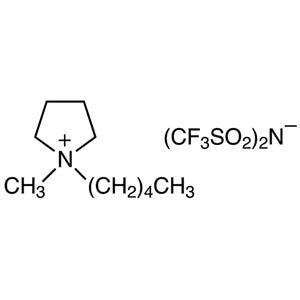
- TCI M3118 380497-17-6 1-Methyl-1-pentylpyrrolidinium Bis(trifluoromethanesulfonyl)imide
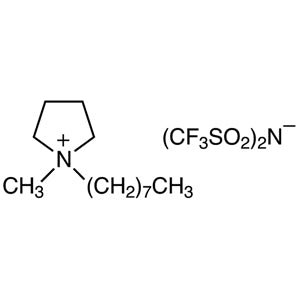
- TCI M3117 927021-43-0 1-Methyl-1-n-octylpyrrolidinium Bis(trifluoromethanesulfonyl)imide
- TCI M2980 852620-97-4 1-Methyl-1-propylpyrrolidinium Bis(fluorosulfonyl)imide
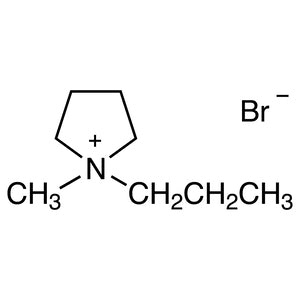
- TCI M3496 608140-09-6 1-Methyl-1-propylpyrrolidin-1-ium Bromide
- Lithium and sodium battery electrolyte research, where the wide electrochemical window and non-flammable nature allow cell testing at conditions that would be unsafe with conventional carbonate solvents.
- Supercapacitor and electrical double-layer studies, since the broad stability window permits higher operating voltages and therefore a meaningful increase in measurable energy density per device.
- Electrodeposition of reactive and refractory metals, because the absence of an acidic proton on the pyrrolidinium cation suppresses competing hydrogen evolution at the working electrode.
- Green chemistry and solvent-replacement work, where the negligible vapour pressure removes solvent evaporation and the associated emission and inhalation exposure from the reaction setup entirely.
- Fundamental electrochemical characterisation such as cyclic voltammetry and impedance spectroscopy, where the hydrophobic TFSI anion gives reproducible baselines with less interference from adventitious water.
| Brand | TCI (Tokyo Chemical Industry) |
|---|---|
| CAS number | 223437-05-6 |
| Molecular formula | — |
| Purity | — |
| Category | Chemistry > Building Blocks > Fluorinated Building Blocks |
| Pack sizes | Please refer to the available packaging options listed for this catalogue item |
| Physical form | Room-temperature ionic liquid (liquid at ambient temperature) |
| Storage | Keep tightly closed in a cool, dry place, protected from moisture |
- Product Code: M2098
Store the container tightly closed in a cool, dry area away from moisture, since water uptake will alter the electrochemical behaviour of the ionic liquid even though the TFSI anion is comparatively hydrophobic. Original manufacturer bottles are the preferred container; where transfer is required, use clean, dry glass or fluoropolymer vessels with sealed closures, and handle the liquid under an inert atmosphere or in a glovebox when the intended work is moisture-sensitive. Dispense in a well-ventilated area or fume hood using dry syringes or pipettes, and wear safety glasses, chemically resistant gloves, and a laboratory coat. Keep the material away from strong oxidising agents and incompatible chemicals, and consult the manufacturer's safety data sheet before first use and before disposal.
—
Product Categories
Produk Terkait
-
1-Butyl-1-methylpyrrolidiniumBis(trifluoromethanesulfonyl)imide TCI B2851
Regular price From Rp 1.829.100,00Regular price -
1-Allyl-1-methylpyrrolidiniumBis(trifluoromethanesulfonyl)imide TCI A3089
Regular price Rp 2.757.300,00Regular price -
1-Methyl-1-pentylpyrrolidiniumBis(trifluoromethanesulfonyl)imide TCI M3118
Regular price From Rp 903.000,00Regular price -
1-Methyl-1-n-octylpyrrolidiniumBis(trifluoromethanesulfonyl)imide TCI M3117
Regular price From Rp 2.969.400,00Regular price -
1-Methyl-1-propylpyrrolidiniumBis(fluorosulfonyl)imide TCI M2980
Regular price From Rp 2.809.800,00Regular price -
1-Methyl-1-propylpyrrolidin-1-iumBromide TCI M3496
Regular price From Rp 1.618.050,00Regular price -
1-VinylimidazoleBis(trifluoromethanesulfonyl)imide TCI V0145
Regular price Rp 2.757.300,00Regular price -
TrimethylpropylammoniumBis(trifluoromethanesulfonyl)imide TCI T2761
Regular price From Rp 1.856.400,00Regular price