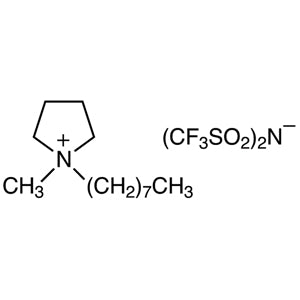
TCI M3117 1-Methyl-1-n-octylpyrrolidinium Bis(trifluoromethanesulfonyl)imide is an ionic liquid from the pyrrolidinium family, paired with the bis(trifluoromethanesulfonyl)imide anion commonly abbreviated as NTf2. The compound belongs to the class of room temperature ionic liquids, meaning it is a salt that remains in the liquid state at around ambient temperature. Because of this, it can act as a solvent and as an electrolyte at the same time. In the laboratory the material is used as a reaction medium that is practically non-volatile, as an electrolyte in electrochemical research, and as an extracting phase in the selective separation of organic compounds and metal ions.
The characteristics that make researchers select this ionic liquid are its very low vapour pressure, its wide electrochemical stability window, and its good thermal stability, the latter two owing much to the NTf2 anion whose charge is strongly delocalised. The n-octyl chain on the cation confers a more pronounced hydrophobic character than shorter-chain derivatives, so this ionic liquid tends to form two separate phases with water and is therefore very well suited to liquid-liquid extraction. The same chain length also influences viscosity and the ability to dissolve non-polar compounds, giving researchers one clearly defined structural variable to work with.
In Indonesian laboratories the material is typically found in university and institutional research groups working on electrochemistry, green solvents, and separation science. It is generally handled in small quantities on the bench, where its non-volatile nature makes it convenient for work that would otherwise require continuous solvent replenishment or extensive vapour control. Its role as a structural variable also suits comparative studies in which several chain lengths of the same cation family are evaluated side by side.
TCI brochures (PDF)
- Ionic Liquids 2026-06-08 · p. 11
Related TCI products
- TCI B2851 223437-11-4 1-Butyl-1-methylpyrrolidinium Bis(trifluoromethanesulfonyl)imide
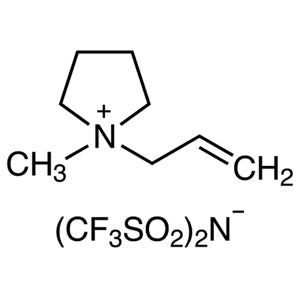
- TCI A3089 1059624-23-5 1-Allyl-1-methylpyrrolidinium Bis(trifluoromethanesulfonyl)imide
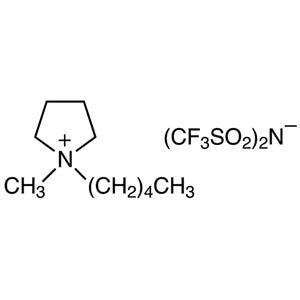
- TCI M3118 380497-17-6 1-Methyl-1-pentylpyrrolidinium Bis(trifluoromethanesulfonyl)imide
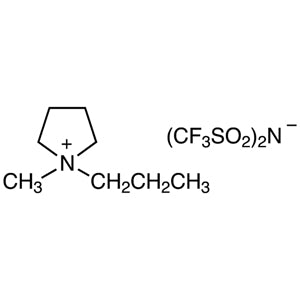
- TCI M2098 223437-05-6 1-Methyl-1-propylpyrrolidinium Bis(trifluoromethanesulfonyl)imide
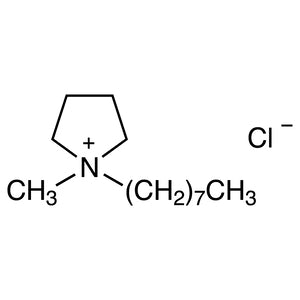
- TCI M3499 909398-60-3 1-Methyl-1-octylpyrrolidin-1-ium Chloride
- TCI V0145 1013027-27-4 1-Vinylimidazole Bis(trifluoromethanesulfonyl)imide
- Non-volatile reaction medium: the material serves as a solvent that practically does not evaporate, allowing reactions to be run without the continuous solvent loss associated with conventional organic solvents.
- Electrolyte for electrochemical research: its wide electrochemical stability window lets researchers explore a broad potential range before the medium itself begins to decompose at the electrode.
- Liquid-liquid extraction phase: the strongly hydrophobic n-octyl chain promotes the formation of two separate phases with water, which is the basic requirement for this separation technique.
- Selective separation of metal ions: the compound acts as an extracting phase in studies where target metal ions are partitioned out of an aqueous phase into the ionic liquid.
- Structure-property studies: the defined n-octyl chain length gives one clear structural variable for investigating how chain length affects viscosity and non-polar solubility.
| Brand | TCI |
|---|---|
| CAS number | 927021-43-0 |
| Molecular formula | — |
| Purity | — |
| Category | Chemistry > Specialty Synthesis > Ionic Liquids [Specialty Synthesis] |
| Pack sizes | please refer to the catalogue listing for the available pack sizes of this item |
| Physical form | liquid at around room temperature (room temperature ionic liquid) |
| Storage | keep in a tightly closed container, protected from moisture |
Store the material in its original tightly closed container, kept away from moisture since the hydrophobic character of this ionic liquid does not prevent surface water uptake that can affect electrochemical measurements. Glass containers with well-sealing closures are generally suitable for laboratory-scale storage and for aliquoting. Handle the substance in a well-ventilated area or fume hood using standard laboratory personal protective equipment, including safety glasses, a laboratory coat, and chemically resistant gloves. Avoid contact with skin and eyes, and clean any spillage promptly. Always consult the manufacturer's safety data sheet before use, as it is the authoritative source for handling, storage, and disposal requirements for this product.
—
Produk Terkait
-
1-Butyl-1-methylpyrrolidiniumBis(trifluoromethanesulfonyl)imide TCI B2851
Regular price From Rp 1.881.600,00Regular priceRp 1.331.400,00Sale price From Rp 1.881.600,00 -
1-Allyl-1-methylpyrrolidiniumBis(trifluoromethanesulfonyl)imide TCI A3089
Regular price Rp 2.809.800,00Regular priceRp 1.980.300,00Sale price Rp 2.809.800,00 -
1-Methyl-1-pentylpyrrolidiniumBis(trifluoromethanesulfonyl)imide TCI M3118
Regular price From Rp 955.500,00Regular priceRp 683.550,00Sale price From Rp 955.500,00 -
1-Methyl-1-propylpyrrolidiniumBis(trifluoromethanesulfonyl)imide TCI M2098
Regular price From Rp 2.093.700,00Regular priceRp 1.479.450,00Sale price From Rp 2.093.700,00 -
1-Methyl-1-octylpyrrolidin-1-iumChloride TCI M3499
Regular price From Rp 1.033.200,00Regular priceRp 738.150,00Sale price From Rp 1.033.200,00 -
1-VinylimidazoleBis(trifluoromethanesulfonyl)imide TCI V0145
Regular price Rp 2.809.800,00Regular priceRp 1.980.300,00Sale price Rp 2.809.800,00 -
TrimethylpropylammoniumBis(trifluoromethanesulfonyl)imide TCI T2761
Regular price From Rp 1.908.900,00Regular priceRp 1.350.300,00Sale price From Rp 1.908.900,00 -
TributylmethylammoniumBis(trifluoromethanesulfonyl)imide TCI T2679
Regular price From Rp 1.749.300,00Regular priceRp 1.239.000,00Sale price From Rp 1.749.300,00