

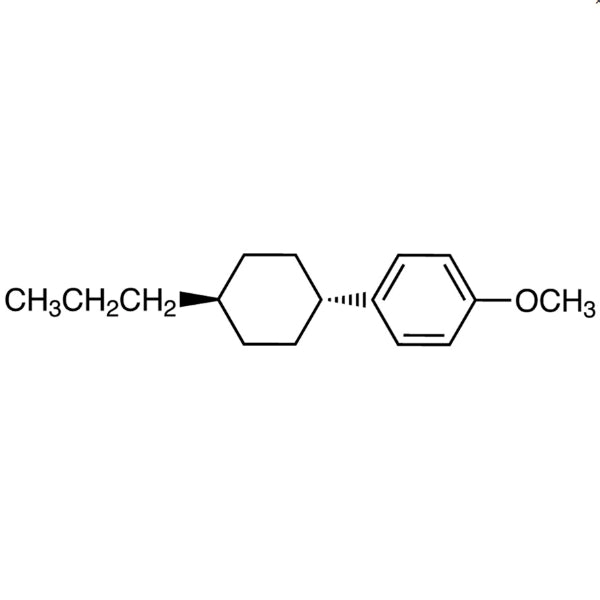
TCI M3152 1-Methoxy-4-(trans-4-propylcyclohexyl)benzene is a phenylcyclohexane compound that joins a methoxy-substituted benzene ring to a propyl-substituted cyclohexane ring in the trans configuration. This rigid, rod-shaped structure is a classic motif in materials chemistry, particularly as a building block and component for liquid crystal materials and other functional organic compounds. In the laboratory it serves as a starting material for the synthesis of further derivatives through reactions on the aromatic ring, and equally as a reference compound in studies of the relationship between molecular structure and mesomorphic behaviour.
The property that makes this compound a preferred choice is the trans geometry of the cyclohexane ring, which ensures that both substituents occupy equatorial positions, producing a straight molecule that packs readily in parallel alignment. This regularity is a prerequisite for the formation of mesomorphic phases, and it also makes the compound straightforward to purify by recrystallisation. The methoxy group on the aromatic ring is electron-donating, so it activates the ring toward electrophilic substitution while simultaneously providing a handle for demethylation to the corresponding phenol — a gateway to a wide range of further derivatives.
In Indonesian laboratories this material is typically used in university and institutional research settings working on materials chemistry and organic synthesis, where a well-defined rod-like intermediate is needed as a reliable starting point. It is handled at bench scale for derivative preparation, structure–property studies, and as a comparison standard when characterising new mesogenic candidates. The TCI packaging format suits research-scale consumption rather than production use.
Related TCI products
- TCI E1369 80944-44-1 1-Ethoxy-4-(trans-4-propylcyclohexyl)benzene
- TCI E1367 84540-32-9 1-Ethoxy-4-(trans-4-pentylcyclohexyl)benzene
- TCI B5881 85600-56-2 4,4'-Bis(trans-4-propylcyclohexyl)biphenyl
- TCI B5364 208709-55-1 1-Butoxy-2,3-difluoro-4-(trans-4-propylcyclohexyl)benzene
- TCI B4539 173336-76-0 4-Bromo-1-methoxy-2-(3-methoxypropoxy)benzene
- TCI P1617 61203-99-4 4-(trans-4-Propylcyclohexyl)benzonitrile
- Liquid crystal materials research — the rigid rod-shaped trans-cyclohexylbenzene core is the classic mesogenic framework, making this compound a direct component and reference material in mesophase formulation work.
- Organic synthesis starting material — the electron-rich methoxy-activated aromatic ring readily undergoes electrophilic substitution, allowing chemists to elaborate the scaffold into a range of substituted derivatives.
- Demethylation to phenolic intermediates — the methoxy group provides a defined handle for cleavage to the free phenol, opening access to ethers, esters, and further functionalised building blocks.
- Structure–property relationship studies — as a well-defined reference compound, it lets researchers isolate the contribution of chain length and ring geometry to observed mesomorphic behaviour in comparative series.
- Method development and purification practice — the compound's regular packing and crystalline behaviour make it suitable for developing and validating recrystallisation and chromatographic separation procedures in the laboratory.
| Brand | TCI (Tokyo Chemical Industry) |
|---|---|
| CAS number | 81936-32-5 |
| Molecular formula | — |
| Purity | — |
| Category | Chemistry > Building Blocks > Non-Heterocyclic Building Blocks |
| Pack sizes | available in standard TCI research-scale pack sizes; please confirm the current option when ordering |
| Physical form | — |
| Storage | store in a cool, dry place in the tightly closed original container |
- Catalogue Number: M3152
Store the container tightly closed in a cool, dry, well-ventilated area, away from direct sunlight, heat sources, and any strong oxidising agents. Keep the material in its original supplier container or in a compatible tightly sealed glass bottle, and label any transferred portion clearly with the compound name and CAS number. Handle in a fume hood using standard laboratory personal protective equipment — safety glasses, gloves, and a laboratory coat — and avoid the generation of dust or aerosols. Allow refrigerated containers to reach room temperature before opening to prevent moisture condensation, and always consult the manufacturer's safety data sheet before first use and for full disposal guidance.
—
Produk Terkait
-
1-Ethoxy-4-(trans-4-propylcyclohexyl)benzene TCI E1369
Regular price From Rp 1.298.850,00Regular price -
1-Ethoxy-4-(trans-4-pentylcyclohexyl)benzene TCI E1367
Regular price From Rp 1.353.450,00Regular price -
4,4'-Bis(trans-4-propylcyclohexyl)biphenyl TCI B5881
Regular price Rp 1.565.550,00Regular price -
1-Butoxy-2,3-difluoro-4-(trans-4-propylcyclohexyl)benzene TCI B5364
Regular price From Rp 1.696.800,00Regular price -
4-Bromo-1-methoxy-2-(3-methoxypropoxy)benzene TCI B4539
Regular price From Rp 848.400,00Regular price -
4-(trans-4-Propylcyclohexyl)benzonitrile TCI P1617
Regular price Rp 2.597.700,00Regular price -
1-Ethoxy-2,3-difluoro-4-(trans-4-propylcyclohexyl)benzene TCI E1230
Regular price Rp 1.087.800,00Regular price -
4-Ethyl-4'-(trans-4-propylcyclohexyl)biphenyl TCI E1162
Regular price Rp 2.597.700,00Regular price


