

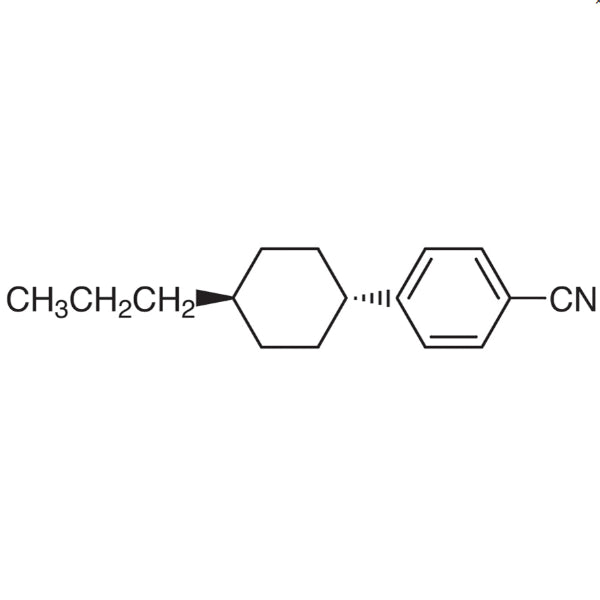
4-(trans-4-Propylcyclohexyl)benzonitrile is a chemical compound widely utilized in materials science research, particularly in the development of liquid crystal (LC) materials. This compound plays a crucial role in the creation of advanced electronic materials, where its molecular structure enables controlled molecular orientation under electric or magnetic fields. Its significance lies in its ability to support the formation of ordered liquid crystal phases, essential for modern display technologies and optical devices. In laboratory settings, it is a key component in the formulation of LC materials that are integral to the production of high-performance electronic components.
The compound is preferred due to its stable thermal and electro-optic properties, which ensure consistent performance under varying conditions. Its ability to form well-ordered crystalline structures enhances its utility in research applications. Additionally, its good solubility in organic solvents facilitates synthesis and processing, making it a versatile material for researchers. These characteristics make it a reliable choice for scientists working on next-generation electronic and optical materials.
In Indonesian laboratories, this compound is commonly used in applied research within the fields of information technology, electronics, and material science. Researchers at universities and research institutions frequently employ it to develop new LC-based technologies and improve existing display systems. Its application supports innovation in both academic and industrial research environments.
TCI brochures (PDF)
- Liquid Crystal Materials 2026-04-01 · p. 4
Related TCI products
- TCI B5364 208709-55-1 1-Butoxy-2,3-difluoro-4-(trans-4-propylcyclohexyl)benzene
- TCI M3152 81936-32-5 1-Methoxy-4-(trans-4-propylcyclohexyl)benzene
- TCI E1369 80944-44-1 1-Ethoxy-4-(trans-4-propylcyclohexyl)benzene
- TCI E1230 174350-05-1 1-Ethoxy-2,3-difluoro-4-(trans-4-propylcyclohexyl)benzene
- TCI E1162 84540-37-4 4-Ethyl-4'-(trans-4-propylcyclohexyl)biphenyl
- TCI B5881 85600-56-2 4,4'-Bis(trans-4-propylcyclohexyl)biphenyl
- Liquid Crystal Display Development: This compound is ideal for creating LC materials used in modern display technologies due to its ability to align under electric fields.
- Optical Device Fabrication: Its stable electro-optic properties make it suitable for the production of optical components requiring precise molecular alignment.
- Electronic Material Research: It is used in the study of advanced electronic materials, particularly those requiring controlled molecular orientation for functionality.
- Material Science Innovation: The compound supports the development of new materials with tailored properties for specialized applications.
- Academic Research Projects: It is frequently used in university and research institute studies to explore new LC-based technologies and applications.
| Brand | TCI |
|---|---|
| CAS number | 61203-99-4 |
| Molecular formula | — |
| Purity | — |
| Category | Materials Science > Electronic Materials > Liquid Crystal (LC) Materials |
| Pack sizes | Available in various quantities as per supplier specifications |
| Physical form | Liquid |
| Storage | Store in a cool, dry place away from direct sunlight |
This compound should be stored in a cool, dry environment, away from direct sunlight and sources of heat. It is recommended to use airtight, sealed containers to prevent contamination and maintain its chemical integrity. Due to its chemical nature, it should be handled with appropriate personal protective equipment, including gloves and safety goggles. It is important to ensure proper ventilation in the laboratory to minimize exposure. The compound is not classified as hazardous under standard laboratory conditions, but standard safety protocols should still be followed during handling and storage. Always keep the material in a secure location to prevent accidental spills or exposure.
—
Produk Terkait
-
1-Butoxy-2,3-difluoro-4-(trans-4-propylcyclohexyl)benzene TCI B5364
Regular price From Rp 1.696.800,00Regular price -
1-Methoxy-4-(trans-4-propylcyclohexyl)benzene TCI M3152
Regular price From Rp 689.850,00Regular price -
1-Ethoxy-4-(trans-4-propylcyclohexyl)benzene TCI E1369
Regular price From Rp 1.298.850,00Regular price -
1-Ethoxy-2,3-difluoro-4-(trans-4-propylcyclohexyl)benzene TCI E1230
Regular price Rp 1.087.800,00Regular price -
4-Ethyl-4'-(trans-4-propylcyclohexyl)biphenyl TCI E1162
Regular price Rp 2.597.700,00Regular price -
4,4'-Bis(trans-4-propylcyclohexyl)biphenyl TCI B5881
Regular price Rp 1.565.550,00Regular price -
4-(trans-4-Butylcyclohexyl)benzonitrile TCI B4924
Regular price From Rp 795.900,00Regular price


