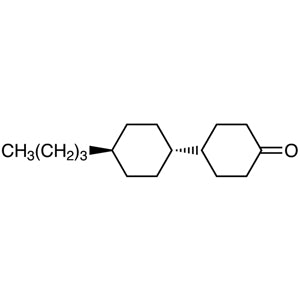
4-(trans-4-Butylcyclohexyl)benzonitrile is a chemical compound widely used in materials science, particularly in the study and development of liquid crystal (LC) materials. This compound plays a crucial role in laboratory settings where researchers are working on advanced materials with unique optical and electronic properties. Its molecular structure enables specific interactions with its surrounding environment, making it an essential component in the formulation of LC materials. As a key ingredient in LC research, it supports the creation of materials that are vital for modern display technologies and optical devices.
The compound is preferred due to its stable molecular structure and polar characteristics, which allow for effective interactions with various mediums. These properties contribute to its suitability in applications requiring precise control over material behavior. Additionally, its good thermal properties make it ideal for use in environments where temperature stability is critical. These attributes make it a reliable choice for researchers aiming to develop materials with fast response times to electric fields.
In Indonesian laboratories, 4-(trans-4-Butylcyclohexyl)benzonitrile is commonly used in research and development projects focused on liquid crystal materials. It is particularly valuable in the pursuit of innovative materials with enhanced optical and electronic performance. Its application in local research settings highlights its importance in advancing material science in the region.
TCI brochures (PDF)
- Liquid Crystal Materials 2026-04-01 · p. 5
Related TCI products
- TCI A1828 61204-01-1 4-(trans-4-Amylcyclohexyl)benzonitrile
- TCI P1617 61203-99-4 4-(trans-4-Propylcyclohexyl)benzonitrile
- TCI E0703 72928-54-2 4-(trans-4-Ethylcyclohexyl)benzonitrile
- TCI E1396 67589-47-3 4-Ethoxyphenyl trans-4-Butylcyclohexanecarboxylate
- TCI B5318 83626-35-1 4-(trans-4-Butylcyclohexyl)benzoic Acid
- TCI B4946 92413-47-3 4-(trans-4-Butylcyclohexyl)cyclohexanone
- Liquid Crystal Material Development: This compound is essential for creating LC materials with unique optical and electronic properties, supporting advanced display technologies.
- Optical Device Research: Its polar characteristics and thermal stability make it suitable for studies involving optical components and devices.
- Electronic Material Formulation: It is used in the synthesis of materials that respond quickly to electric fields, enhancing performance in electronic applications.
- Material Characterization Studies: Its stable molecular structure allows for accurate analysis and testing in various experimental setups.
- Display Technology Innovation: It contributes to the development of next-generation display technologies by improving material responsiveness and performance.
| Brand | TCI |
|---|---|
| CAS number | 61204-00-0 |
| Molecular formula | — |
| Purity | — |
| Category | Materials Science > Electronic Materials > Liquid Crystal (LC) Materials |
| Pack sizes | — |
| Physical form | — |
| Storage | Store in a cool, dry place away from direct sunlight |
This compound should be stored in a cool, dry environment to maintain its stability and prevent degradation. It is recommended to use sealed containers to minimize exposure to moisture and air, which can affect its properties. Due to its chemical nature, it should be handled with appropriate personal protective equipment, such as gloves and safety goggles. Storage should be in a well-ventilated area to reduce the risk of inhalation. Avoid contact with incompatible substances to ensure safety during handling and storage. Proper labeling of containers is essential for safe laboratory practices and to prevent accidental exposure.
—
Produk Terkait
-
4-(trans-4-Amylcyclohexyl)benzonitrile TCI A1828
Regular price From Rp 2.702.700,00Regular priceRp 1.905.750,00Sale price From Rp 2.702.700,00 -
4-(trans-4-Propylcyclohexyl)benzonitrile TCI P1617
Regular price Rp 2.650.200,00Regular priceRp 1.869.000,00Sale price Rp 2.650.200,00 -
4-(trans-4-Ethylcyclohexyl)benzonitrile TCI E0703
Regular price Rp 1.192.800,00Regular priceRp 849.450,00Sale price Rp 1.192.800,00 -
4-Ethoxyphenyltrans-4-Butylcyclohexanecarboxylate TCI E1396
Regular price From Rp 2.464.350,00Regular priceRp 1.738.800,00Sale price From Rp 2.464.350,00 -
4-(trans-4-Butylcyclohexyl)benzoicAcid TCI B5318
Regular price Rp 1.298.850,00Regular priceRp 924.000,00Sale price Rp 1.298.850,00 -
4-(trans-4-Butylcyclohexyl)cyclohexanone TCI B4946
Regular price From Rp 742.350,00Regular priceRp 534.450,00Sale price From Rp 742.350,00 -
4-(trans-4-Butylcyclohexyl)phenol TCI B2644
Regular price From Rp 2.147.250,00Regular priceRp 1.517.250,00Sale price From Rp 2.147.250,00 -
4-tert-ButylcyclohexylAcetate(cis-andtrans-mixture) TCI A0723
Regular price From Rp 505.050,00Regular priceRp 352.800,00Sale price From Rp 505.050,00