

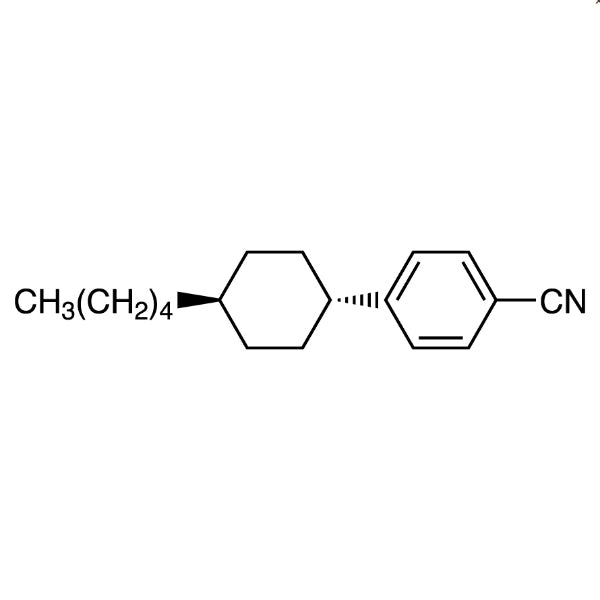
4-(trans-4-Amylcyclohexyl)benzonitrile is a chemical compound widely used in material science, particularly in the study and development of liquid crystal (LC) materials. This compound plays a crucial role in laboratory settings where researchers are working on advanced electronic materials and display technologies. Its molecular structure, featuring a benzonitrile group, contributes to its unique properties that are essential for creating stable and functional LC materials. In the context of Indonesian laboratories, this compound is a key component in the synthesis and characterization of LC materials used in electronic devices and display technologies.
The compound is preferred due to its ability to form stable molecular structures and its favorable dielectric properties. These characteristics make it ideal for applications requiring high precision and consistency. Its moderate volatility also facilitates ease of handling and manipulation in laboratory environments. The combination of these properties ensures that it remains a reliable choice for researchers working on LC-based technologies. Additionally, its chemical stability allows for consistent performance across various experimental conditions, making it a valuable resource in material science research.
In Indonesian laboratories, 4-(trans-4-Amylcyclohexyl)benzonitrile is commonly used in research related to electronic materials and display technologies. It is an essential component in the development of liquid crystal materials used in modern electronic devices. Its role in synthesizing and characterizing LC materials makes it indispensable for scientists and researchers working on advanced material applications in Indonesia.
TCI brochures (PDF)
- Liquid Crystal Materials 2026-04-01 · p. 5
Related TCI products
- TCI A2568 68065-81-6 trans-4'-(4-Amylcyclohexyl)biphenyl-4-carbonitrile
- TCI B4924 61204-00-0 4-(trans-4-Butylcyclohexyl)benzonitrile
- TCI P1617 61203-99-4 4-(trans-4-Propylcyclohexyl)benzonitrile
- TCI E0703 72928-54-2 4-(trans-4-Ethylcyclohexyl)benzonitrile
- TCI A2593 65355-30-8 4-(trans-4-Amylcyclohexyl)benzoic Acid
- TCI A1827 82575-69-7 4-(trans-4-Amylcyclohexyl)phenol
- Liquid Crystal Material Synthesis: This compound is ideal for synthesizing LC materials due to its stable molecular structure and dielectric properties, making it suitable for creating high-performance display materials.
- Electronic Display Development: It is used in the development of electronic displays, providing the necessary chemical stability and optical properties required for advanced display technologies.
- Material Characterization Studies: Its predictable behavior under various conditions allows for accurate characterization of LC materials, supporting research into their physical and chemical properties.
- Advanced Electronic Material Research: The compound is essential in research focused on developing new electronic materials with enhanced performance and stability.
- Industrial Prototype Testing: It is used in testing prototypes for LC-based devices, ensuring the materials meet the required specifications for commercial applications.
| Brand | TCI |
|---|---|
| CAS number | 61204-01-1 |
| Molecular formula | — |
| Purity | — |
| Category | Materials Science > Electronic Materials > Liquid Crystal (LC) Materials |
| Pack sizes | Available in standard laboratory quantities as per supplier specifications |
| Physical form | Liquid |
| Storage | Store in a cool, dry place away from direct sunlight and incompatible substances |
This compound should be stored in a cool, dry environment, away from direct sunlight and sources of heat. It is recommended to use airtight containers to prevent exposure to moisture and air, which can affect its stability. Due to its moderate volatility, it should be handled in a well-ventilated area to minimize inhalation risks. Laboratory personnel should wear appropriate personal protective equipment, including gloves and safety goggles, when handling the compound. It is important to keep the compound away from incompatible materials such as strong acids or bases to prevent chemical reactions. Proper labeling and storage practices are essential to ensure the safety of laboratory staff and the integrity of the material.
—
Produk Terkait
-
trans-4'-(4-Amylcyclohexyl)biphenyl-4-carbonitrile TCI A2568
Regular price Rp 795.900,00Regular priceRp 572.250,00Sale price Rp 795.900,00 -
4-(trans-4-Butylcyclohexyl)benzonitrile TCI B4924
Regular price Rp 848.400,00Regular priceRp 609.000,00Sale price Rp 848.400,00 -
4-(trans-4-Propylcyclohexyl)benzonitrile TCI P1617
Regular price Rp 2.650.200,00Regular priceRp 1.869.000,00Sale price Rp 2.650.200,00 -
4-(trans-4-Ethylcyclohexyl)benzonitrile TCI E0703
Regular price Rp 1.192.800,00Regular priceRp 849.450,00Sale price Rp 1.192.800,00 -
4-(trans-4-Amylcyclohexyl)benzoicAcid TCI A2593
Regular price Rp 1.087.800,00Regular priceRp 775.950,00Sale price Rp 1.087.800,00 -
4-(trans-4-Amylcyclohexyl)phenol TCI A1827
Regular price Rp 1.087.800,00Regular priceRp 775.950,00Sale price Rp 1.087.800,00 -
4-(trans-4-Vinylcyclohexyl)benzonitrile TCI V0135
Regular price Rp 1.618.050,00Regular priceRp 1.146.600,00Sale price Rp 1.618.050,00 -
trans-4-(2-Nitroethenyl)benzonitrile TCI N0708
Regular price Rp 2.121.000,00Regular priceRp 1.498.350,00Sale price Rp 2.121.000,00


