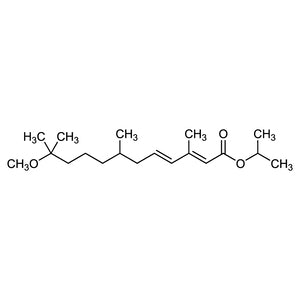
Methoprene (mixture of isomers), with CAS number 40596-69-8, is a chemical compound widely used in life science research, particularly in cell biology and nutrition research. This compound is structurally similar to insect growth regulators (IGRs), making it an essential tool for studying insect development and control in laboratory settings. Methoprene is commonly employed to regulate the growth and metamorphosis of insects, offering researchers a reliable method to manipulate biological processes in controlled environments. Its utility spans across various scientific disciplines, supporting both fundamental and applied research in entomology and ecological studies.
One of the key advantages of Methoprene is its chemical stability under specific conditions, which ensures consistent performance in experimental setups. Despite its sensitivity to temperature and humidity, it remains a preferred choice due to its effectiveness in inhibiting protein synthesis necessary for insect metamorphosis. This property makes it a valuable reagent for studies focused on pest management and ecological balance. Additionally, Methoprene is non-toxic to humans in small doses, which enhances its safety profile in laboratory environments, provided it is handled with appropriate care.
In Indonesian laboratories, Methoprene is frequently used in research related to pest control and ecosystem studies. Its versatility allows it to be applied in both small-scale experiments and large-scale research projects. As a result, it has become a popular choice among researchers in Indonesia, contributing to advancements in biological sciences and environmental research.
Related TCI products
- TCI P2945 52645-53-1 Permethrin (mixture of isomers)
- TCI M3580 65733-16-6 S-(+)-Methoprene
- TCI A0851 122-40-7 alpha-Amylcinnamaldehyde (mixture of isomers)
- TCI T0608 4602-84-0 Farnesol (mixture of isomers)
- TCI M1068 1101843-02-0 Methyl Jasmonate (mixture of isomers)
- TCI J0004 221682-41-3 Jasmonic Acid (mixture of isomers)
- Pest management research benefits from Methoprene's ability to control insect development, making it ideal for studying population dynamics and ecological impact.
- Nutritional studies utilize Methoprene to investigate the effects of insect growth regulators on metabolic processes and developmental pathways.
- Cell biology experiments leverage Methoprene to explore its influence on protein synthesis and cellular transformation mechanisms.
- Ecological research employs Methoprene to simulate environmental stressors on insect populations, aiding in biodiversity and conservation studies.
- Environmental impact assessments use Methoprene to evaluate the long-term effects of insect growth regulators on ecosystems and food chains.
| Brand | TCI |
|---|---|
| CAS number | 40596-69-8 |
| Molecular formula | — |
| Purity | — |
| Category | Life Science > Cell Biology > Nutrition Research |
| Pack sizes | Available in various quantities as per supplier specifications |
| Physical form | Liquid |
| Storage | Store in a cool, dry place away from direct sunlight and moisture |
Methoprene should be stored in a cool, dry environment to maintain its chemical stability and effectiveness. It is recommended to use airtight containers to prevent exposure to moisture and temperature fluctuations. Due to its sensitivity to environmental conditions, proper storage is essential to ensure consistent performance in experiments. Laboratory personnel should handle Methoprene with care, using appropriate personal protective equipment when necessary. While it is non-toxic in small doses, it is important to follow standard laboratory safety protocols to minimize any potential risks. Keeping Methoprene in a designated storage area helps maintain a safe and organized laboratory environment.
—
Produk Terkait
-
Permethrin(mixtureofisomers) TCI P2945
Regular price From Rp 1.670.550,00Regular price -
S-(+)-Methoprene TCI M3580
Regular price Rp 3.021.900,00Regular price -
alpha-Amylcinnamaldehyde(mixtureofisomers) TCI A0851
Regular price From Rp 637.350,00Regular price -
Farnesol(mixtureofisomers) TCI T0608
Regular price From Rp 557.550,00Regular price -
MethylJasmonate(mixtureofisomers) TCI M1068
Regular price From Rp 3.578.400,00Regular price -
JasmonicAcid(mixtureofisomers) TCI J0004
Regular price From Rp 5.485.200,00Regular price -
Iohexol(mixtureofisomers) TCI I0903
Regular price From Rp 1.353.450,00Regular price -
Aluminon(mixtureofisomers) TCI A0240
Regular price From Rp 1.776.600,00Regular price