


TCI M3883 2-(4-Methoxyphenoxy)propanoic Acid is an aromatic carboxylic acid built on a propanoic acid backbone bearing a 4-methoxyphenoxy group at the alpha carbon. This aryloxypropanoate structure is a classic motif in applied organic chemistry and is widely known because its sodium salt, lactisole, has been studied as a sweetness inhibitor. In the laboratory, the compound serves as a non-heterocyclic building block for preparing esters, amides, and other derivatives, while also acting as a research material in studies of flavour chemistry and taste receptors.
The characteristic that makes this compound a preferred choice is the presence of two complementary functional groups. The carboxylic acid provides a coupling point that is readily activated toward ester or amide formation, while the aromatic ether with its methoxy substituent contributes chemical stability along with a distinctive electronic character suited to ultraviolet detection. The stereogenic centre at the alpha carbon makes the material attractive for enantiomer separation studies, chiral column testing, and asymmetric synthesis, since the biological activity of aryloxypropanoate derivatives often depends on configuration.
As a solid organic acid, the material is relatively straightforward to weigh, dissolve, and handle under ordinary bench conditions. In Indonesian laboratories it is typically used in university and institutional organic synthesis work, in derivatisation studies, and in analytical method development where a well-defined aromatic acid is needed as a starting material or reference structure. Its role suits both teaching-scale preparative work and small-scale research synthesis.
Related TCI products
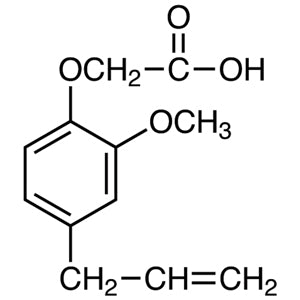
- TCI A3037 6331-61-9 (4-Allyl-2-methoxyphenoxy)acetic Acid
- TCI H0641 56183-35-8 4-(3-Hydroxyphenoxy)benzoic Acid
- TCI H1819 621-54-5 3-(3-Hydroxyphenyl)propanoic Acid
- TCI B5207 23116-94-1 1,5-Bis(2-hydroxyphenoxy)-3-oxapentane
- TCI B1485 5085-95-0 1,4-Bis(3-hydroxyphenoxy)benzene
- TCI B1484 126716-90-3 1,3-Bis(4-hydroxyphenoxy)benzene
- Ester and amide synthesis: the carboxylic acid group is easily activated for coupling, making this a convenient starting acid for preparing a range of derivatives.
- Non-heterocyclic building block chemistry: the aryloxypropanoate skeleton provides a defined aromatic framework that can be elaborated further in multi-step organic synthesis routes.
- Taste receptor and flavour chemistry research: as the parent acid of lactisole, the compound supports investigations into sweetness inhibition and related receptor studies.
- Chiral separation and chiral column evaluation: the stereogenic alpha carbon makes this acid a practical test substrate for enantiomer resolution method development.
- Asymmetric synthesis studies: configuration-dependent activity in aryloxypropanoate derivatives makes this material useful for exploring stereoselective transformations and their outcomes.
| Brand | TCI |
|---|---|
| CAS number | 13794-15-5 |
| Molecular formula | — |
| Purity | — |
| Category | Chemistry > Building Blocks > Non-Heterocyclic Building Blocks |
| Pack sizes | available in standard TCI research packaging; please refer to the catalogue listing for the sizes offered |
| Physical form | solid organic acid |
| Storage | keep in a cool, dry place in a tightly closed container, away from moisture |
Store the container tightly closed in a cool, dry, and well-ventilated area, protected from moisture and direct sunlight. Original manufacturer packaging or chemically compatible glass or amber bottles with secure closures are suitable for transfer and subdivision. Handle inside a fume hood where dust may be generated, and wear a laboratory coat, safety goggles, and appropriate gloves. As an organic acid, avoid contact with skin and eyes and keep away from incompatible bases and strong oxidising agents. Weigh carefully to minimise dust formation, reseal promptly after use, label all subdivided containers clearly, and consult the manufacturer safety data sheet before first use.
—
Produk Terkait
-
(4-Allyl-2-methoxyphenoxy)aceticAcid TCI A3037
Regular price From Rp 2.041.200,00Regular price -
4-(3-Hydroxyphenoxy)benzoicAcid TCI H0641
Regular price From Rp 2.889.600,00Regular price -
3-(3-Hydroxyphenyl)propanoicAcid TCI H1819
Regular price From Rp 875.700,00Regular price -
1,5-Bis(2-hydroxyphenoxy)-3-oxapentane TCI B5207
Regular price Rp 1.618.050,00Regular price -
1,4-Bis(3-hydroxyphenoxy)benzene TCI B1485
Regular price Rp 3.578.400,00Regular price -
1,3-Bis(4-hydroxyphenoxy)benzene TCI B1484
Regular price From Rp 2.174.550,00Regular price -
Bis[2-(4-methoxyphenoxy)ethyl]Ether TCI B1479
Regular price Rp 1.298.850,00Regular price -
1,3-Bis(4-methoxyphenoxy)benzene TCI B1454
Regular price Rp 3.446.100,00Regular price


![104104-12-3 Bis[2-(4-methoxyphenoxy)ethyl] Ether - AMI Scientific](http://amiscientific.com/cdn/shop/files/TCI2510B1479.jpg?v=1769141601&width=533)
