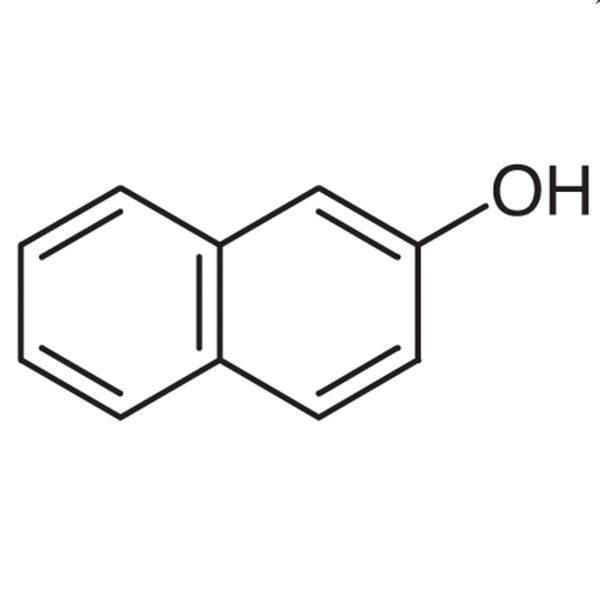
2-Naphthol, also known as beta-naphthol, is the phenolic isomer of naphthalene bearing a hydroxyl group at the second position of the ring system. It ranks among the most important starting materials in dye chemistry and preparative organic chemistry, because its aromatic ring is strongly activated and reacts rapidly at the positions adjacent to the hydroxyl group. In the laboratory, beta-naphthol is commonly used as a coupling component in the preparation of azo dyes, as a starting material for classical transformations such as the Betti reaction and the Bucherer reaction, and as a model compound in teaching practicals that demonstrate the reactivity of aromatic phenols to students.
Several properties explain why this compound is so frequently chosen. It shows high reactivity toward electrophiles at specific positions on the ring, giving predictable and clean substitution patterns. Its phenolic acidity allows it to dissolve in dilute base and to be precipitated again on acidification, which makes purification and separation straightforward. It also has a strong tendency to form coloured crystalline products that are easy to purify by recrystallisation. The clarity of its reaction outcomes makes beta-naphthol particularly suitable for experiments that depend on visual observation, for example the formation of orange to red dye precipitates in diazonium coupling reactions.
In Indonesian laboratories, 2-Naphthol is a familiar reagent in university organic chemistry teaching laboratories, in research groups working on dye and heterocycle synthesis, and in analytical work where a reliable coupling component is required. As a solid that is stable at room temperature, the material is easy to weigh out and to store, which suits teaching schedules where reagents are dispensed repeatedly across many student groups and stored between practical sessions.
- Azo dye synthesis: beta-naphthol serves as the coupling component in diazonium coupling reactions, where its activated ring reacts quickly to give brightly coloured precipitates that students and researchers can observe directly and isolate by filtration.
- Betti reaction preparations: the compound acts as the phenolic partner in this classical three-component condensation, its high ring reactivity allowing the reaction to proceed cleanly and to deliver crystalline products suitable for further study.
- Bucherer reaction studies: 2-Naphthol is the standard substrate for converting the naphtholic hydroxyl group into an amino group, making it the reference material for teaching and investigating this reversible transformation.
- Undergraduate teaching practicals: its predictable behaviour and visually obvious reaction outcomes make it an excellent model compound for demonstrating aromatic phenol reactivity, electrophilic substitution and the concept of ring activation.
- Acid-base extraction and purification exercises: because the phenolic hydroxyl allows dissolution in dilute base and recovery by acidification, the material is well suited to practicals teaching separation technique and recrystallisation.
| Brand | TCI |
|---|---|
| CAS number | 135-19-3 |
| Molecular formula | — |
| Purity | — |
| Category | Chemistry > Building Blocks > Non-Heterocyclic Building Blocks |
| Pack sizes | available in the standard TCI pack sizes listed for this catalogue number |
| Physical form | solid, stable at room temperature |
| Storage | store in the closed original container under the conditions stated on the manufacturer's label |
- Catalogue number: N0027
Store 2-Naphthol in its tightly closed original container in a cool, dry and well ventilated area, away from direct sunlight and from incompatible materials such as strong oxidising agents. Amber glass or the supplied container is suitable for keeping the solid dry and protected from light. Handle the material in a fume hood, wearing safety glasses, gloves and a laboratory coat, and avoid generating or inhaling dust when weighing. Keep the container closed when not in use, clean any spilled solid promptly, wash hands after handling, and consult the manufacturer's safety data sheet before first use and before disposal of residues.
—
Produk Terkait
-
Disodium1-Naphthol-3,6-disulfonateHydrate TCI V0037
Regular price Rp 584.850,00Regular price -
5,6,7,8-Tetrahydro-1-naphthol TCI T2816
Regular price From Rp 1.353.450,00Regular price -
7-Bromo-2-naphthol TCI B4580
Regular price From Rp 769.650,00Regular price -
3-Bromo-2-naphthol TCI B3127
Regular price From Rp 2.650.200,00Regular price -
6-Bromo-2-naphthol TCI B0621
Regular price From Rp 1.961.400,00Regular price -
1-Bromo-2-naphthol TCI B0620
Regular price Rp 2.782.500,00Regular price -
1,2,3,4-Tetrahydro-1-naphthol TCI T1111
Regular price From Rp 1.167.600,00Regular price -
5,6,7,8-Tetrahydro-2-naphthol TCI T0108
Regular price Rp 2.386.650,00Regular price