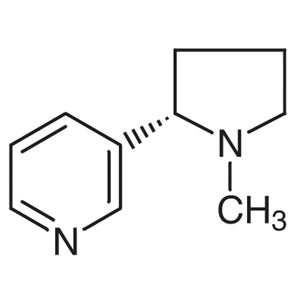
TCI N0079 Nicotine is a pyridine alkaloid that serves as the principal component of the tobacco plant and ranks among the most intensively studied compounds in nervous system pharmacology. In the laboratory, nicotine functions as an analytical standard for content determination in tobacco products and biological samples, as a reference ligand in studies of nicotinic acetylcholine receptors, and as a test substance in toxicology and neuropharmacology research. Its role as a reference compound makes the availability of quality-controlled material a fundamental requirement for testing laboratories that depend on reproducible results.
The characteristic that makes nicotine the compound of choice is its structure, which combines a pyridine ring with a methylated pyrrolidine ring, producing a base that is chiral and highly active biologically. The compound presents as a colorless to yellow liquid that is miscible with water and a range of organic solvents, simplifying the preparation of solutions across diverse assay systems. As a free base, nicotine darkens readily on exposure to air and light as a result of oxidation, so the reagent-grade product from TCI is packaged to minimize that exposure. Its volatility and capacity for absorption through the skin make careful handling an integral part of working with this material.
In Indonesian laboratories, TCI N0079 Nicotine is typically drawn upon by tobacco product testing facilities, university pharmacology and pharmacy departments, and research groups working in toxicology and neuroscience. It is used to prepare calibration standards for chromatographic assays, to serve as a positive control in receptor binding work, and to support method development and verification. Because the compound acts as a comparison point against which sample results are judged, laboratories generally treat consistency of the reference material as a prerequisite for defensible analytical data.
- Analytical standard preparation for tobacco product testing, where nicotine serves as the reference against which sample content is quantified, making a quality-controlled grade essential for reliable calibration curves.
- Nicotinic acetylcholine receptor studies, in which nicotine acts as the reference ligand because its well-characterized binding behaviour provides a dependable comparison point for evaluating other candidate compounds.
- Toxicology research applications, where nicotine functions as a test substance whose biological activity and absorption characteristics are extensively documented, supporting interpretable and comparable experimental outcomes.
- Neuropharmacology investigations of nervous system signalling, for which nicotine is chosen as one of the most intensively studied compounds in this field, offering an established behavioural and pharmacological reference.
- Determination of nicotine content in biological samples, where the reagent-grade material supports the preparation of spiking solutions and calibration standards required for accurate quantitative measurement.
| Brand | TCI |
|---|---|
| CAS number | 54-11-5 |
| Molecular formula | — |
| Purity | — |
| Category | Life Science > Biochemicals and Reagents > Alkaloids |
| Pack sizes | available in the standard TCI catalogue packaging options; please confirm the pack size required when ordering |
| Physical form | colorless to yellow liquid, miscible with water and various organic solvents |
| Storage | packaged to minimize exposure to air and light, as the free base darkens through oxidation |
Store TCI N0079 Nicotine in its original tightly closed container, protected from air and light, since the free base darkens through oxidation when exposed to these conditions. Keep the container upright in a cool, well-ventilated storage area away from incompatible materials, and reseal it promptly after each withdrawal to limit headspace exposure. Because the compound is volatile and can be absorbed through the skin, all handling should take place in a functioning fume hood with appropriate chemical-resistant gloves, safety eyewear, and a laboratory coat. Use clean, dry glassware or compatible solvent-resistant containers when preparing dilutions, label all working solutions clearly, and avoid generating aerosols. Dispose of residues and contaminated consumables in accordance with the laboratory's chemical waste procedures, and consult the manufacturer's safety data sheet before first use.
—
Produk Terkait
-
TCI B5774 5,10-Bis(4,4,5,5-tetramethyl-1,3,2-dioxaborolan-2-yl)naphtho[1,2-c:5,6-c']bis([1,2,5]oxadiazole)
Regular price Rp 10.255.350,00Regular price -
Dihydroiodide TCI B6569
Regular price From Rp 1.936.200,00Regular price -
Trifluoromethanesulfonate TCI B7003
Regular price From Rp 1.936.200,00Regular price
![5,10-Bis(4,4,5,5-tetramethyl-1,3,2-dioxaborolan-2-yl)naphtho[1,2-c:5,6-c']bis([1,2,5]oxadiazole) - TCI B5774 - AMI Scientific](http://amiscientific.com/cdn/shop/files/TCI2510B5774.jpg?v=1769180228&width=533)