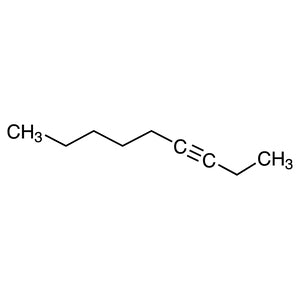
3-Nonyne is a chemical compound classified under the category of building blocks in organic chemistry. It is a simple yet versatile molecule with a carbon chain featuring a triple bond, making it a valuable component in synthetic chemistry. In the laboratory, 3-Nonyne serves as a foundational material for the synthesis of more complex organic compounds. Its straightforward structure allows chemists to modify and build upon it, enabling the creation of diverse molecular structures tailored for specific research goals. This flexibility makes it a key tool in the development of new chemical entities.
The compound’s chemical properties are both stable and reactive, depending on the experimental conditions. It is non-hygroscopic and has a tendency to evaporate, which requires careful handling. These characteristics make it suitable for use in controlled environments where temperature and atmospheric conditions can be regulated. Its sensitivity to oxidation and other chemical reactions also means that it must be stored and used with precision to maintain its integrity and effectiveness in chemical processes.
In Indonesian laboratories, 3-Nonyne is commonly used in organic chemistry research, particularly in the synthesis of new compounds. It is also found in scientific studies related to the development of chemical materials for industrial and pharmaceutical applications. Its availability and reliability make it a preferred choice for researchers aiming to explore chemical synthesis and innovation in various scientific fields.
- Organic synthesis is a key application where 3-Nonyne is used to build complex molecules through alkyne functional groups, offering versatility in reaction pathways.
- Pharmaceutical research benefits from 3-Nonyne as a building block for developing new drug compounds, allowing for structural modifications and functional group introduction.
- Industrial chemical development utilizes 3-Nonyne to create specialized materials, leveraging its reactivity for polymer and specialty chemical synthesis.
- Academic research in chemistry often incorporates 3-Nonyne to explore reaction mechanisms and synthetic methodologies in undergraduate and graduate studies.
- Material science applications use 3-Nonyne to design new polymers and functional materials, taking advantage of its triple bond for cross-linking and structural stability.
| Brand | TCI |
|---|---|
| CAS number | 20184-89-8 |
| Molecular formula | — |
| Purity | — |
| Category | Chemistry > Building Blocks > Non-Heterocyclic Building Blocks |
| Pack sizes | — |
| Physical form | — |
| Storage | Store in a cool, dry place away from light and incompatible materials. |
3-Nonyne should be stored in a cool, dry environment, away from direct sunlight and sources of heat. It is recommended to use sealed containers to prevent evaporation and exposure to air. Due to its sensitivity to oxidation, it should be kept in airtight containers to minimize contact with oxygen. The compound is not hygroscopic, but it is advisable to handle it in a controlled laboratory setting to maintain its chemical integrity. Always ensure proper ventilation when working with 3-Nonyne to avoid inhalation of vapors. Proper protective equipment, such as gloves and safety goggles, should be worn during handling to ensure laboratory safety.
—
Produk Terkait
-
1-Phenyl-1-nonyne TCI P0363
Regular price Rp 2.942.100,00Regular priceRp 2.056.950,00Sale price Rp 2.942.100,00 -
1-Nonyne TCI N0301
Regular price Rp 1.087.800,00Regular priceRp 760.200,00Sale price Rp 1.087.800,00 -
1,3,5-Triethynylbenzene TCI T2760
Regular price From Rp 3.578.400,00Regular priceRp 2.502.150,00Sale price From Rp 3.578.400,00 -
1-Butyl-4-ethynylbenzene TCI B2301
Regular price From Rp 980.700,00Regular priceRp 685.650,00Sale price From Rp 980.700,00 -
3,3-Dimethyl-1-butyne TCI B1114
Regular price From Rp 3.446.100,00Regular priceRp 2.409.750,00Sale price From Rp 3.446.100,00 -
2-Butyne TCI B0951
Regular price Rp 1.405.950,00Regular priceRp 982.800,00Sale price Rp 1.405.950,00 -
7-Tetradecyne TCI T0762
Regular price From Rp 4.957.050,00Regular priceRp 3.466.050,00Sale price From Rp 4.957.050,00 -
1-Tetradecyne TCI T0761
Regular price From Rp 1.273.650,00Regular priceRp 890.400,00Sale price From Rp 1.273.650,00