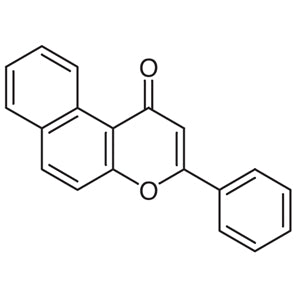
Beta-Naphthoflavone is a chemical compound classified under the category of heterocyclic compounds. It serves as a fundamental building block in chemical synthesis, playing a crucial role in the development of complex molecular structures. This compound is widely utilized in laboratory settings for its ability to participate in various chemical reactions, including substitution and oxidation processes. Its structural stability and reactivity make it an essential tool for researchers working on molecular structure analysis and synthetic chemistry.
One of the key reasons beta-naphthoflavone is preferred in laboratories is its chemical stability and moderate reactivity, which allow for efficient and controlled chemical reactions. It also exhibits good solubility in organic solvents such as ethyl acetate and ethanol, facilitating easy handling and purification during experiments. These properties make it a versatile compound for use in both academic and industrial research environments.
In Indonesian laboratories, beta-naphthoflavone is commonly used by researchers and students in higher education institutions and research organizations. Its applications span across organic synthesis and analytical chemistry, making it a popular choice for those involved in molecular structure studies and compound development.
- Organic synthesis experiments benefit from beta-naphthoflavone due to its structural versatility and ability to participate in a wide range of chemical reactions.
- Molecular structure analysis relies on this compound for its stability and reactivity, aiding in the identification and characterization of complex compounds.
- Substitution reactions often utilize beta-naphthoflavone as a starting material because of its predictable chemical behavior and ease of functionalization.
- Oxidation studies frequently incorporate beta-naphthoflavone due to its capacity to undergo controlled oxidation under specific conditions.
- Analytical chemistry applications use beta-naphthoflavone for its solubility properties, which facilitate sample preparation and analysis in various solvent systems.
| Brand | TCI |
|---|---|
| CAS number | 6051-87-2 |
| Molecular formula | — |
| Purity | — |
| Category | Chemistry > Building Blocks > Heterocyclic Building Blocks |
| Pack sizes | Available in various quantities as per supplier specifications |
| Physical form | Solid |
| Storage | Store in a cool, dry place away from direct light |
Beta-naphthoflavone should be stored in a cool, dry place, away from direct sunlight and sources of heat. It is recommended to use airtight containers to prevent moisture absorption and contamination. As a solid compound, it is typically stored in glass or plastic containers that are resistant to chemical reactions. In laboratory settings, it is important to handle the compound with appropriate personal protective equipment, such as gloves and safety goggles, to ensure safe handling. Due to its chemical stability, it does not require special storage conditions beyond standard laboratory practices. Always ensure proper ventilation when working with this compound to minimize exposure risks.
—
Produk Terkait
-
TCI B5774 5,10-Bis(4,4,5,5-tetramethyl-1,3,2-dioxaborolan-2-yl)naphtho[1,2-c:5,6-c']bis([1,2,5]oxadiazole)
Regular price Rp 10.255.350,00Regular price -
Dihydroiodide TCI B6569
Regular price From Rp 1.936.200,00Regular price -
Trifluoromethanesulfonate TCI B7003
Regular price From Rp 1.936.200,00Regular price
![5,10-Bis(4,4,5,5-tetramethyl-1,3,2-dioxaborolan-2-yl)naphtho[1,2-c:5,6-c']bis([1,2,5]oxadiazole) - TCI B5774 - AMI Scientific](http://amiscientific.com/cdn/shop/files/TCI2510B5774.jpg?v=1769180228&width=533)