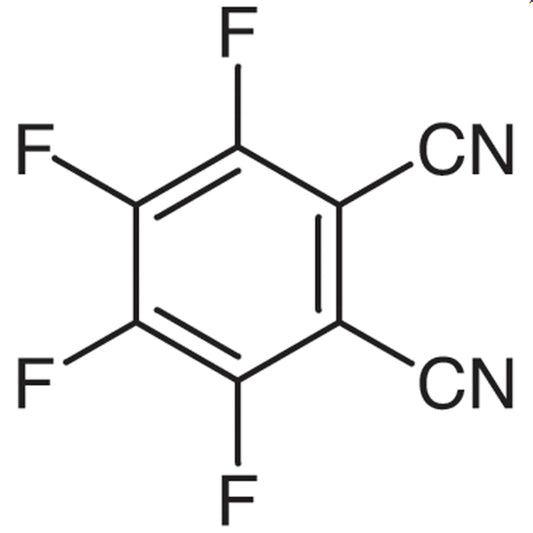
3-Nitrophthalonitrile is a chemical compound widely used in scientific experiments, particularly in the fields of organic chemistry and materials science. As a building block for advanced materials, it plays a crucial role in the synthesis of complex organic structures. Its unique molecular structure enables a variety of chemical reactions, including substitution, reduction, and the formation of more intricate compounds. In laboratory settings, this compound is essential for researchers aiming to develop new materials with specific properties.
The chemical properties of 3-Nitrophthalonitrile make it a preferred choice for various applications. It exhibits stability under certain conditions while remaining reactive enough to participate in diverse chemical transformations. Its non-volatile nature simplifies handling and storage, making it ideal for routine laboratory use. Additionally, its molecular complexity allows for flexible chemical modifications, enabling the creation of new compounds tailored to specific research needs.
In Indonesian laboratories, 3-Nitrophthalonitrile is commonly used in organic chemistry and materials research. It is a key component in experiments involving the synthesis of complex molecules and the development of advanced materials. Researchers and students rely on this compound for its versatility and reliability in experimental processes. Its availability through AMI Scientific ensures that it is accessible for scientific inquiry in Indonesia.
- Organic synthesis experiments benefit from 3-Nitrophthalonitrile due to its reactivity and structural versatility, allowing the creation of complex organic compounds.
- Materials science research utilizes this compound as a building block for developing new materials with tailored properties, such as conductivity or optical characteristics.
- Chemical modification studies leverage its molecular complexity to explore various reaction pathways and functional group transformations.
- Analytical chemistry applications use it as a reference standard for identifying and quantifying compounds in complex mixtures.
- Educational institutions incorporate it into curriculum-based experiments to teach fundamental concepts in organic chemistry and material synthesis.
| Brand | TCI |
|---|---|
| CAS number | 51762-67-5 |
| Molecular formula | — |
| Purity | — |
| Category | Materials Science > Material Building Blocks > Phthalocyanine Building Blocks |
| Pack sizes | Available in standard laboratory quantities |
| Physical form | Solid |
| Storage | Store in a cool, dry place away from light and moisture |
3-Nitrophthalonitrile should be stored in a cool, dry environment, away from direct light and moisture to maintain its chemical integrity. It is recommended to use airtight containers to prevent exposure to air and potential moisture absorption. Due to its non-volatile nature, it is less prone to evaporation, but proper sealing is still essential for long-term stability. In laboratory settings, it should be handled with standard chemical safety precautions, including the use of gloves and appropriate ventilation. It is not classified as a hazardous substance under normal conditions, but care should be taken to avoid contamination during handling and storage.
—
Produk Terkait
-
4-Nitrophthalonitrile TCI N0524
Regular price From Rp 4.796.400,00Regular priceRp 3.369.450,00Sale price From Rp 4.796.400,00 -
Phthalonitrile TCI P0404
Regular price From Rp 557.550,00Regular priceRp 405.300,00Sale price From Rp 557.550,00 -
Tetrachlorophthalonitrile TCI T3067
Regular price From Rp 1.378.650,00Regular priceRp 979.650,00Sale price From Rp 1.378.650,00 -
Tetrafluorophthalonitrile TCI T1402
Regular price From Rp 1.298.850,00Regular priceRp 924.000,00Sale price From Rp 1.298.850,00 -
4-Fluorophthalonitrile TCI F1169
Regular price From Rp 2.518.950,00Regular priceRp 1.776.600,00Sale price From Rp 2.518.950,00 -
4,5-Difluorophthalonitrile TCI D3963
Regular price From Rp 2.677.500,00Regular priceRp 1.887.900,00Sale price From Rp 2.677.500,00 -
4,5-Dichlorophthalonitrile TCI D2189
Regular price Rp 3.340.050,00Regular priceRp 2.350.950,00Sale price Rp 3.340.050,00 -
4-Iodophthalonitrile TCI I1050
Regular price Rp 4.876.200,00Regular priceRp 3.425.100,00Sale price Rp 4.876.200,00