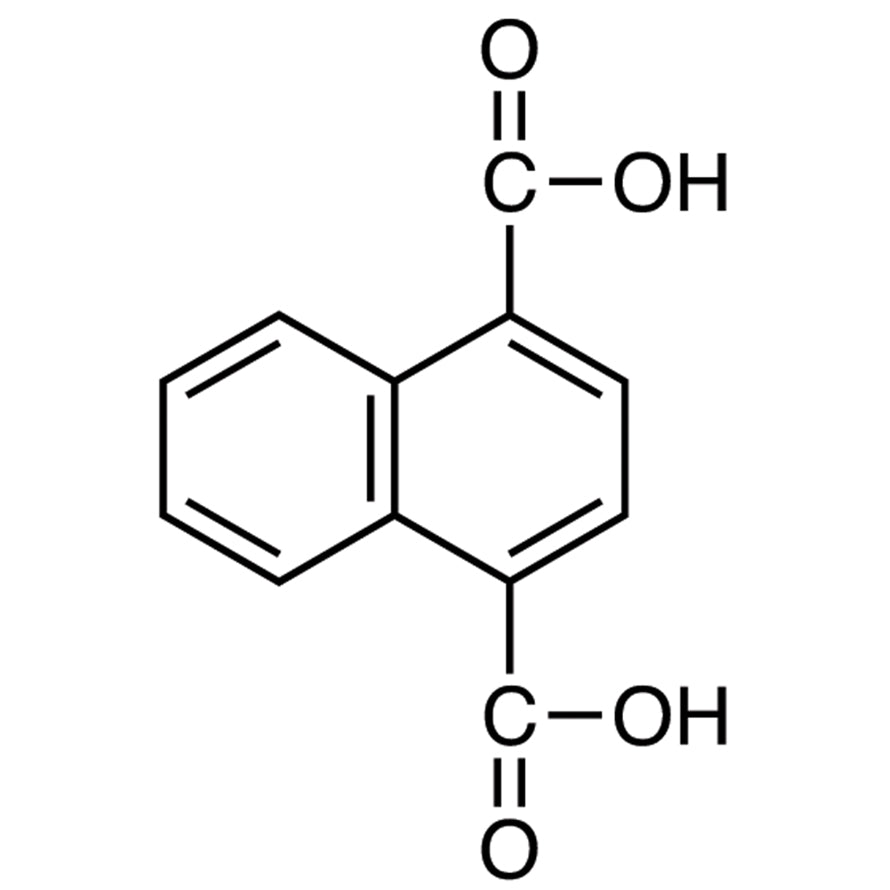
TCI 1,4-Naphthalenedicarboxylic Acid (product code N0606, CAS 605-70-9) is an aromatic dicarboxylic acid with two carboxyl groups at the 1 and 4 positions of the naphthalene ring. TCI lists it under Metal Organic Frameworks (MOF) and Their Raw Materials, within Organic-Inorganic Hybrid Materials in Materials Science. In the laboratory, its main use is as an organic linker. It bridges metal ions or metal clusters to build porous crystalline networks. It is also used as a monomer for high-performance aromatic polyesters and polyamides, where its rigid aromatic core adds to the properties of the finished polymer.
Researchers choose this compound because its naphthalene backbone is rigid and planar, and its two carboxylate groups point in fixed directions. That fixed geometry matters when designing MOF structures with predictable topologies. Compared with simple benzene-based linkers such as terephthalic acid, the naphthalene ring offers a larger aromatic surface area, extra steric effects, and useful photoluminescent behaviour. These features can change pore size, framework stability, and how the framework interacts with guest molecules. TCI's consistent quality also matters, because impurities can disrupt MOF crystallisation and make results harder to reproduce.
In Indonesia, this material is relevant to inorganic chemistry, materials science, and chemical engineering laboratories. Typical research areas include gas adsorption, CO2 capture, heterogeneous catalysis, and luminescent sensors. University research groups and research institutes working on porous coordination polymers can use it as a well-defined building block in solvothermal synthesis. Polymer laboratories developing aromatic polyesters and polyamides can use it as a rigid monomer. It is a practical choice for both academic projects and applied materials development that need a reliable dicarboxylate linker.
TCI brochures (PDF)
- Organic Linker Molecules for Metal Organic Frameworks (MOFs) 2026-05-11 · p. 4
- Monomers 2025-05-28 · p. 35
Related TCI products
- TCI N0526 2169-87-1 2,3-Naphthalenedicarboxylic Acid
- TCI N0377 1141-38-4 2,6-Naphthalenedicarboxylic Acid
- TCI D4383 879360-14-2 Decahydro-1,4-naphthalenedicarboxylic Acid (mixture of isomers)
- TCI A0088 142-45-0 Acetylenedicarboxylic Acid
- TCI T1374 1551-39-9 Tetrafluoroisophthalic Acid
- TCI B1191 787-70-2 4,4'-Biphenyldicarboxylic Acid
- MOF synthesis: the rigid, planar naphthalene core and fixed carboxylate directions let researchers design porous frameworks with predictable, reproducible structures.
- Gas adsorption and CO2 capture studies: the larger aromatic surface and steric effects of the naphthalene ring can change pore size and how the framework interacts with gas molecules.
- Heterogeneous catalysis: frameworks built from this linker give stable, porous supports in which metal nodes and pore environments can be tuned for catalytic reactions.
- Luminescent sensors: the photoluminescence of the naphthalene unit makes the resulting frameworks good candidates for optical sensing of guest molecules or analytes.
- High-performance polymer research: as a monomer for aromatic polyesters and polyamides, its rigid structure adds to the thermal and mechanical performance of the polymers.
| Brand | TCI (product code N0606) |
|---|---|
| CAS number | 605-70-9 |
| Molecular formula | — |
| Purity | — |
| Category | Materials Science > Organic-Inorganic Hybrid Materials > Metal Organic Frameworks (MOF) and Their Raw Materials |
| Pack sizes | see the available options on the product listing |
| Physical form | solid |
| Storage | keep in a tightly closed container in a cool, dry place |
Store 1,4-Naphthalenedicarboxylic Acid in its original tightly sealed container in a cool, dry, well-ventilated place. Keep it away from moisture, direct sunlight, heat sources, and incompatible materials such as strong oxidising agents and strong bases. Label containers clearly and reseal them promptly after each use to limit contamination, which could affect sensitive MOF crystallisation work. Wear standard personal protective equipment when handling, including safety glasses, gloves, and a lab coat. Weigh and transfer the powder in a fume hood or ventilated area to avoid inhaling dust. Do not eat or drink in the work area, and wash your hands after handling. Always read the supplier's Safety Data Sheet (SDS) for detailed hazard, first-aid, and disposal information before use.
—
Product Categories
- Organic-Inorganic Hybrid MaterialsMetal Organic Frameworks (MOF) and Their Raw MaterialsOrganic Linker Molecules [Metal Organic Frameworks (MOFs) Precursors]
- Polymer/Macromolecule ReagentsMetal Organic Frameworks (MOF) and Their Raw MaterialsOrganic Linker Molecules [Metal Organic Frameworks (MOFs) Precursors]
- Polymer/Macromolecule ReagentsMonomersDicarboxylic Acid Monomers
Produk Terkait
-
2,3-NaphthalenedicarboxylicAcid TCI N0526
Regular price From Rp 1.538.250,00Regular priceRp 1.075.200,00Sale price From Rp 1.538.250,00 -
2,6-NaphthalenedicarboxylicAcid TCI N0377
Regular price From Rp 743.400,00Regular priceRp 519.750,00Sale price From Rp 743.400,00 -
Decahydro-1,4-naphthalenedicarboxylicAcid(mixtureofisomers) TCI D4383
Regular price Rp 3.605.700,00Regular priceRp 2.521.050,00Sale price Rp 3.605.700,00 -
AcetylenedicarboxylicAcid TCI A0088
Regular price From Rp 1.220.100,00Regular priceRp 868.350,00Sale price From Rp 1.220.100,00 -
TetrafluoroisophthalicAcid TCI T1374
Regular price From Rp 2.625.000,00Regular priceRp 1.835.400,00Sale price From Rp 2.625.000,00 -
4,4'-BiphenyldicarboxylicAcid TCI B1191
Regular price From Rp 1.749.300,00Regular priceRp 1.223.250,00Sale price From Rp 1.749.300,00 -
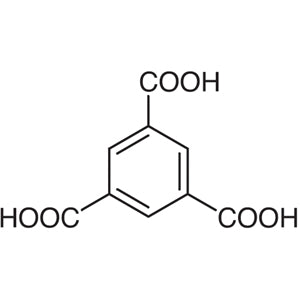
1,3,5-BenzenetricarboxylicAcid TCI B0043
Regular price From Rp 1.035.300,00Regular priceRp 723.450,00Sale price From Rp 1.035.300,00 -
Anthraquinone-2,3-dicarboxylicAcid TCI A1681
Regular price Rp 9.461.550,00Regular priceRp 6.616.050,00Sale price Rp 9.461.550,00