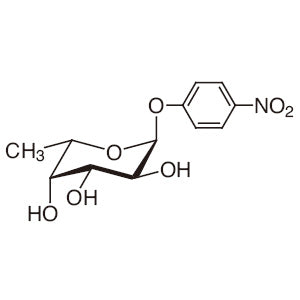
![2001-96-9 4-Nitrophenyl beta-D-Xylopyranoside [Substrate for beta-Xylosidase] - AMI Scientific](http://amiscientific.com/cdn/shop/files/TCI2510N0620.jpg?v=1767130146&width=1946)
![2001-96-9 4-Nitrophenyl beta-D-Xylopyranoside [Substrate for beta-Xylosidase] - AMI Scientific](http://amiscientific.com/cdn/shop/files/TCI2510N0620.jpg?v=1767130146&width=1445)
TCI N0620 4-Nitrophenyl beta-D-Xylopyranoside is a chromogenic substrate for the enzyme beta-xylosidase. It consists of a xylose sugar linked to 4-nitrophenol through a beta-glycosidic bond. When beta-xylosidase cleaves this bond, it releases 4-nitrophenol, which turns yellow under alkaline conditions and can be measured by spectrophotometry. Beta-xylosidase is a key enzyme in breaking down xylan, the main component of hemicellulose in plant cell walls. This makes the substrate an important tool in research on biomass-degrading enzymes, and it is widely used in glycoscience and chemical biology laboratories.
Researchers choose this substrate because it gives a fast, specific and quantitative way to measure beta-xylosidase activity. Measuring enzyme activity with natural substrates such as xylan often requires more complex reducing-sugar analysis. This chromogenic substrate gives a direct colour signal instead, which simplifies the workflow and makes results easier to reproduce. It makes it easier to screen many microbial isolates, optimise fermentation conditions and characterise purified enzymes. Its specificity for the beta-xylosidic bond also helps researchers tell beta-xylosidase activity apart from xylanases and other glycosidases in complex enzyme mixtures.
Indonesia has abundant lignocellulosic biomass, such as agricultural and plantation residues, so this substrate is relevant to many local research programmes. University biochemistry and microbiology laboratories, biotechnology research institutes and industrial research and development teams use it to find and characterise enzymes that can turn plant biomass into value-added products. Typical work includes screening local microbial isolates, studying enzymes for bioconversion processes and supporting student research projects in enzymology and applied microbiology.
TCI brochures (PDF)
- Reagents for Glyco Chemistry & Biology 5th Edition · p. 74
- Reagents for Biological Research 2025-03-11 · p. 22
Related TCI products
- TCI N0619 10357-27-4 4-Nitrophenyl alpha-D-Mannopyranoside [Substrate for alpha-Mannosidase]
- TCI N0618 10344-94-2 4-Nitrophenyl beta-D-Glucuronide [Substrate for beta-Glucuronidase]
- TCI N0616 3150-24-1 4-Nitrophenyl beta-D-Galactopyranoside [Substrate for beta-Galactosidase]
- TCI N0493 3767-28-0 4-Nitrophenyl alpha-D-Glucopyranoside [Substrate for alpha-D-Glucosidase]
- TCI N0492 7493-95-0 4-Nitrophenyl alpha-D-Galactopyranoside [Substrate for alpha-D-Galactosidase]
- TCI N0235 2492-87-7 4-Nitrophenyl beta-D-Glucopyranoside Monohydrate [Substrate for beta-D-Glucosidase]
- Beta-xylosidase activity assays: the substrate releases coloured 4-nitrophenol when cleaved, so enzyme activity can be quantified directly and reproducibly by spectrophotometric measurement.
- Screening of microbial isolates: the direct colour signal makes it practical to test large numbers of bacterial or fungal isolates for beta-xylosidase production without complex reducing-sugar analysis.
- Fermentation optimisation studies: researchers can quickly compare beta-xylosidase activity under different culture conditions, which helps them choose the conditions that best support enzyme production.
- Characterisation of purified enzymes: the quantitative colour response suits kinetic studies and the evaluation of how factors such as pH or temperature affect a purified beta-xylosidase.
- Distinguishing glycosidase activities: its specificity for the beta-xylosidic bond helps separate beta-xylosidase activity from xylanase and other glycosidase activities in mixed enzyme preparations.
| Brand | TCI |
|---|---|
| CAS number | 2001-96-9 |
| Molecular formula | — |
| Purity | — |
| Category | Chemistry > Chemical Biology > Glycoscience |
| Pack sizes | available in several pack sizes; please contact AMI Scientific for current options |
| Physical form | — |
| Storage | follow the storage conditions stated on the TCI label and the product documentation |
- Product code: N0620
Store 4-Nitrophenyl beta-D-Xylopyranoside in its original, tightly closed container and follow the storage temperature on the TCI label and the Safety Data Sheet. Keep the container in a dry place, away from moisture, heat and direct light, because these can degrade glycoside substrates over time. Where possible, prepare solutions fresh before use. Handle the material in a clean, well-ventilated area and wear standard laboratory protective equipment, including gloves, safety glasses and a lab coat. Avoid inhaling dust and avoid contact with skin and eyes. Keep in mind that the reaction product, 4-nitrophenol, should also be handled with care. Always read the Safety Data Sheet before use, and dispose of residues according to local laboratory waste regulations.
—
Product Categories
- GlycoscienceEnzyme, Lectin, Antibody [Glycoscience]Glycohydrases and Related Reagents [Glycoscience]
- GlycoscienceGlyco Building BlocksProtected Sugars [Oligosaccharides by Component Sugar]
- GlycoscienceGlyco Building BlockspNP(para-Nitorophenyl) Glycoseides [Glyco Building Blocks]
- GlycoscienceMonosaccharides [Glycoscience]Xyloses [Glycoscience]
- Biochemicals and ReagentsCarbohydrates
Produk Terkait
-
4-Nitrophenylalpha-D-Mannopyranoside[Substrateforalpha-Mannosidase] TCI N0619
Regular price Rp 4.902.450,00Regular price -
4-Nitrophenylbeta-D-Glucuronide[Substrateforbeta-Glucuronidase] TCI N0618
Regular price Rp 1.776.600,00Regular price -
4-Nitrophenylbeta-D-Galactopyranoside[Substrateforbeta-Galactosidase] TCI N0616
Regular price From Rp 1.961.400,00Regular price -
4-Nitrophenylalpha-D-Glucopyranoside[Substrateforalpha-D-Glucosidase] TCI N0493
Regular price From Rp 2.147.250,00Regular price -
4-Nitrophenylalpha-D-Galactopyranoside[Substrateforalpha-D-Galactosidase] TCI N0492
Regular price Rp 1.298.850,00Regular price -
4-Nitrophenylbeta-D-GlucopyranosideMonohydrate[Substrateforbeta-D-Glucosidase] TCI N0235
Regular price From Rp 2.359.350,00Regular price -
2-Nitrophenylbeta-D-Galactopyranoside[Substrateforbeta-D-Galactosidase] TCI N0418
Regular price From Rp 848.400,00Regular price -
4-Nitrophenylalpha-L-Fucopyranoside TCI N0392
Regular price From Rp 1.565.550,00Regular price
![10357-27-4 4-Nitrophenyl alpha-D-Mannopyranoside [Substrate for alpha-Mannosidase] - AMI Scientific](http://amiscientific.com/cdn/shop/files/TCI2510N0619.jpg?v=1767130142&width=533)
![10344-94-2 4-Nitrophenyl beta-D-Glucuronide [Substrate for beta-Glucuronidase] - AMI Scientific](http://amiscientific.com/cdn/shop/files/TCI2510N0618.jpg?v=1767130139&width=533)
![3150-24-1 4-Nitrophenyl beta-D-Galactopyranoside [Substrate for beta-Galactosidase] - AMI Scientific](http://amiscientific.com/cdn/shop/files/TCI2510N0616.jpg?v=1767130131&width=533)
![3767-28-0 4-Nitrophenyl alpha-D-Glucopyranoside [Substrate for alpha-D-Glucosidase] - AMI Scientific](http://amiscientific.com/cdn/shop/files/TCI2510N0493.jpg?v=1767129938&width=533)
![7493-95-0 4-Nitrophenyl alpha-D-Galactopyranoside [Substrate for alpha-D-Galactosidase] - AMI Scientific](http://amiscientific.com/cdn/shop/files/TCI2510N0492.jpg?v=1767129934&width=533)
![2492-87-7 4-Nitrophenyl beta-D-Glucopyranoside Monohydrate [Substrate for beta-D-Glucosidase] - AMI Scientific](http://amiscientific.com/cdn/shop/files/TCI2510N0235.jpg?v=1767129472&width=533)
![369-07-3 2-Nitrophenyl beta-D-Galactopyranoside [Substrate for beta-D-Galactosidase] - AMI Scientific](http://amiscientific.com/cdn/shop/files/TCI2510N0418.jpg?v=1767129806&width=533)