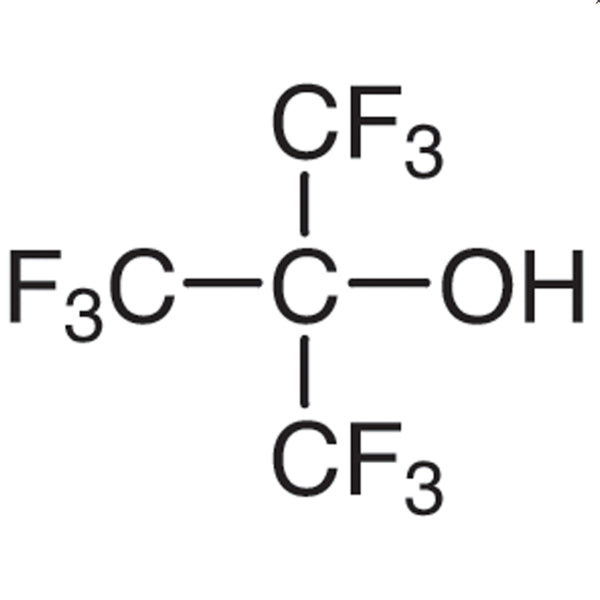
Nonafluoro-tert-butyl Alcohol from TCI (product code N0692), also known as perfluoro-tert-butanol, is a tertiary alcohol in which all three methyl groups have been replaced by trifluoromethyl groups. Because the molecule is symmetrical, its nine fluorine atoms are chemically equivalent. This makes it an unusual member of the fluorinated building block family. In the laboratory it is used to introduce the perfluoro-tert-butyl group into target molecules, as a specialty solvent or additive, and as a reagent in organofluorine and coordination chemistry.
The three trifluoromethyl groups strongly withdraw electrons, so the hydroxyl group is far more acidic than in ordinary alcohols, while the compound itself is only weakly nucleophilic. Together, these properties make it a strong hydrogen-bond-donating solvent or co-solvent that can stabilize cationic intermediates without competing as a nucleophile. Its conjugate base, the perfluoro-tert-butoxide anion, coordinates very weakly and is used to build weakly coordinating ligands and anions. Because all nine fluorines are equivalent, the group gives one sharp signal in 19F NMR, which makes it a popular tracer label.
In Indonesia, this material suits research groups working in organofluorine chemistry, inorganic and organometallic chemistry, and synthetic methodology at universities, research institutes, and industrial R&D laboratories. Chemists can use it to prepare perfluoro-tert-butyl derivatives, to test reaction conditions that need a strongly hydrogen-bonding, weakly nucleophilic medium, or to design molecules with a clean 19F NMR handle for reaction monitoring, binding studies, or analytical method development in teaching and research settings.
TCI brochures (PDF)
- Fluorous Chemistry 2025-01-21 · p. 5
- Fluorination Reagents, Fluorinated Building Blocks 2026-03-18 · p. 53
Related TCI products
- TCI N1038 756-13-8 1,1,1,2,2,4,5,5,5-Nonafluoro-4-(trifluoromethyl)-3-pentanone
- TCI N0711 29420-49-3 Potassium Nonafluoro-1-butanesulfonate
- TCI N0709 375-73-5 Nonafluoro-1-butanesulfonic Acid
- TCI N0689 424-36-2 Ethyl Nonafluorovalerate
- TCI N0677 79963-95-4 2,2,2-Trifluoroethyl Nonafluorobutanesulfonate
- TCI N0499 423-39-2 Nonafluorobutyl Iodide
- Introducing the perfluoro-tert-butyl group: the compound works as a building block that installs a bulky, symmetrical, heavily fluorinated group onto target molecules during synthetic work.
- Specialty solvent or co-solvent: its highly acidic hydroxyl group and weak nucleophilicity give strong hydrogen bonding that can stabilize cationic intermediates without reacting with them.
- Weakly coordinating anions and ligands: the perfluoro-tert-butoxide conjugate base coordinates very weakly, so it is useful for building ligands and anions in coordination and organometallic chemistry.
- 19F NMR tracer labeling: the nine equivalent fluorine atoms give a single sharp 19F NMR signal, which makes the group easy to detect and track in complex mixtures.
- Organofluorine reagent studies: its unusual electronic properties make it a useful reagent for exploring reactivity, acidity effects, and fluorine-substituent behavior in organofluorine chemistry research.
| Brand | TCI (product code N0692) |
|---|---|
| CAS number | 2378-02-1 |
| Molecular formula | — |
| Purity | — |
| Category | Chemistry > Building Blocks > Fluorinated Building Blocks |
| Pack sizes | available in the pack sizes TCI offers for this product; please confirm when ordering |
| Physical form | see the TCI product specification sheet |
| Storage | follow the storage conditions on the TCI label and Safety Data Sheet |
Store Nonafluoro-tert-butyl Alcohol in its original, tightly closed container in a cool, dry, well-ventilated area, away from heat sources, strong bases, and incompatible materials, and follow the specific conditions on the TCI label and Safety Data Sheet. Keep containers sealed when not in use to reduce evaporation and contamination. Handle it in a fume hood and wear suitable personal protective equipment, including chemical-resistant gloves, safety goggles, and a laboratory coat. Because it is a strongly acidic fluorinated alcohol, avoid contact with skin, eyes, and inhalation of vapors. Dispose of waste according to local regulations for fluorinated organic chemicals.
—
Produk Terkait
-
1,1,1,2,2,4,5,5,5-Nonafluoro-4-(trifluoromethyl)-3-pentanone TCI N1038
Regular price From Rp 3.232.950,00Regular price -
PotassiumNonafluoro-1-butanesulfonate TCI N0711
Regular price Rp 1.644.300,00Regular price -
Nonafluoro-1-butanesulfonicAcid TCI N0709
Regular price From Rp 823.200,00Regular price -
EthylNonafluorovalerate TCI N0689
Regular price Rp 1.115.100,00Regular price -
2,2,2-TrifluoroethylNonafluorobutanesulfonate TCI N0677
Regular price Rp 2.386.650,00Regular price -
NonafluorobutylIodide TCI N0499
Regular price From Rp 1.618.050,00Regular price -
MethylNonafluorovalerate TCI M1912
Regular price Rp 2.094.750,00Regular price -
EthylNonafluorobutylEther(mixtureofisomers) TCI E0528
Regular price From Rp 1.035.300,00Regular price