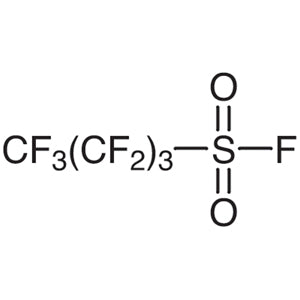
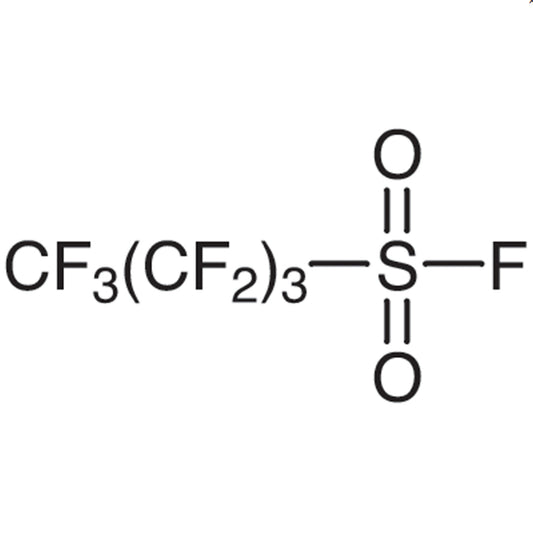
Potassium Nonafluoro-1-butanesulfonate from TCI (product code N0711) is the potassium salt of perfluorobutanesulfonic acid. It is classified as a fluorinated building block and a fluorinated anionic salt. In the laboratory it serves three main purposes: it is a stable, easy-to-handle source of the nonaflate anion, it works as a short-chain fluorinated surfactant, and it is used as an additive in polymer research. The materials literature also describes this salt as a flame-retardant additive for polycarbonate, so it is relevant to both synthetic and applied materials work.
This potassium salt is a solid and is less corrosive than the free acid, so it is easier to weigh and store than the acid form. The strong C-F bonds make the nonaflate anion highly stable, both chemically and thermally. The anion also coordinates only weakly to cations, which helps in reactions that need a non-interfering counterion. The perfluorobutyl chain gives the salt distinctive surface activity, allowing it to lower surface tension. These properties make it useful in synthesis, such as ion-exchange reactions, and in material formulation.
In Indonesia, this material suits polymer and materials chemistry laboratories that study additives and formulation behaviour. It also fits research laboratories in the engineering plastics industry, where flame-retardant additives for polycarbonate are a relevant topic. Inorganic chemistry and electrochemistry laboratories that need a stable, weakly coordinating anion will find it a convenient reagent too. University research groups and industrial R&D teams can use it for routine synthesis work and for exploratory material studies.
TCI brochures (PDF)
- Fluorous Chemistry 2025-01-21 · p. 9
- Polymer Additives 2026-04-16 · p. 12
Related TCI products
- TCI N0709 375-73-5 Nonafluoro-1-butanesulfonic Acid
- TCI N0710 131651-65-5 Lithium Nonafluoro-1-butanesulfonate
- TCI P1098 375-72-4 Perfluoro-1-butanesulfonyl Fluoride
- TCI N1038 756-13-8 1,1,1,2,2,4,5,5,5-Nonafluoro-4-(trifluoromethyl)-3-pentanone
- TCI N0692 2378-02-1 Nonafluoro-tert-butyl Alcohol
- TCI N0677 79963-95-4 2,2,2-Trifluoroethyl Nonafluorobutanesulfonate
- Nonaflate anion source: the salt supplies a chemically and thermally stable nonaflate anion in a solid form that is easier to handle than the corrosive free acid.
- Ion-exchange reactions: the weakly coordinating nonaflate anion can be moved onto other cations in synthesis, making the salt a practical starting material for preparing other nonaflate compounds.
- Short-chain fluorinated surfactant studies: the perfluorobutyl chain gives the salt distinctive surface activity and lets it lower surface tension, which is useful when studying interfacial behaviour in solutions.
- Polymer research additives: researchers can add the salt to polymer formulations to study how a fluorinated anionic additive affects material properties and processing behaviour.
- Flame-retardant research for polycarbonate: the materials literature describes this salt as a flame-retardant additive for polycarbonate, so it is relevant to engineering plastics development and testing.
| Brand | TCI (product code N0711) |
|---|---|
| CAS number | 29420-49-3 |
| Molecular formula | — |
| Purity | — |
| Category | Chemistry > Building Blocks > Fluorinated Building Blocks |
| Pack sizes | Available in TCI standard pack sizes; please confirm current options with AMI Scientific |
| Physical form | Solid (potassium salt) |
| Storage | Keep in a tightly closed container in a cool, dry place; follow the TCI label and Safety Data Sheet |
Keep Potassium Nonafluoro-1-butanesulfonate in its original, tightly sealed container in a cool, dry, well-ventilated area, away from moisture and incompatible materials. Close the container properly after each use to keep the solid in good condition. Do not generate dust when weighing or transferring the material. Wear suitable personal protective equipment, including safety glasses, gloves, and a laboratory coat. Handle the salt in a fume hood or a well-ventilated area. Because it is a fluorinated compound, collect waste separately and dispose of it according to local regulations and institutional procedures. Always check the TCI Safety Data Sheet for specific hazard information and first-aid measures before use.
—
Produk Terkait
-
Nonafluoro-1-butanesulfonicAcid TCI N0709
Regular price From Rp 823.200,00Regular price -
LithiumNonafluoro-1-butanesulfonate TCI N0710
Regular price Rp 1.803.900,00Regular price -
Perfluoro-1-butanesulfonylFluoride TCI P1098
Regular price From Rp 1.405.950,00Regular price -
1,1,1,2,2,4,5,5,5-Nonafluoro-4-(trifluoromethyl)-3-pentanone TCI N1038
Regular price From Rp 3.232.950,00Regular price -
Nonafluoro-tert-butylAlcohol TCI N0692
Regular price From Rp 1.458.450,00Regular price -
2,2,2-TrifluoroethylNonafluorobutanesulfonate TCI N0677
Regular price Rp 2.386.650,00Regular price -
UndecafluorohexanoicAcid TCI U0067
Regular price From Rp 2.227.050,00Regular price -
EthylNonafluorovalerate TCI N0689
Regular price Rp 1.115.100,00Regular price