

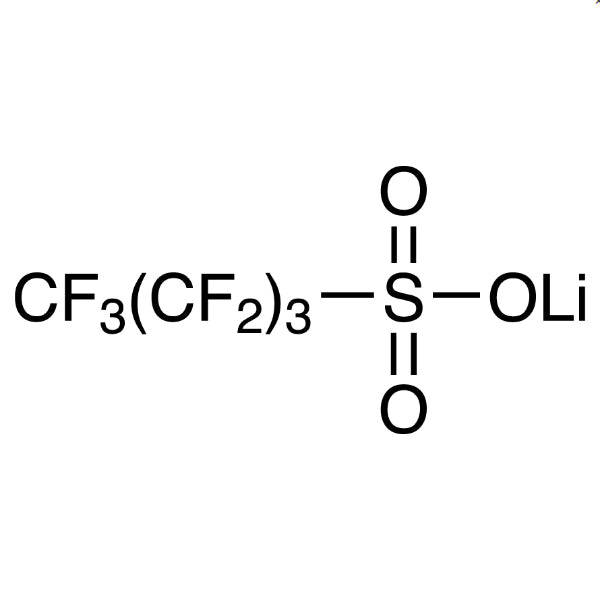
Lithium Nonafluoro-1-butanesulfonate from TCI (product code N0710) is the lithium salt of nonafluorobutanesulfonic acid, and its nonaflate anion is fully fluorinated. TCI lists this compound under battery materials, specifically battery electrolytes. In the laboratory, it serves as an alternative lithium salt in electrolyte research for lithium-ion batteries and solid polymer electrolytes. It is also used in studies of ion transport and electrochemical stability, where researchers need a well-defined, fluorinated lithium source.
Researchers choose this salt because the nonaflate anion is highly stable and weakly coordinating. The sulfonate group and the perfluorobutyl chain spread the negative charge across the anion, so lithium ions dissociate more readily in polar organic solvents and in polymer matrices. Strong carbon-fluorine bonds give the anion good chemical and thermal resistance. The salt also makes a useful comparison with more common lithium salts. For example, researchers can use it to examine how perfluoroalkyl chain length affects ionic conductivity and the formation of electrode interfaces.
In Indonesia, this material is relevant to energy and battery research laboratories at universities and research institutions. That includes groups developing electrolytes for electric vehicles and stationary energy storage systems, where interest in lithium-ion technology keeps growing. Graduate researchers and academic teams working on new electrolyte formulations, polymer electrolyte membranes, or basic electrochemical characterisation can use this TCI salt as a dependable reference material in their experiments.
TCI brochures (PDF)
- Lithium Electrolytes 2026-04-06 · p. 1
- Lithium Compounds for Research and Experimental Use 2026-02-10 · p. 2
- Battery Research Reagents 2026-09-18 · p. 3
- Fluorous Chemistry 2025-01-21 · p. 9
Related TCI products
- TCI L0307 119229-99-1 Lithium Bis(nonafluorobutanesulfonyl)imide
- TCI N0711 29420-49-3 Potassium Nonafluoro-1-butanesulfonate
- TCI L0420 176719-70-3 Lithium [(Nonafluorobutyl)sulfonyl][(trifluoromethyl)sulfonyl]azanide
- TCI N0709 375-73-5 Nonafluoro-1-butanesulfonic Acid
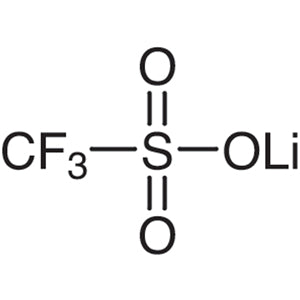
- TCI T1548 33454-82-9 Lithium Trifluoromethanesulfonate
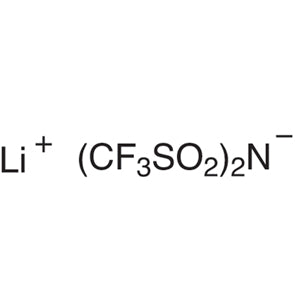
- TCI B2542 90076-65-6 Lithium Bis(trifluoromethanesulfonyl)imide
- Lithium-ion battery electrolyte research: the salt acts as an alternative lithium source, and its weakly coordinating nonaflate anion helps lithium ions dissociate in polar organic solvents.
- Solid polymer electrolyte development: the charge on the anion is spread out, so lithium ions dissociate well inside polymer matrices, which suits studies of ion-conducting membranes.
- Ion transport studies: researchers can use this salt to examine how lithium ions move through liquid and polymer electrolyte systems under controlled experimental conditions.
- Electrochemical stability investigations: the strong C-F bonds of the fully fluorinated anion give good chemical and thermal resistance, so it suits stability window and degradation studies.
- Comparative salt studies: the perfluorobutyl chain makes it a useful counterpart to more common lithium salts when evaluating how perfluoroalkyl chain length affects conductivity and electrode interface formation.
| Brand | TCI (product code N0710) |
|---|---|
| CAS number | 131651-65-5 |
| Molecular formula | — |
| Purity | — |
| Category | Materials Science > Battery Materials > Battery Electrolytes |
| Pack sizes | 25g |
| Physical form | see the TCI product specification sheet |
| Storage | keep tightly closed in a cool, dry place and protect from moisture |
Keep Lithium Nonafluoro-1-butanesulfonate in its original, tightly sealed container in a cool, dry, well-ventilated area, away from moisture and incompatible substances. Because water can affect electrolyte performance, users preparing battery electrolytes should handle and weigh the salt in a dry environment such as a glovebox or dry room. Wear standard laboratory protective equipment, including gloves, safety glasses, and a lab coat. Avoid breathing in dust and avoid contact with skin and eyes. Read the TCI Safety Data Sheet before use, and dispose of fluorinated waste according to local regulations.
—
Produk Terkait
-
LithiumBis(nonafluorobutanesulfonyl)imide TCI L0307
Regular price From Rp 1.115.100,00Regular price -
PotassiumNonafluoro-1-butanesulfonate TCI N0711
Regular price Rp 1.644.300,00Regular price -
Lithium[(Nonafluorobutyl)sulfonyl][(trifluoromethyl)sulfonyl]azanide TCI L0420
Regular price From Rp 3.340.050,00Regular price -
Nonafluoro-1-butanesulfonicAcid TCI N0709
Regular price From Rp 823.200,00Regular price -
LithiumTrifluoromethanesulfonate TCI T1548
Regular price Rp 1.485.750,00Regular price -
LithiumBis(trifluoromethanesulfonyl)imide TCI B2542
Regular price From Rp 1.431.150,00Regular price -
LithiumStearate TCI S0237
Regular price From Rp 664.650,00Regular price -
LithiumPyruvateMonohydrate[GuaranteedforStandardtoGOT,GPT] TCI P0659
Regular price Rp 2.094.750,00Regular price


![176719-70-3 Lithium [(Nonafluorobutyl)sulfonyl][(trifluoromethyl)sulfonyl]azanide - AMI Scientific](http://amiscientific.com/cdn/shop/files/TCI2510L0420.jpg?v=1767121891&width=533)


![2922-61-4 Lithium Pyruvate Monohydrate [Guaranteed for Standard to GOT, GPT] - AMI Scientific](http://amiscientific.com/cdn/shop/files/TCI2510P0659.jpg?v=1767133566&width=533)