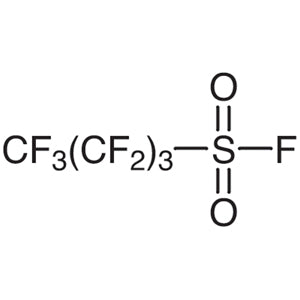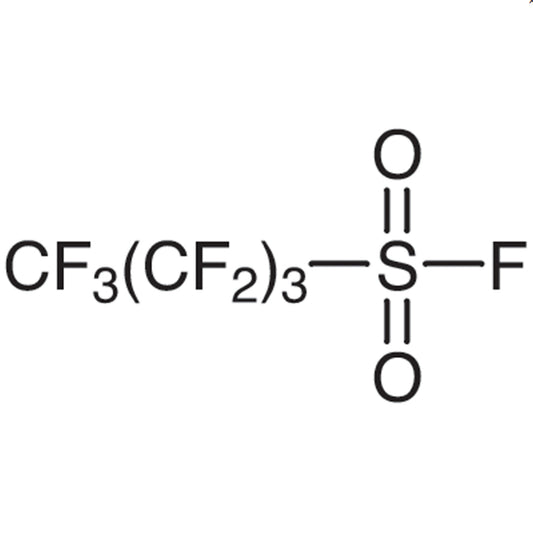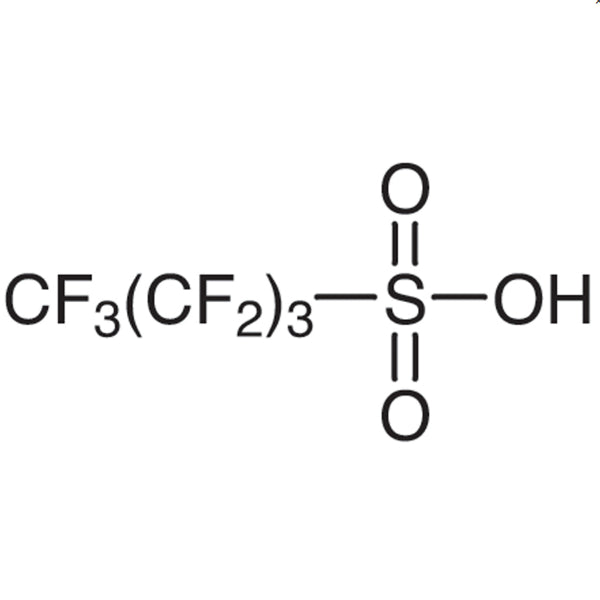
Nonafluoro-1-butanesulfonic Acid from TCI (product code N0709) is a perfluorinated sulfonic acid with a four-carbon chain in which every hydrogen atom has been replaced by fluorine. It is commonly abbreviated as PFBS. It is a very strong acid because the inductive effect of the perfluoroalkyl chain stabilizes its conjugate anion. In the laboratory, it serves as a strong acid catalyst, a precursor to the nonaflate group, and a fluorinated building block in both organic and materials chemistry.
Chemists choose this compound because it combines high acidity with a very stable, weakly coordinating anion. The nonaflate anion is an excellent leaving group, comparable to triflate. For this reason, nonaflate derivatives of alcohols or phenols are useful substrates in palladium-catalyzed cross-coupling reactions. The short perfluoroalkyl chain also gives the molecule distinctive hydrophobic and lipophobic character. In many studies it is also used as a short-chain alternative to long-chain perfluorinated compounds, which widens its value in research on fluorinated substances.
In Indonesia, this material is relevant to advanced organic synthesis laboratories, materials and polymer laboratories, and environmental analytical laboratories that need PFAS compounds as reference materials. Synthesis groups in universities and research institutes can use it to make nonaflate intermediates and to run strongly acid-catalyzed transformations. Materials researchers can use it to study how fluorinated building blocks change surface and bulk properties. Environmental testing laboratories can use it as a well-defined short-chain PFAS compound in analytical and monitoring work.
TCI brochures (PDF)
- Fluorous Chemistry 2025-01-21 · p. 9
- Polymer Additives 2026-04-16 · p. 12
Related TCI products
- TCI N0711 29420-49-3 Potassium Nonafluoro-1-butanesulfonate
- TCI P1098 375-72-4 Perfluoro-1-butanesulfonyl Fluoride
- TCI N1038 756-13-8 1,1,1,2,2,4,5,5,5-Nonafluoro-4-(trifluoromethyl)-3-pentanone
- TCI N0710 131651-65-5 Lithium Nonafluoro-1-butanesulfonate
- TCI N0692 2378-02-1 Nonafluoro-tert-butyl Alcohol
- TCI N0677 79963-95-4 2,2,2-Trifluoroethyl Nonafluorobutanesulfonate
- Strong acid catalysis: its very high acidity and weakly coordinating anion make it well suited to catalyzing organic reactions that need a powerful proton source with minimal anion interference.
- Nonaflate precursor chemistry: it provides the nonaflate group, and converting alcohols or phenols into nonaflates gives substrates with a leaving group comparable to triflate for further transformations.
- Palladium-catalyzed cross-coupling: nonaflate derivatives prepared from this acid work well as electrophilic partners in palladium-catalyzed cross-coupling reactions, because the nonaflate anion is an excellent leaving group.
- Fluorinated building block research: its fully fluorinated four-carbon chain lets researchers add perfluoroalkyl segments that give target molecules and materials distinctive hydrophobic and lipophobic behavior.
- PFAS reference and comparative studies: as a well-characterized short-chain perfluorinated compound, it suits environmental and analytical studies that compare short-chain PFAS with long-chain perfluorinated compounds.
| Brand | TCI (product code N0709) |
|---|---|
| CAS number | 375-73-5 |
| Molecular formula | — |
| Purity | — |
| Category | Chemistry > Building Blocks > Fluorinated Building Blocks |
| Pack sizes | please contact AMI Scientific for available pack sizes |
| Physical form | — |
| Storage | keep tightly closed in a cool, dry, well-ventilated area, and follow the TCI label and Safety Data Sheet |
- Common abbreviation: PFBS
Nonafluoro-1-butanesulfonic Acid is a very strong acid and should be handled as a corrosive substance. Store it in its original tightly sealed container, or in a compatible acid-resistant container, in a cool, dry, well-ventilated area away from bases, reactive metals, and incompatible materials. Protect it from moisture. Handle it in a fume hood while wearing chemical-resistant gloves, safety goggles, and a laboratory coat. Avoid contact with skin and eyes and avoid breathing vapors. Because it is a PFAS compound, collect waste separately and dispose of it according to local regulations. Always check the TCI Safety Data Sheet before use.
—
Produk Terkait
-
PotassiumNonafluoro-1-butanesulfonate TCI N0711
Regular price Rp 1.644.300,00Regular price -
Perfluoro-1-butanesulfonylFluoride TCI P1098
Regular price From Rp 1.405.950,00Regular price -
1,1,1,2,2,4,5,5,5-Nonafluoro-4-(trifluoromethyl)-3-pentanone TCI N1038
Regular price From Rp 3.232.950,00Regular price -
LithiumNonafluoro-1-butanesulfonate TCI N0710
Regular price Rp 1.803.900,00Regular price -
Nonafluoro-tert-butylAlcohol TCI N0692
Regular price From Rp 1.458.450,00Regular price -
2,2,2-TrifluoroethylNonafluorobutanesulfonate TCI N0677
Regular price Rp 2.386.650,00Regular price -
UndecafluorohexanoicAcid TCI U0067
Regular price From Rp 2.227.050,00Regular price -
EthylNonafluorovalerate TCI N0689
Regular price Rp 1.115.100,00Regular price