


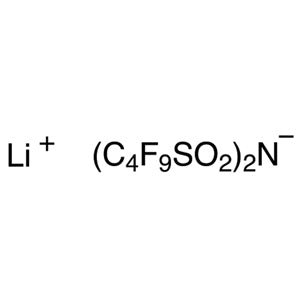
Lithium Bis(nonafluorobutanesulfonyl)imide (LiBF₄) is an inorganic salt widely used in chemical reactions and catalytic processes within laboratory settings. This compound plays a crucial role in electrochemical applications, particularly in lithium-ion batteries, where it functions as an essential electrolyte component. Its strong ionic properties enable efficient charge transfer, making it a key material for energy storage research. In catalytic systems, LiBF₄ is often employed to enhance reaction rates and improve the selectivity of chemical transformations. Due to its stability and reactivity, it is a favored choice among researchers working in inorganic chemistry and catalysis.
The compound's high stability and strong ionic character make it a preferred choice for various laboratory applications. Its low hygroscopic nature ensures that it can be stored and used without the need for additional drying agents or solvents. This characteristic simplifies handling and enhances the reliability of experimental results. Additionally, its ability to maintain structural integrity under extreme conditions allows for use in a wide range of chemical environments. The compound’s non-degradative properties further contribute to its reliability in both small-scale and large-scale laboratory operations.
In Indonesian laboratories, Lithium Bis(nonafluorobutanesulfonyl)imide is commonly used in inorganic chemistry research and battery technology development. It is a key component in experiments related to electrochemistry, catalysis, and material synthesis. Researchers in Indonesia rely on this compound for its consistent performance and compatibility with various experimental setups. Its widespread use in both academic and industrial research underscores its importance in modern chemical applications.
TCI brochures (PDF)
- Practical Lithium Ion Battery Electrolytes with Low Water Content 2024-10-23 · p. 1
- Lithium Electrolytes 2026-04-06 · p. 1
- Lithium Compounds for Research and Experimental Use 2026-02-10 · p. 2
- Lithium Battery Research Reagents 2026-06-04 · p. 2
- Battery Research Reagents 2026-09-18 · p. 3
- Fluorous Chemistry 2025-01-21 · p. 9
Related TCI products
- TCI B2542 90076-65-6 Lithium Bis(trifluoromethanesulfonyl)imide
- TCI L0281 171611-11-3 Lithium Bis(fluorosulfonyl)imide
- TCI L0420 176719-70-3 Lithium [(Nonafluorobutyl)sulfonyl][(trifluoromethyl)sulfonyl]azanide
- TCI N0710 131651-65-5 Lithium Nonafluoro-1-butanesulfonate
- TCI B2543 90076-67-8 Potassium Bis(trifluoromethanesulfonyl)imide
- TCI P2410 860653-59-4 Potassium (Fluorosulfonyl)(trifluoromethanesulfonyl)imide
- Electrochemical Research: LiBF₄ is ideal for studying battery performance due to its role as an electrolyte in lithium-ion cells, enabling efficient ion transport and stable charge retention.
- Catalytic Reactions: Its strong ionic character makes it a valuable catalyst or co-catalyst in organic and inorganic reactions, enhancing reaction rates and selectivity.
- Material Synthesis: The compound is used in the preparation of advanced materials, such as solid electrolytes and conductive polymers, due to its stability and ionic conductivity.
- Analytical Chemistry: LiBF₄ is employed in electrochemical sensors and analytical techniques where precise ion detection and measurement are required.
- Energy Storage Development: It plays a critical role in the development of next-generation battery technologies, supporting research into high-capacity and long-lasting energy storage systems.
| Brand | TCI |
|---|---|
| CAS number | 119229-99-1 |
| Molecular formula | — |
| Purity | — |
| Category | Chemistry > Catalysis and Inorganic Chemistry > Metallic Salts |
| Pack sizes | Available in various quantities suitable for both small and large-scale laboratory use |
| Physical form | Solid powder |
| Storage | Store in a cool, dry place away from moisture and direct sunlight |
Lithium Bis(nonafluorobutanesulfonyl)imide should be stored in a cool, dry environment to maintain its stability and prevent moisture absorption. It is recommended to use airtight containers made of inert materials such as glass or polyethylene to ensure long-term preservation. Due to its low hygroscopic nature, it does not require desiccant packaging, but care should be taken to avoid exposure to humidity. In laboratory settings, it should be handled with appropriate personal protective equipment, including gloves and safety goggles, to ensure safe handling. The compound is non-toxic in its solid form but should be treated with standard chemical safety protocols to prevent accidental spills or contamination. Proper labeling and storage conditions are essential to maintain its effectiveness and safety in research applications.
—
Product Categories
- Battery MaterialsBattery Electrolytes [Battery Materials]Lithium Electrolytes [Battery Materials]
- Electronic MaterialsBattery MaterialsBattery Electrolytes [Battery Materials]
- Electronic MaterialsPerovskite Solar Cell (PSC) MaterialsCarrier Transport Layer Addives [Perovskite Solar Cell (PSC) Materials]
Produk Terkait
-
LithiumBis(trifluoromethanesulfonyl)imide TCI B2542
Regular price From Rp 1.483.650,00Regular priceRp 1.053.150,00Sale price From Rp 1.483.650,00 -
LithiumBis(fluorosulfonyl)imide TCI L0281
Regular price From Rp 1.644.300,00Regular priceRp 1.149.750,00Sale price From Rp 1.644.300,00 -
Lithium[(Nonafluorobutyl)sulfonyl][(trifluoromethyl)sulfonyl]azanide TCI L0420
Regular price From Rp 3.392.550,00Regular priceRp 2.387.700,00Sale price From Rp 3.392.550,00 -
LithiumNonafluoro-1-butanesulfonate TCI N0710
Regular price Rp 1.803.900,00Regular priceRp 1.261.050,00Sale price Rp 1.803.900,00 -
PotassiumBis(trifluoromethanesulfonyl)imide TCI B2543
Regular price From Rp 717.150,00Regular priceRp 516.600,00Sale price From Rp 717.150,00 -
Potassium(Fluorosulfonyl)(trifluoromethanesulfonyl)imide TCI P2410
Regular price From Rp 2.041.200,00Regular priceRp 1.442.700,00Sale price From Rp 2.041.200,00 -
LithiumHexafluorophosphate TCI L0146
Regular price From Rp 2.227.050,00Regular priceRp 1.557.150,00Sale price From Rp 2.227.050,00 -
Zinc(II)Bis(trifluoromethanesulfonyl)imide TCI Z0027
Regular price From Rp 1.618.050,00Regular priceRp 1.146.600,00Sale price From Rp 1.618.050,00

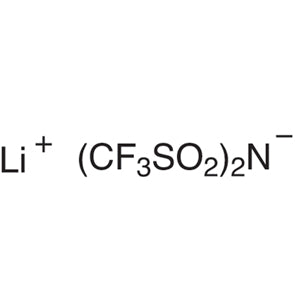


![TCI L0420 176719-70-3 Lithium [(Nonafluorobutyl)sulfonyl][(trifluoromethyl)sulfonyl]azanide](http://amiscientific.com/cdn/shop/files/TCI2510L0420_495d6d2d-c256-4908-a7a0-1af1a85a5651.jpg?v=1792646534&width=533)
![176719-70-3 Lithium [(Nonafluorobutyl)sulfonyl][(trifluoromethyl)sulfonyl]azanide - AMI Scientific](http://amiscientific.com/cdn/shop/files/TCI2510L0420.jpg?v=1767121891&width=533)


