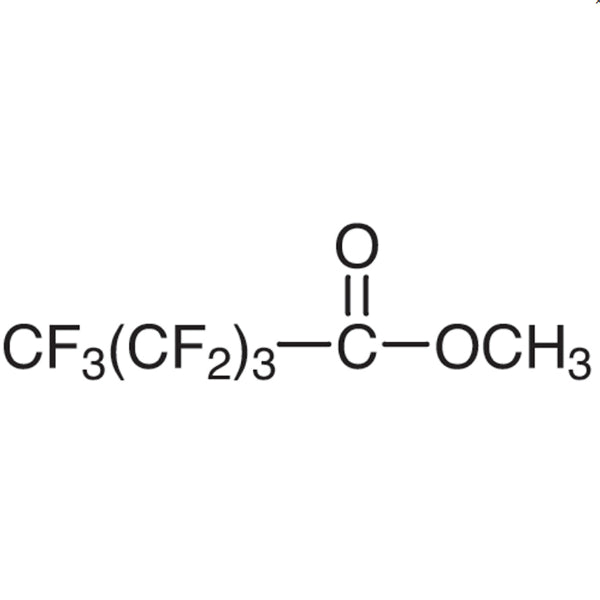
TCI M1912 13038-26-1 Methyl Nonafluorovalerate is a fluorinated chemical compound widely used in laboratory settings for its unique chemical properties. As a fluorinated building block, it plays a key role in the synthesis of organofluorine compounds, which are essential in various scientific fields. This compound is particularly valued for its high fluorine content, which contributes to its stability and reactivity in controlled environments. Its presence in laboratory research helps scientists develop new materials and pharmaceuticals with enhanced performance characteristics.
The compound’s high fluorination level gives it exceptional chemical stability and controlled reactivity, making it a preferred choice for specialized chemical reactions. It exhibits good solubility in organic solvents, which facilitates its use in a wide range of synthetic processes. Its ability to participate in substitution reactions and other chemical transformations makes it an essential tool for researchers aiming to create compounds with specific functional properties. These characteristics make it a reliable and versatile reagent in advanced chemical applications.
In Indonesian laboratories, TCI M1912 13038-26-1 Methyl Nonafluorovalerate is commonly used in scientific research and product development, especially in organic chemistry and pharmaceutical studies. It supports the creation of novel compounds with tailored properties, contributing to innovation in both academic and industrial research settings. Its availability through AMI Scientific ensures that Indonesian researchers have access to this important fluorinated compound for their work.
TCI brochures (PDF)
- Fluorous Chemistry 2025-01-21 · p. 8
- Fluorination Reagents, Fluorinated Building Blocks 2026-03-18 · p. 53
Related TCI products
- TCI N0689 424-36-2 Ethyl Nonafluorovalerate
- TCI N1038 756-13-8 1,1,1,2,2,4,5,5,5-Nonafluoro-4-(trifluoromethyl)-3-pentanone
- TCI N0692 2378-02-1 Nonafluoro-tert-butyl Alcohol
- TCI N0711 29420-49-3 Potassium Nonafluoro-1-butanesulfonate
- TCI N0709 375-73-5 Nonafluoro-1-butanesulfonic Acid
- TCI N0499 423-39-2 Nonafluorobutyl Iodide
- Organic synthesis applications benefit from this compound’s stability and reactivity, enabling the creation of complex fluorinated molecules.
- Pharmaceutical research utilizes its unique properties to develop drugs with improved bioavailability and stability.
- Material science applications leverage its hydrophobic and chemical resistance properties for creating advanced polymer materials.
- Analytical chemistry uses it as a standard for fluorinated compound identification and quantification.
- Environmental studies incorporate it to study the behavior and degradation of fluorinated substances in different conditions.
| Brand | TCI |
|---|---|
| CAS number | 13038-26-1 |
| Molecular formula | — |
| Purity | — |
| Category | Chemistry > Building Blocks > Fluorinated Building Blocks |
| Pack sizes | — |
| Physical form | — |
| Storage | Store in a cool, dry place away from light and incompatible materials |
This compound should be stored in a cool, dry environment, away from direct sunlight and sources of heat. It is recommended to use sealed containers made of inert materials to prevent contamination and maintain its chemical integrity. Due to its fluorinated nature, it is important to handle it with appropriate personal protective equipment, such as gloves and safety goggles, to ensure safety in the laboratory. Avoid exposure to incompatible substances, and ensure proper ventilation when working with it. Regular monitoring of storage conditions is advised to maintain the compound’s stability and effectiveness for laboratory use.
—
Produk Terkait
-
EthylNonafluorovalerate TCI N0689
Regular price Rp 1.115.100,00Regular price -
1,1,1,2,2,4,5,5,5-Nonafluoro-4-(trifluoromethyl)-3-pentanone TCI N1038
Regular price From Rp 3.232.950,00Regular price -
Nonafluoro-tert-butylAlcohol TCI N0692
Regular price From Rp 1.458.450,00Regular price -
PotassiumNonafluoro-1-butanesulfonate TCI N0711
Regular price Rp 1.644.300,00Regular price -
Nonafluoro-1-butanesulfonicAcid TCI N0709
Regular price From Rp 823.200,00Regular price -
NonafluorobutylIodide TCI N0499
Regular price From Rp 1.618.050,00Regular price -
EthylNonafluorobutylEther(mixtureofisomers) TCI E0528
Regular price From Rp 1.035.300,00Regular price -
4,4,5,5,6,6,7,7,7-Nonafluoro-1-heptanol TCI N1040
Regular price From Rp 3.021.900,00Regular price