


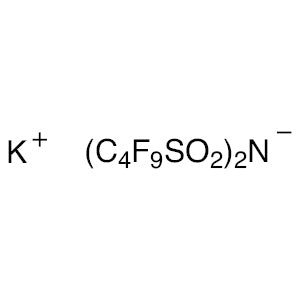
Potassium Bis(nonafluorobutanesulfonyl)imide from TCI (product code N0712) is the potassium salt of an imide anion that carries two nonafluorobutanesulfonyl groups on a single nitrogen atom. Structurally, it is a longer-chain analogue of the widely used bis(trifluoromethanesulfonyl)imide anion. TCI lists this compound under main-group element chemistry. In the laboratory, it serves as a source of a very weakly coordinating anion for ionic liquids, electrolytes, and cationic catalytic systems, where the counter-anion should stay in the background and not interfere with the reactive centre.
Bis(perfluoroalkanesulfonyl)imide anions are known for spreading their negative charge widely across the two sulfonyl groups and the central nitrogen atom. As a result, the anion is highly stable and almost non-nucleophilic, so it rarely competes with substrates or ligands for a cationic metal or organic centre. The perfluorobutyl chains are longer than triflyl groups, which makes the anion larger and more hydrophobic. These features affect the melting point, solubility, and cation interactions of the salts it forms. Because it is supplied as the potassium salt, the anion can be transferred easily by ion exchange onto organic or metal cations, giving researchers a practical way to build new salts.
In Indonesia, this material is relevant to inorganic and organometallic chemistry laboratories, ionic liquid research groups, and electrochemistry and battery teams exploring new anions. University research groups and institutional laboratories can use it to prepare weakly coordinated cationic complexes, to test how anion size and hydrophobicity affect ionic liquid behaviour, or to screen new electrolyte formulations. It works well as a longer-chain point of comparison alongside the more common triflyl-based imide salts.
TCI brochures (PDF)
- Fluorous Chemistry 2025-01-21 · p. 9
- Metallic Salts 2025-11-06 · p. 14
Related TCI products
- TCI O0492 129135-86-0 Sodium Bis(nonafluorobutanesulfonyl)imide
- TCI C3447 689282-13-1 Calcium(II) Bis(nonafluorobutanesulfonyl)imide
- TCI P2509 14984-76-0 Potassium Bis(fluorosulfonyl)imide
- TCI P2410 860653-59-4 Potassium (Fluorosulfonyl)(trifluoromethanesulfonyl)imide
- TCI L0307 119229-99-1 Lithium Bis(nonafluorobutanesulfonyl)imide
- TCI L0420 176719-70-3 Lithium [(Nonafluorobutyl)sulfonyl][(trifluoromethyl)sulfonyl]azanide
- Ionic liquid synthesis: the potassium salt allows simple ion exchange with organic cations, introducing a bulky, hydrophobic, weakly coordinating anion that changes the melting point and solubility of the resulting ionic liquids.
- Electrolyte research: the highly delocalised, stable imide anion makes it a candidate for electrochemistry and battery groups studying how new anions affect electrolyte behaviour compared with conventional triflyl-based imides.
- Cationic catalytic systems: its almost non-nucleophilic character means the anion is unlikely to bind the active cationic metal or organic centre, which helps preserve catalytic reactivity in sensitive transformations.
- Preparation of weakly coordinated metal complexes: inorganic and organometallic laboratories can use salt metathesis with this potassium salt to install the anion on metal cations and study their coordination behaviour.
- Structure–property comparison studies: as a longer-chain analogue of bis(trifluoromethanesulfonyl)imide, it lets researchers study how perfluoroalkyl chain length affects anion size, hydrophobicity, and interactions with cations.
| Brand | TCI (product code N0712) |
|---|---|
| CAS number | 129135-87-1 |
| Molecular formula | — |
| Purity | — |
| Category | Chemistry > Catalysis and Inorganic Chemistry > Main-group Elements |
| Pack sizes | available pack sizes are shown on the product page |
| Physical form | see the TCI product documentation (not stated here) |
| Storage | follow the storage conditions given on the TCI label and Safety Data Sheet |
Keep the product in its original, tightly closed container in a cool, dry, well-ventilated area, away from moisture and incompatible materials. Always follow the specific storage temperature and conditions on the TCI label and Safety Data Sheet. Once opened, reseal the container promptly to limit exposure to humid air, and transfer portions only into clean, dry, clearly labelled containers made of compatible material. Handle the compound in a fume hood or well-ventilated workspace. Wear suitable personal protective equipment, including safety glasses, chemical-resistant gloves, and a laboratory coat. Avoid creating or breathing dust and avoid contact with skin and eyes. Dispose of waste and contaminated materials according to institutional procedures and local regulations for fluorinated chemical waste.
—
Produk Terkait
-
SodiumBis(nonafluorobutanesulfonyl)imide TCI O0492
Regular price From Rp 1.643.250,00Regular priceRp 1.164.450,00Sale price From Rp 1.643.250,00 -
Calcium(II)Bis(nonafluorobutanesulfonyl)imide TCI C3447
Regular price From Rp 1.856.400,00Regular priceRp 1.313.550,00Sale price From Rp 1.856.400,00 -
PotassiumBis(fluorosulfonyl)imide TCI P2509
Regular price From Rp 1.035.300,00Regular priceRp 723.450,00Sale price From Rp 1.035.300,00 -
Potassium(Fluorosulfonyl)(trifluoromethanesulfonyl)imide TCI P2410
Regular price From Rp 2.041.200,00Regular priceRp 1.442.700,00Sale price From Rp 2.041.200,00 -
LithiumBis(nonafluorobutanesulfonyl)imide TCI L0307
Regular price From Rp 1.167.600,00Regular priceRp 831.600,00Sale price From Rp 1.167.600,00 -
Lithium[(Nonafluorobutyl)sulfonyl][(trifluoromethyl)sulfonyl]azanide TCI L0420
Regular price From Rp 3.392.550,00Regular priceRp 2.387.700,00Sale price From Rp 3.392.550,00 -
Zinc(II)Bis(trifluoromethanesulfonyl)imide TCI Z0027
Regular price From Rp 1.618.050,00Regular priceRp 1.146.600,00Sale price From Rp 1.618.050,00 -
Barium(II)Bis(trifluoromethanesulfonyl)imide TCI B5171
Regular price From Rp 1.961.400,00Regular priceRp 1.387.050,00Sale price From Rp 1.961.400,00


![TCI L0420 176719-70-3 Lithium [(Nonafluorobutyl)sulfonyl][(trifluoromethyl)sulfonyl]azanide](http://amiscientific.com/cdn/shop/files/TCI2510L0420_495d6d2d-c256-4908-a7a0-1af1a85a5651.jpg?v=1792646534&width=533)
![176719-70-3 Lithium [(Nonafluorobutyl)sulfonyl][(trifluoromethyl)sulfonyl]azanide - AMI Scientific](http://amiscientific.com/cdn/shop/files/TCI2510L0420.jpg?v=1767121891&width=533)


