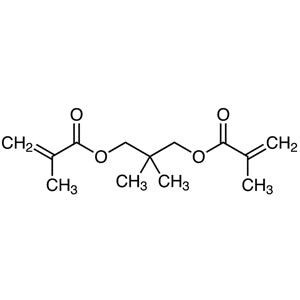
Neopentyl Glycol Dimethacrylate (NPGDMA) is a dimethacrylate monomer: an ester of neopentyl glycol carrying two methacrylate groups. TCI supplies it stabilized with MEHQ (monomethyl ether of hydroquinone), which stops it from polymerizing on its own during storage. In materials science laboratories, NPGDMA is used as a crosslinking agent. Both methacrylate groups can take part in free-radical polymerization. This lets the monomer join growing polymer chains into a three-dimensional network, which is harder, more stable and more resistant to solvents than a comparable linear polymer.
Several structural features make NPGDMA a common choice. Its neopentyl glycol segment has a quaternary carbon atom bearing two methyl groups. This crowds the space around the ester linkages, a feature known to improve resistance to hydrolysis and weathering. The two methacrylate groups sit relatively close together, so the networks it forms tend to be dense and rigid. The monomer works in both thermal polymerization and photopolymerization, provided a suitable initiator is used. MEHQ extends its shelf life, but the inhibitor needs to be accounted for in a formulation, or removed when a reaction requires inhibitor-free monomer.
In Indonesia, NPGDMA is relevant to polymer research at universities and to development work in materials laboratories. Researchers use it to study crosslink density, network formation and how structure relates to properties in methacrylate systems. It suits laboratories that prepare crosslinked polymer samples by thermal curing or by light-initiated curing. It is also a practical reagent for teaching and research on free-radical polymerization, where a well-defined difunctional monomer helps produce reproducible network structures for comparison studies.
TCI brochures (PDF)
- Biomaterials Research Reagents 2025-02-19 · p. 12
- Monomers 2025-05-28 · p. 9
Related TCI products
- TCI T3488 2082-81-7 Tetramethylene Glycol Dimethacrylate (stabilized with MEHQ)
- TCI T3486 109-17-1 Tetraethylene Glycol Dimethacrylate (stabilized with HQ)
- TCI T1352 25852-47-5 Polyethylene Glycol Dimethacrylate (n=approx 4) (stabilized with MEHQ)
- TCI T0948 109-16-0 Triethylene Glycol Dimethacrylate (stabilized with MEHQ)
- TCI P2760 25852-47-5 Polyethylene Glycol Dimethacrylate (n=approx 14) (stabilized with MEHQ)
- TCI P2709 25852-47-5 Polyethylene Glycol Dimethacrylate (n=approx 9) (stabilized with MEHQ)
- Crosslinked polymer synthesis: its two polymerizable methacrylate groups let it link polymer chains into three-dimensional networks that are harder, more stable and more solvent-resistant than linear polymers.
- Photopolymerization studies: the monomer works with suitable photoinitiators, so it fits light-cured resin research where fast, controlled network formation is needed under the right conditions.
- Thermal free-radical polymerization: it can be cured with a suitable thermal initiator, which makes it useful in conventional bulk or solution polymerization experiments that call for a difunctional crosslinker.
- Research on durable polymer networks: the steric crowding from the quaternary carbon of the neopentyl segment is known to improve resistance to hydrolysis and weathering, which is relevant for durability-focused materials studies.
- Structure–property studies of rigid networks: the short spacing between its two methacrylate groups tends to give dense, rigid networks, so it is a useful reference crosslinker when comparing network density and stiffness.
| Brand | TCI (product code N0780) |
|---|---|
| CAS number | 1985-51-9 |
| Molecular formula | — |
| Purity | — |
| Category | Materials Science > Polymer/Macromolecule Reagents > Monomers |
| Pack sizes | see the product page for the pack sizes currently offered |
| Physical form | — |
| Storage | keep it in its original tightly closed container under the conditions stated on the TCI label and Safety Data Sheet |
- Stabilizer: stabilized with MEHQ (monomethyl ether of hydroquinone)
Store Neopentyl Glycol Dimethacrylate in its original, tightly closed container, in a cool, dry, well-ventilated place away from direct sunlight, heat sources and ignition sources. Keep it away from polymerization initiators, strong oxidizers and other incompatible materials that could trigger unwanted polymerization. Follow the storage temperature on the TCI label and Safety Data Sheet. MEHQ stabilizes the monomer, but inhibitor protection weakens with age and poor storage, so date containers when opened and use older stock first. When handling it, wear chemical-resistant gloves, safety glasses and a lab coat, and work in a fume hood or a well-ventilated area. Avoid skin contact and breathing in vapors, because methacrylate monomers can cause skin sensitization. If inhibitor-free monomer is needed, remove the MEHQ just before use and do not store the purified material for long. Dispose of waste according to local regulations and the Safety Data Sheet.
—
Product Categories
Produk Terkait
-
TetramethyleneGlycolDimethacrylate(stabilizedwithMEHQ) TCI T3488
Regular price Rp 3.763.200,00Regular priceRp 2.631.300,00Sale price Rp 3.763.200,00 -
TetraethyleneGlycolDimethacrylate(stabilizedwithHQ) TCI T3486
Regular price Rp 1.298.850,00Regular priceRp 908.250,00Sale price Rp 1.298.850,00 -
PolyethyleneGlycolDimethacrylate(n=approx4)(stabilizedwithMEHQ) TCI T1352
Regular price Rp 505.050,00Regular priceRp 352.800,00Sale price Rp 505.050,00 -
TriethyleneGlycolDimethacrylate(stabilizedwithMEHQ) TCI T0948
Regular price Rp 505.050,00Regular priceRp 352.800,00Sale price Rp 505.050,00 -
PolyethyleneGlycolDimethacrylate(n=approx14)(stabilizedwithMEHQ) TCI P2760
Regular price Rp 610.050,00Regular priceRp 426.300,00Sale price Rp 610.050,00 -
PolyethyleneGlycolDimethacrylate(n=approx9)(stabilizedwithMEHQ) TCI P2709
Regular price Rp 610.050,00Regular priceRp 426.300,00Sale price Rp 610.050,00 -
NeopentylGlycolDiacrylate(stabilizedwithMEHQ) TCI N0790
Regular price Rp 875.700,00Regular priceRp 627.900,00Sale price Rp 875.700,00 -
EthyleneGlycolDimethacrylate(stabilizedwithHQ) TCI E0102
Regular price From Rp 452.550,00Regular price