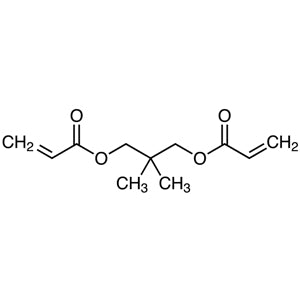
TCI N0790 Neopentyl Glycol Diacrylate (stabilized with MEHQ) is a difunctional acrylate monomer. Each molecule carries two acrylate groups attached to a neopentyl glycol backbone. In the laboratory it is used as a crosslinking agent in free-radical polymerization, whether the reaction is started by heat or by ultraviolet light. Because each molecule has two reactive double bonds, it can join two polymer chains at once and build a three-dimensional network. That network largely sets the hardness, chemical resistance, and dimensional stability of the cured material, which makes this monomer a common building block in polymer and materials research.
Researchers choose this crosslinker for its branched, compact neopentyl backbone. That structure helps produce a fairly rigid polymer network that holds up better against hydrolysis than some straight-chain diacrylates. The monomer also mixes readily with other acrylates and methacrylates, so formulators can adjust viscosity and crosslink density to suit the application. It is supplied with MEHQ (monomethyl ether of hydroquinone) as a stabilizer, which prevents spontaneous polymerization during storage. The monomer therefore stays stable until it is deliberately activated with an initiator, which makes experiments more reproducible.
In Indonesia, this material is used in university polymer and materials science laboratories, in research institutes, and in industrial R&D groups working on coatings, adhesives, inks, and UV-curable formulations. It is typically part of experiments on crosslinked networks, photopolymerization studies, and trial formulations where the network structure has to be controlled. As a TCI Non-Heterocyclic Building Block, it gives these laboratories a consistent, well-identified reagent for routine synthesis and for developing new polymer materials.
- UV-curing studies: the two acrylate groups react quickly under ultraviolet initiation, so it suits research on photopolymerized coatings, films, and cured resin systems.
- Thermal free-radical crosslinking: it acts as a difunctional crosslinker in heat-initiated polymerizations, linking polymer chains into a three-dimensional network with controllable density.
- Coating and adhesive formulation research: its compact neopentyl backbone gives rigid, hydrolysis-resistant networks, which suits trial formulations where chemical resistance and hardness matter.
- Viscosity and crosslink-density tuning: it blends readily with other acrylates and methacrylates, so formulators can adjust flow behaviour and network tightness in experimental resin mixtures.
- Polymer network and materials science teaching: as a well-defined difunctional monomer, it clearly shows how crosslinking affects the mechanical and chemical properties of polymers.
| Brand | TCI (product code N0790) |
|---|---|
| CAS number | 2223-82-7 |
| Molecular formula | — |
| Purity | — |
| Category | Chemistry > Building Blocks > Non-Heterocyclic Building Blocks |
| Pack sizes | as listed on the product page, following TCI availability |
| Physical form | — |
| Storage | keep cool and away from light, following the TCI label and Safety Data Sheet |
- Stabilizer: MEHQ (monomethyl ether of hydroquinone)
Store the monomer in its original, tightly closed TCI container in a cool, dry, well-ventilated area, away from direct sunlight, UV sources, heat, and ignition sources. Keep it separate from polymerization initiators, peroxides, strong oxidizers, and bases, since these can trigger unwanted polymerization. Follow the storage temperature on the label and Safety Data Sheet. Acrylate monomers can irritate the skin and eyes and may cause sensitization, so wear chemical-resistant gloves, safety glasses, and a lab coat, and handle the material in a fume hood. Avoid breathing vapours, clean up spills promptly, and dispose of waste according to local regulations.
—
Produk Terkait
-
TCI B5774 5,10-Bis(4,4,5,5-tetramethyl-1,3,2-dioxaborolan-2-yl)naphtho[1,2-c:5,6-c']bis([1,2,5]oxadiazole)
Regular price Rp 10.255.350,00Regular price -
Dihydroiodide TCI B6569
Regular price From Rp 1.936.200,00Regular price -
Trifluoromethanesulfonate TCI B7003
Regular price From Rp 1.936.200,00Regular price
![5,10-Bis(4,4,5,5-tetramethyl-1,3,2-dioxaborolan-2-yl)naphtho[1,2-c:5,6-c']bis([1,2,5]oxadiazole) - TCI B5774 - AMI Scientific](http://amiscientific.com/cdn/shop/files/TCI2510B5774.jpg?v=1769180228&width=533)