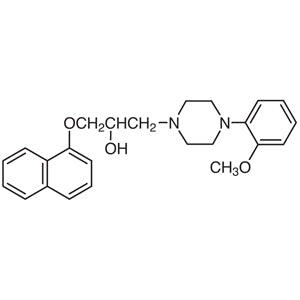
Naftopidil from TCI (catalogue number N0832, CAS 57149-07-2) is an arylpiperazine derivative known as an alpha-1 adrenergic receptor antagonist. Published literature reports that it has a relatively higher affinity for the alpha-1D subtype. In some countries, naftopidil is used clinically to manage lower urinary tract symptoms caused by benign prostatic enlargement. This TCI product, however, is supplied only as a pharmaceutical research reagent for experimental use and is not intended for therapeutic purposes. In the laboratory, naftopidil serves as a reference ligand and a pharmacological tool in adrenergic receptor studies.
Researchers choose naftopidil because its receptor subtype selectivity differs from that of other alpha-1 antagonists such as prazosin or tamsulosin. This makes it useful in comparative studies and in characterising receptor subtypes, where differences in binding behaviour between ligands help separate the contributions of individual subtypes. Its structure combines a naphthyloxy group, a propanol chain and a methoxyphenylpiperazine ring. This combination interests medicinal chemists who study structure-activity relationships of GPCR ligands. A number of publications have also looked at the effects of naftopidil on cell proliferation in cancer models, so its research uses are fairly broad.
In Indonesian laboratories, naftopidil is mainly relevant to university pharmacology and pharmacy departments, medicinal chemistry research groups and biomedical research institutes working on receptor pharmacology. It suits comparative in vitro studies alongside other alpha-1 antagonists, structure-activity investigations of arylpiperazine compounds and exploratory cell-based work in oncology research. As a TCI reagent in the Pharmaceutical Research Reagents (for Experimental Use) category, it helps local research teams run pharmacological experiments with a well-documented reference compound. It is for research use only and must not be used for human or veterinary treatment.
TCI brochures (PDF)
- Antimicrobials and Antitumor Agents for Research and Experimental Use 2025-04-24 · p. 19
- Pharmaceutical Ingredients for Research and Experimental Use 2026-03-09 · p. 19
- Alpha-1 adrenergic receptor studies: naftopidil is a known alpha-1 antagonist, so it works well as a reference ligand when characterising receptor binding and functional antagonism in experimental systems.
- Receptor subtype characterisation: literature reports a relatively higher affinity for the alpha-1D subtype, which makes naftopidil helpful for telling apart subtype-specific responses in pharmacological assays.
- Comparative antagonist profiling: its selectivity profile differs from prazosin and tamsulosin, so researchers can use it in head-to-head comparisons that bring out differences in subtype preference between alpha-1 antagonists.
- Structure-activity relationship research: the molecule combines naphthyloxy, propanol and methoxyphenylpiperazine groups, giving medicinal chemists a useful scaffold for studying how structure affects the activity of GPCR ligands.
- Cell proliferation studies in cancer models: several publications have examined naftopidil's effects on cell proliferation, so it can be included as a test compound in exploratory oncology research using cultured cell models.
| Brand | TCI (catalogue number N0832) |
|---|---|
| CAS number | 57149-07-2 |
| Molecular formula | — |
| Purity | — |
| Category | Life Science > Biochemicals and Reagents > Pharmaceutical Research Reagents (for Experimental Use) |
| Pack sizes | please confirm the available pack sizes with AMI Scientific before ordering |
| Physical form | refer to the TCI product label and Certificate of Analysis |
| Storage | follow the storage conditions stated on the TCI label and Safety Data Sheet |
Store naftopidil in its original, tightly closed container, following the storage conditions printed on the TCI label and in the Safety Data Sheet. As a general practice, keep it in a cool, dry, well-ventilated area, away from direct light, moisture and incompatible substances. Once opened, reseal the container promptly to limit moisture uptake. Handle the compound as a pharmacologically active substance: wear gloves, safety glasses and a lab coat, avoid creating dust, and do not inhale it or let it touch your skin. Weigh and prepare solutions in a fume hood or ventilated enclosure. Label all prepared solutions clearly, and dispose of waste according to local laboratory and environmental rules. This product is for research use only.
—
Product Categories
- Biochemicals and ReagentsPharmaceutical Research Reagents (for Experimental Use)Antitumor Research Reagents (for Experimental Use)
- Biochemicals and ReagentsPharmaceutical Research Reagents (for Experimental Use)Pharmaceutical Research Reagents (Others)
- Pharmaceutical Development and Drug Discovery ResearchPharmaceutical Research Reagents (for Experimental Use)Antitumor Research Reagents (for Experimental Use)
- Pharmaceutical Development and Drug Discovery ResearchPharmaceutical Research Reagents (for Experimental Use)Pharmaceutical Research Reagents (Others)
Produk Terkait
-
UlipristalAcetate TCI U0102
Regular price From Rp 5.062.050,00Regular price -
NoscapineHydrochloride TCI N0963
Regular price Rp 3.340.050,00Regular price -
Finasteride TCI F0675
Regular price From Rp 4.001.550,00Regular price -
Erlotinib TCI E1529
Regular price Rp 1.696.800,00Regular price -
CyproteroneAcetate TCI C2942
Regular price From Rp 2.518.950,00Regular price -
Ibudilast TCI I0740
Regular price From Rp 1.908.900,00Regular price -
Imiquimod TCI I0747
Regular price Rp 2.094.750,00Regular price -
Aminopterin TCI A0410
Regular price From Rp 1.829.100,00Regular price