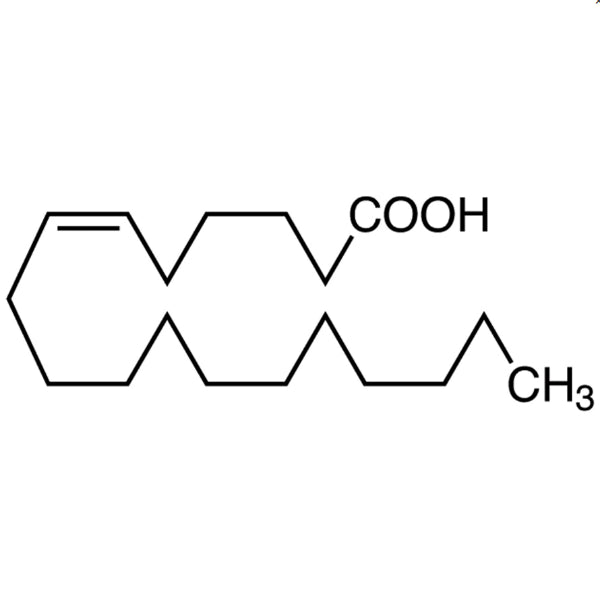
Petroselinic Acid is a monounsaturated fatty acid with an 18-carbon chain and a cis double bond at the sixth carbon position. It is a positional isomer of oleic acid and occurs naturally in the seed oils of plants in the Apiaceae family, such as coriander and parsley. In the laboratory, petroselinic acid is used as a research reagent for colloidal quantum dots, as a lipid reference material, and as a building block for synthesising oleochemical derivatives. This TCI product is supplied under the Colloidal Quantum Dot (QD) Research Reagents category.
Researchers choose petroselinic acid mainly because its double bond sits in a different position from the one in oleic acid. That difference changes the shape of the molecule, how tightly the chains pack, and how the molecule interacts with nanocrystal surfaces. As a result, researchers can compare how ligand structure affects colloidal stability and the optical properties of quantum dots. Its carboxyl group can coordinate with metal atoms on nanoparticle surfaces, so it works as a surface ligand. Oxidative cleavage of its double bond also gives different fragments from those of oleic acid, which is useful in oleochemical research.
In Indonesia, petroselinic acid is relevant to nanomaterials laboratories that develop quantum dots and perovskite nanocrystals. These groups often need several fatty acid ligands to study how chain structure affects particle behaviour. It is also useful in natural product chemistry laboratories that study seed oils, particularly oils from Apiaceae plants such as coriander and parsley. University research groups, materials science centres and analytical laboratories can use it as a reference compound in lipid characterisation work and as a starting material for exploring oleochemical derivatives.
- Colloidal quantum dot ligand studies: the carboxyl group coordinates with metal atoms on the nanocrystal surface, so the compound can be tested as a capping ligand that is structurally different from oleic acid.
- Ligand structure comparison research: because its double bond is at the sixth carbon, researchers can study how double-bond position affects chain packing, colloidal stability and the optical properties of quantum dots.
- Perovskite nanocrystal development: nanomaterial laboratories can use it as an alternative fatty acid ligand to see how ligand molecular shape influences nanocrystal surface interactions and dispersion behaviour.
- Lipid reference material: as a naturally occurring fatty acid found in Apiaceae seed oils, it can be used as a reference when identifying and characterising fatty acids in plant oil samples.
- Oleochemical derivative synthesis: oxidative cleavage of its double bond gives fragments different from those of oleic acid, which makes it a useful building block for oleochemical research.
| Brand | TCI (product code O0009) |
|---|---|
| CAS number | 593-39-5 |
| Molecular formula | — |
| Purity | — |
| Category | Materials Science > Electronic Materials > Colloidal Quantum Dot (QD) Research Reagents |
| Pack sizes | available in the manufacturer's standard pack sizes; please ask AMI Scientific for current options |
| Physical form | — |
| Storage | follow the storage conditions on the TCI product label and Safety Data Sheet |
- Chemical identity: monounsaturated C18 fatty acid with a cis double bond at the sixth carbon, a positional isomer of oleic acid
Store petroselinic acid in its original, tightly closed container in a cool, dry, well-ventilated area away from direct light and heat. Unsaturated fatty acids can oxidise at the double bond, so keep the container closed when not in use. For sensitive work, consider flushing opened containers with an inert gas. Keep it away from strong oxidising agents. When handling it, wear standard laboratory protection, including gloves, safety glasses and a lab coat, and avoid contact with skin and eyes. Use clean glass or compatible tools to prevent contamination. Always check the manufacturer's label and Safety Data Sheet for specific storage temperatures and hazard information before use.
—
Produk Terkait
-
TCI B5774 5,10-Bis(4,4,5,5-tetramethyl-1,3,2-dioxaborolan-2-yl)naphtho[1,2-c:5,6-c']bis([1,2,5]oxadiazole)
Regular price Rp 10.255.350,00Regular price -
Dihydroiodide TCI B6569
Regular price From Rp 1.936.200,00Regular price -
Trifluoromethanesulfonate TCI B7003
Regular price From Rp 1.936.200,00Regular price
![5,10-Bis(4,4,5,5-tetramethyl-1,3,2-dioxaborolan-2-yl)naphtho[1,2-c:5,6-c']bis([1,2,5]oxadiazole) - TCI B5774 - AMI Scientific](http://amiscientific.com/cdn/shop/files/TCI2510B5774.jpg?v=1769180228&width=533)