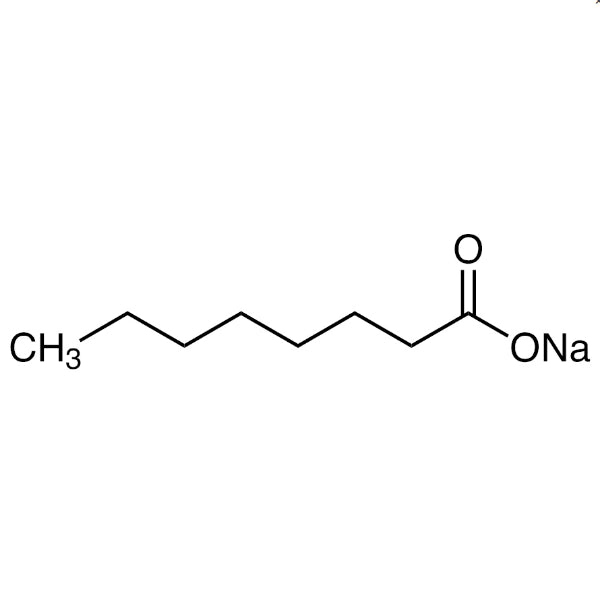
Sodium n-Octanoate, also known as sodium caprylate, is the sodium salt of n-octanoic acid. TCI supplies it under catalogue number O0034 and places it in its Life Science range of biochemicals and lipid reagents. It is a medium-chain fatty acid soap, which makes it amphiphilic: its hydrocarbon tail is hydrophobic and its carboxylate head is ionic. Because of this dual character, biochemistry and pharmaceutical laboratories use it widely as a mild anionic surfactant, as a protein-stabilising agent, and as a model compound for studying how lipids behave in solution.
A major reason researchers choose Sodium n-Octanoate is that it binds to proteins. The best-known example is serum albumin, and sodium caprylate has a long history of use as a stabiliser that protects albumin against heat. Its eight-carbon chain is short enough to make it more water-soluble than long-chain soaps, yet long enough to give it measurable surface activity. That balance makes it easy to work with in aqueous systems. It is also supplied as a solid, so it can be weighed accurately when preparing solutions of a defined concentration, which helps experiments stay reproducible from batch to batch.
In Indonesia, Sodium n-Octanoate is relevant to pharmaceutical laboratories researching protein formulations, to biotechnology laboratories working on protein purification and handling, and to university research groups studying surfactants and lipid behaviour in solution. It also suits teaching and research laboratories that need a well-characterised, medium-chain fatty acid salt as a reference or model compound. AMI Scientific supplies this TCI reagent to research institutions, quality control laboratories, and academic users across the country.
- Protein stabilisation studies: it binds to proteins such as serum albumin, so researchers use it to study and improve how well protein solutions hold up under heat stress.
- Mild anionic surfactant work: its amphiphilic structure gives it gentle surface activity, which suits experiments where harsher, long-chain detergents could disrupt sensitive biomolecules.
- Model compound for lipid behaviour: as a medium-chain fatty acid soap, it is a simple, well-defined system for studying how lipids self-associate and interact in aqueous solution.
- Pharmaceutical formulation research: its long use as an albumin stabiliser makes it a relevant reference excipient when laboratories assess protein-based formulations and their stability.
- Preparation of defined standard solutions: its solid form and good water solubility allow accurate weighing and reliable preparation of solutions at a specific concentration for repeatable experiments.
| Brand | TCI (catalogue number O0034) |
|---|---|
| CAS number | 1984-06-1 |
| Molecular formula | — |
| Purity | — |
| Category | Life Science > Biochemicals and Reagents > Lipids |
| Pack sizes | Available in TCI's standard pack sizes; please ask AMI Scientific which sizes are currently offered |
| Physical form | Solid |
| Storage | Keep in a tightly closed container in a cool, dry place; follow the TCI label and Safety Data Sheet |
Store Sodium n-Octanoate in its original, tightly sealed container in a cool, dry, well-ventilated area, away from moisture, direct sunlight, and incompatible substances such as strong oxidising agents and strong acids. Reseal the container promptly after use so the solid does not absorb humidity, which could affect weighing accuracy. Handle it using good laboratory practice: wear a lab coat, safety glasses, and gloves, avoid creating or breathing in dust, and avoid contact with skin and eyes. Use clean, dry spatulas and glassware when weighing. Always read the TCI Safety Data Sheet for full hazard information, the recommended storage conditions, first-aid measures, and disposal requirements before use.
—
Produk Terkait
-
TCI B5774 5,10-Bis(4,4,5,5-tetramethyl-1,3,2-dioxaborolan-2-yl)naphtho[1,2-c:5,6-c']bis([1,2,5]oxadiazole)
Regular price Rp 10.255.350,00Regular price -
Dihydroiodide TCI B6569
Regular price From Rp 1.936.200,00Regular price -
Trifluoromethanesulfonate TCI B7003
Regular price From Rp 1.936.200,00Regular price
![5,10-Bis(4,4,5,5-tetramethyl-1,3,2-dioxaborolan-2-yl)naphtho[1,2-c:5,6-c']bis([1,2,5]oxadiazole) - TCI B5774 - AMI Scientific](http://amiscientific.com/cdn/shop/files/TCI2510B5774.jpg?v=1769180228&width=533)