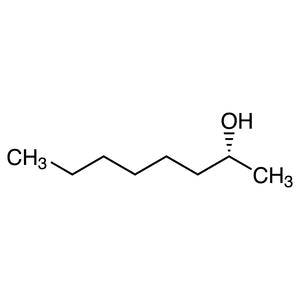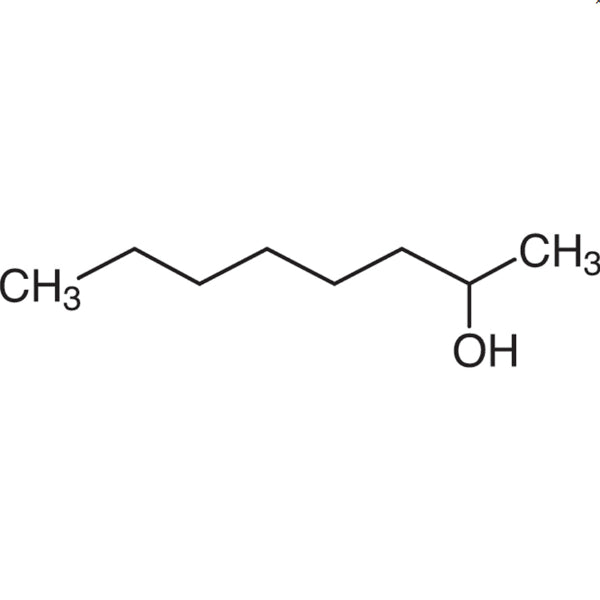
2-Octanol is a secondary alcohol with eight carbon atoms. Its hydroxyl group sits on the second carbon, which makes that carbon a chiral centre, so the compound often appears in studies of stereochemistry and enantiomer resolution. TCI supplies 2-Octanol as a non-heterocyclic building block for organic synthesis. Laboratories use it as a model substrate for secondary alcohol reactions, as a starting material for making 2-octanone, and as a precursor for branched ester and ether derivatives.
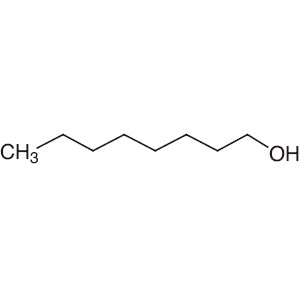
Researchers choose 2-Octanol because it behaves quite differently from its primary isomer, 1-octanol. It oxidises at a different rate, shows different selectivity in esterification, and has its own tendencies in elimination reactions. These differences make it a useful comparison compound in both teaching and research. Its chiral centre has made it a popular substrate for testing enzymatic kinetic resolution with lipases. Its fairly long hydrocarbon chain makes it lipophilic, so it is easy to work with in organic solvent systems where many biocatalytic and synthetic reactions take place.
In Indonesian laboratories, 2-Octanol is relevant to biocatalysis research groups developing local lipase enzymes. These groups can use it as a standard substrate to measure enzyme activity and enantioselectivity. Organic chemistry laboratories at universities and research institutes also use it to teach and study the reactions of secondary alcohols. Synthesis laboratories can use it as a practical starting material for ketones, esters and ethers when they need a medium-chain branched structure.
- Enzymatic kinetic resolution: 2-Octanol's chiral secondary carbon makes it a standard substrate for testing how well lipases tell its two enantiomers apart.
- Secondary alcohol model reactions: its well-defined secondary hydroxyl group lets researchers study oxidation, esterification and elimination and compare the results directly with 1-octanol.
- Synthesis of 2-octanone: oxidising the secondary hydroxyl group gives the corresponding ketone, so 2-Octanol is a convenient starting material for preparing 2-octanone.
- Preparation of branched esters and ethers: the hydroxyl group on the second carbon gives branched derivatives, which are useful when a synthesis needs a medium-chain, non-linear alkyl group.
- Stereochemistry teaching and research: its single chiral centre and simple structure make it a clear example for demonstrating enantiomers, optical activity and resolution methods to students.
| Brand | TCI (product code O0037) |
|---|---|
| CAS number | 123-96-6 |
| Molecular formula | — |
| Purity | — |
| Category | Chemistry > Building Blocks > Non-Heterocyclic Building Blocks |
| Pack sizes | available in TCI's standard pack sizes; please confirm current options with AMI Scientific |
| Physical form | liquid (secondary aliphatic alcohol) |
| Storage | keep tightly closed in a cool, dry, well-ventilated place; follow the TCI Safety Data Sheet |
Store 2-Octanol in its original tightly sealed container, or in a compatible glass container, in a cool, dry and well-ventilated area. Keep it away from heat, sparks, open flames and strong oxidising agents. Handle the compound in a fume hood or a well-ventilated workspace, and wear standard personal protective equipment, including chemical-resistant gloves, safety glasses and a lab coat. Avoid contact with skin and eyes, and do not breathe in the vapour. Label containers clearly, close them promptly after use, and dispose of waste according to local regulations. Always read the TCI Safety Data Sheet before use for full hazard and handling information.
—
Produk Terkait
-
8-Bromo-1-octanol TCI B1729
Regular price From Rp 3.525.900,00Regular price -
1-Octanol[forDeterminingPartitionCoefficients] TCI O0212
Regular price Rp 4.108.650,00Regular price -
4-Octanol TCI O0155
Regular price Rp 2.491.650,00Regular price -
3-Octanol TCI O0121
Regular price From Rp 1.140.300,00Regular price -
1-Octanol TCI O0036
Regular price From Rp 477.750,00Regular price -
8-Chloro-1-n-octanol TCI C2448
Regular price From Rp 1.246.350,00Regular price -
1H,1H,2H,2H-Tridecafluoro-1-n-octanol TCI T2528
Regular price From Rp 875.700,00Regular price -
(R)-(-)-2-Octanol TCI O0145
Regular price From Rp 3.155.250,00Regular price

![111-87-5 1-Octanol [for Determining Partition Coefficients] - AMI Scientific](http://amiscientific.com/cdn/shop/files/TCI2510O0212.jpg?v=1768362231&width=533)