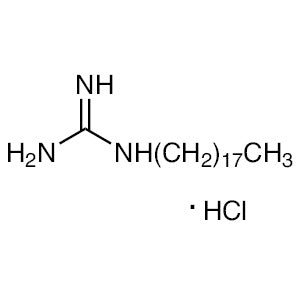
1-Octadecylguanidine Hydrochloride is a chemical compound widely used in pharmaceutical research and drug delivery system development. As a key reagent in the field of medicinal chemistry, it plays a vital role in the formulation of advanced drug delivery systems. Its unique molecular structure enables specific interactions with biological membranes and other cellular components, making it a valuable tool for researchers aiming to enhance drug efficacy and targeting. This compound is essential for the development of targeted therapies and controlled release formulations, supporting both fundamental research and applied pharmaceutical innovation.
The compound is preferred due to its chemical stability under controlled conditions and its ability to form complexes with other molecules in specific environments. These properties allow for precise control over molecular interactions, which is critical in the design of efficient drug delivery mechanisms. Additionally, its good solubility in organic solvents facilitates its use in synthesis processes and various laboratory applications. This solubility profile makes it an ideal choice for researchers who require reliable and consistent performance in experimental setups.
In Indonesian laboratories, 1-Octadecylguanidine Hydrochloride is commonly used in drug development projects, particularly in pharmaceutical and biotechnology research. Local researchers rely on this compound to study drug transport mechanisms and to develop innovative methods for improving drug delivery. Its availability and performance make it a standard component in many research protocols aimed at advancing therapeutic solutions.
Advantages (TCI brochure)
- Guanidine group specifically interacts with phosphate, carboxylate and sulfate groups
- Can be used to functionalize liposomes
TCI brochures (PDF)
- Arginine-Inspired Ligand Guanidine Lipid 2025-11-28 · p. 1
- Drug Delivery System (DDS) Research Reagents 2025-01-29 · p. 1
- Biomaterials Research Reagents 2025-02-19 · p. 32
- Drug Delivery System Development: This compound is used to create targeted drug delivery systems by interacting with cell membranes, enhancing the specificity and efficiency of drug release.
- Pharmaceutical Formulation Research: It supports the development of controlled release formulations, allowing for precise modulation of drug release profiles in various biological environments.
- Membrane Interaction Studies: Its ability to interact with biological membranes makes it ideal for studying membrane permeability and drug transport mechanisms.
- Biodistribution Analysis: It aids in understanding how drugs distribute within the body by mimicking the behavior of active pharmaceutical ingredients.
- Controlled Release Mechanism Optimization: Researchers use it to fine-tune the release kinetics of drug formulations, ensuring optimal therapeutic outcomes.
From the TCI brochure
- Molecular recognition between protein-protein and protein-nucleic acid interactions
- Functionalization of liposomes
| Brand | TCI |
|---|---|
| CAS number | 23604-21-9 |
| Molecular formula | — |
| Purity | — |
| Category | Chemistry > Pharmaceutical Development and Drug Discovery Research Reagents > Drug Delivery Systems (DDS) |
| Pack sizes | Available in various quantities as per standard laboratory supply formats |
| Physical form | Solid powder |
| Storage | Store in a cool, dry place away from moisture and direct sunlight |
Data from the TCI brochure
| Average Diameter | 124 nm (POPC/ODG (9:1) liposomes) |
|---|---|
| PDI | 0.20 (POPC/ODG (9:1) liposomes) |
| ζ potential | +54 mV (POPC/ODG (9:1) liposomes; kondisi pengukuran tidak disebutkan) |
Source: TCI brochure LL091 (2025-11-28)
This compound should be stored in a cool, dry environment to maintain its chemical stability. It is recommended to keep it in airtight containers to prevent moisture absorption, which could affect its performance. Due to its chemical nature, it should be handled with appropriate personal protective equipment, such as gloves and safety goggles, to ensure laboratory safety. Avoid exposure to high temperatures or direct sunlight, as these conditions may alter its properties. Proper labeling and storage conditions are essential to maintain its integrity and ensure safe use in research settings. Always follow standard laboratory safety protocols when working with this compound to minimize any potential risks.
References cited in the TCI brochure
- Mitsuhiko Onda. Molecular Recognition of Nucleotides by the Guanidinium Unit at the Surface of Aqueous Micelles and Bilayers. A Comparison of Microscopic and Macroscopic Interfaces Journal of the American Chemical Society, 1996. doi:10.1021/ja960991+
- Alexandros Pantos. Interactions of Complementary PEGylated Liposomes and Characterization of the Resulting Aggregates Langmuir, 2004. doi:10.1021/la040026u
- Nozomi Watanabe. Comparison of Physicochemical Membrane Properties of Vesicles Modified with Guanidinium Derivatives The Journal of Physical Chemistry B, 2017. doi:10.1021/acs.jpcb.7b04007
Product Categories
Produk Terkait
-
Cholesterol(stabilizedwithalpha-Tocopherol) TCI C0318
Regular price From Rp 1.378.650,00Regular priceRp 979.650,00Sale price From Rp 1.378.650,00 -
1,3-Di-o-tolylguanidine TCI D0953
Regular price From Rp 557.550,00Regular priceRp 405.300,00Sale price From Rp 557.550,00 -
1-Acetylguanidine TCI A3124
Regular price From Rp 1.351.350,00Regular priceRp 960.750,00Sale price From Rp 1.351.350,00 -
1-MethylguanidineSulfate TCI M1691
Regular price Rp 2.306.850,00Regular priceRp 1.628.550,00Sale price Rp 2.306.850,00 -
1-MethylguanidineHydrochloride TCI M0336
Regular price From Rp 1.458.450,00Regular priceRp 1.035.300,00Sale price From Rp 1.458.450,00