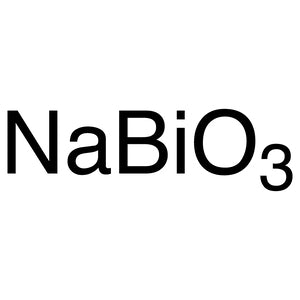
Sodium Bismuthate (NaBiO₃) is a chemical compound widely used in various chemical reactions, particularly in oxidation processes. It is commonly found in chemical laboratories as a reagent with strong oxidizing properties. This compound plays a crucial role in analytical and synthetic chemistry due to its ability to oxidize various substances under controlled conditions. Sodium Bismuthate is known for its chemical stability in specific environments, making it a reliable choice for multiple applications. Its unique reactivity and effectiveness in oxidation reactions make it a valuable tool for researchers and chemists working in both academic and industrial settings.
One of the key reasons sodium bismuthate is preferred is its strong oxidizing ability, which allows it to effectively oxidize ions such as Mn²⁺ to MnO₄⁻. This property is essential in quantitative chemical analysis, where accurate oxidation reactions are required. Additionally, sodium bismuthate has a complex crystalline structure and is available in solid form, which facilitates its use in laboratory experiments. Its low solubility in water also contributes to its practicality, as it can be easily handled in solid form without the need for extensive dissolution. These characteristics make it a versatile and efficient reagent in chemical laboratories.
In Indonesian laboratories, sodium bismuthate is commonly used in chemical research, including quantitative analysis, organic compound synthesis, and various oxidation reactions. It is a standard reagent in analytical chemistry, where its strong oxidizing properties are essential for accurate results. Its use in educational and research institutions across Indonesia highlights its importance in both teaching and experimental work. Sodium bismuthate is an essential component in the chemical toolkit of Indonesian laboratories, supporting a wide range of scientific investigations.
TCI brochures (PDF)
- Metallic Salts 2025-11-06 · p. 14
- Quantitative Analysis: Sodium bismuthate is ideal for quantitative analysis due to its strong oxidizing properties, enabling precise oxidation reactions for accurate measurement.
- Organic Synthesis: It is used in organic synthesis to oxidize specific functional groups, contributing to the formation of complex organic compounds.
- Oxidation Reactions: Its ability to oxidize ions like Mn²⁺ to MnO₄⁻ makes it suitable for various oxidation reactions in chemical experiments.
- Teaching Demonstrations: Sodium bismuthate is frequently used in teaching labs to demonstrate oxidation processes and chemical reactivity.
- Research Applications: It supports research in catalytic processes and inorganic chemistry, offering versatility in experimental setups.
| Brand | TCI |
|---|---|
| CAS number | 12232-99-4 |
| Molecular formula | — |
| Purity | — |
| Category | Chemistry > Catalysis and Inorganic Chemistry > Main-group Elements |
| Pack sizes | Available in various pack sizes for laboratory use |
| Physical form | Solid |
| Storage | Store in a cool, dry place away from moisture and acids |
Sodium bismuthate should be stored in a cool, dry place, away from moisture and acidic environments to maintain its stability. It is recommended to use airtight containers to prevent exposure to air and humidity. Due to its reactivity with water and acids, it should be handled with care, using appropriate personal protective equipment such as gloves and safety goggles. It is important to avoid contact with incompatible substances and ensure proper ventilation in the laboratory. Sodium bismuthate is a potent oxidizing agent, so it should be stored separately from reducing agents and flammable materials to prevent potential hazards. Proper storage and handling are essential to ensure the safety of laboratory personnel and the integrity of the chemical.
—
Produk Terkait
-
StrontiumChromate TCI T4156
Regular price From Rp 1.378.650,00Regular priceRp 963.900,00Sale price From Rp 1.378.650,00 -
SodiumSelenate TCI O0698
Regular price From Rp 1.696.800,00Regular priceRp 1.186.500,00Sale price From Rp 1.696.800,00 -
SodiumSelenite TCI O0697
Regular price From Rp 1.193.850,00Regular priceRp 834.750,00Sale price From Rp 1.193.850,00 -
LithiumNickelCobaltOxide(LiNi08Co02O2) TCI L0415
Regular price From Rp 1.829.100,00Regular priceRp 1.278.900,00Sale price From Rp 1.829.100,00 -
LithiumCobalt(III)Oxide TCI L0384
Regular price From Rp 1.829.100,00Regular priceRp 1.278.900,00Sale price From Rp 1.829.100,00 -
Bismuth(III)NitratePentahydrate TCI B7064
Regular price From Rp 505.050,00Regular priceRp 352.800,00Sale price From Rp 505.050,00 -
Bismuth(III)Sulfide TCI B6649
Regular price From Rp 2.332.050,00Regular priceRp 1.630.650,00Sale price From Rp 2.332.050,00 -
BismuthCarbonateOxide TCI B6578
Regular price From Rp 980.700,00Regular priceRp 701.400,00Sale price From Rp 980.700,00