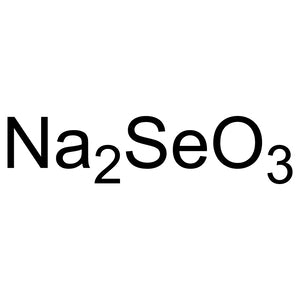
Sodium Selenite (Na₂SeO₃) is an inorganic compound widely used in various chemical experiments conducted in laboratories. It plays a crucial role in catalytic reactions and studies involving main-group elements. As a source of selenium, it is essential for chemical synthesis and redox reactions. Its unique chemical and crystalline structure makes it a valuable reagent in analytical and synthetic processes. Sodium Selenite is commonly found in laboratory settings where precise chemical reactions and material synthesis are required. Its versatility allows it to be applied in multiple scientific fields, including inorganic chemistry and catalysis.
The chemical properties of Sodium Selenite make it a preferred choice for laboratory use. It is chemically stable under certain conditions but highly reactive towards acids and alkali metals. Its corrosive nature and potential to cause skin and eye irritation require careful handling. Despite these challenges, its reactivity and chemical behavior make it ideal for redox reactions and the synthesis of complex compounds. Sodium Selenite’s ability to participate in various chemical transformations enhances its utility in both qualitative and quantitative analysis. Its reactivity also makes it suitable for experiments involving metal and non-metal properties.
In Indonesian laboratories, Sodium Selenite is extensively used in chemical research, particularly in catalysis and analytical studies. It is a common reagent in both academic and industrial settings where chemical synthesis and reactivity studies are conducted. Its application in qualitative and quantitative analysis supports a wide range of experimental needs. Sodium Selenite is also used in the study of metal and non-metal properties, contributing to the advancement of chemical research in Indonesia.
TCI brochures (PDF)
- Metallic Salts 2025-11-06 · p. 14
- Catalytic Reactions: Sodium Selenite is used in catalytic processes due to its ability to facilitate redox reactions and influence reaction pathways.
- Redox Studies: Its reactivity makes it ideal for experiments involving oxidation-reduction reactions, especially in the analysis of metal and non-metal properties.
- Chemical Synthesis: Sodium Selenite serves as a selenium source for the synthesis of complex compounds, supporting organic and inorganic chemistry research.
- Qualitative Analysis: It is employed in qualitative tests to detect the presence of specific ions and compounds in a sample.
- Quantitative Analysis: Its chemical properties allow for accurate measurement in quantitative experiments, aiding in the determination of selenium content in various samples.
| Brand | TCI |
|---|---|
| CAS number | 10102-18-8 |
| Molecular formula | — |
| Purity | — |
| Category | Chemistry > Catalysis and Inorganic Chemistry > Main-group Elements |
| Pack sizes | — |
| Physical form | — |
| Storage | Should be stored in a sealed container to prevent exposure to moisture and air. |
Sodium Selenite should be stored in a sealed container to prevent exposure to moisture and air, which can affect its stability. It is recommended to keep it in a cool, dry place away from direct sunlight and sources of heat. Due to its corrosive nature and potential to cause irritation, it should be handled with appropriate personal protective equipment, such as gloves and safety goggles. Storage should be in a well-ventilated area to minimize inhalation risks. Always ensure that the container is tightly closed to prevent contamination and maintain the integrity of the compound. Proper handling and storage are essential to ensure safety and effectiveness in laboratory applications.
—
Produk Terkait
-
SodiumSelenate TCI O0698
Regular price From Rp 1.696.800,00Regular priceRp 1.186.500,00Sale price From Rp 1.696.800,00 -
StrontiumChromate TCI T4156
Regular price From Rp 1.378.650,00Regular priceRp 963.900,00Sale price From Rp 1.378.650,00 -
SodiumBismuthate TCI O0643
Regular price From Rp 1.510.950,00Regular priceRp 1.056.300,00Sale price From Rp 1.510.950,00 -
LithiumNickelCobaltOxide(LiNi08Co02O2) TCI L0415
Regular price From Rp 1.829.100,00Regular priceRp 1.278.900,00Sale price From Rp 1.829.100,00 -
LithiumCobalt(III)Oxide TCI L0384
Regular price From Rp 1.829.100,00Regular priceRp 1.278.900,00Sale price From Rp 1.829.100,00 -
BariumChromate TCI B6568
Regular price Rp 848.400,00Regular priceRp 593.250,00Sale price Rp 848.400,00 -
ZincChromate TCI Z0061
Regular price From Rp 928.200,00Regular priceRp 648.900,00Sale price From Rp 928.200,00 -
PotassiumDichromate TCI P3156
Regular price From Rp 505.050,00Regular priceRp 352.800,00Sale price From Rp 505.050,00