

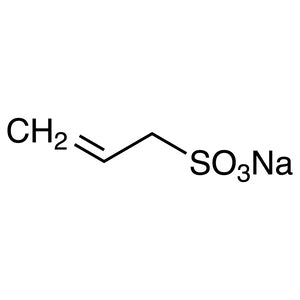
TCI O0690 Sodium Allylsulfonate is the sodium salt of allylsulfonic acid. Its small molecule carries two functional groups: a polymerizable allyl group and an ionic sulfonate group. In the laboratory it is mainly used as a functional monomer or comonomer to add sulfonate groups to polymer chains. It is also known in electrochemistry as an additive in metal plating solutions. These roles make sodium allylsulfonate a useful non-heterocyclic building block for research in polymers, materials, and surface science.
The sulfonate group makes the compound highly soluble in water and gives it a negative charge that stays in place across a wide pH range. Once built into a polymer, this group can make the material more hydrophilic, help with dispersion, and give cationic dyes somewhere to bind. The allyl group is usually less reactive than acrylates or other vinyl monomers and can take part in chain transfer. Researchers often use this behaviour to control the molecular weight of copolymers. Because it comes as a solid salt, it is also easier to weigh and store than the free acid.
In Indonesia, sodium allylsulfonate is relevant to university polymer chemistry groups, materials science laboratories, and industrial R&D teams working on water-soluble or hydrophilic polymers. It also suits electrochemistry and surface-finishing laboratories that study plating bath additives. Researchers who need a reliable sulfonate-bearing monomer for synthesis, formulation studies, or teaching can source this TCI building block through AMI Scientific and use it in both exploratory and routine experiments.
- Functional monomer in polymer synthesis: the allyl group can polymerize, so the compound adds ionic sulfonate groups directly into polymer chains during radical polymerization.
- Comonomer for hydrophilic copolymers: adding it to a copolymer makes the material more hydrophilic and helps it disperse, which matters for water-based and dispersant formulations.
- Molecular weight control in copolymerization: the allyl group is less reactive and can act in chain transfer, so researchers use it to help adjust copolymer molecular weight.
- Dye-receptive polymer modification: the sulfonate group's lasting negative charge gives cationic dyes binding sites, which suits research on dyeable fibres and modified polymer materials.
- Metal plating solution research: sodium allylsulfonate is known as an additive in metal plating solutions, so it suits electrochemistry and surface-finishing studies on bath composition.
| Brand | TCI (product code O0690) |
|---|---|
| CAS number | 2495-39-8 |
| Molecular formula | — |
| Purity | — |
| Category | Chemistry > Building Blocks > Non-Heterocyclic Building Blocks |
| Pack sizes | available in the pack sizes TCI offers for this product |
| Physical form | solid sodium salt |
| Storage | keep in a tightly closed container under the conditions given on the TCI label and safety data sheet |
Store sodium allylsulfonate in its original, tightly sealed container in a cool, dry, well-ventilated area, away from moisture, direct sunlight, and incompatible materials such as strong oxidizing agents. Reseal the container straight after each use so the solid stays in good condition, and follow any specific storage temperature printed on the TCI label. Handle the material with standard laboratory protective equipment, including safety glasses, gloves, and a lab coat. Avoid creating or breathing in dust, and weigh it in a well-ventilated area or under local exhaust. Wash your hands thoroughly after handling. Read the supplier's safety data sheet before use, and dispose of waste according to local regulations and your institution's procedures.
—
Produk Terkait
-
tert-Butylsulfonamide TCI B4347
Regular price Rp 1.776.600,00Regular price -
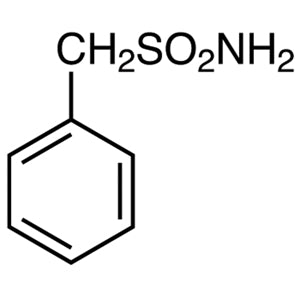
Benzylsulfonamide TCI B3466
Regular price Rp 2.889.600,00Regular price -
4-BiphenylsulfonylChloride TCI B2199
Regular price From Rp 1.485.750,00Regular price -
BenzylsulfonylFluoride TCI B1062
Regular price From Rp 1.405.950,00Regular price -
BenzylsulfonylChloride TCI B0441
Regular price From Rp 1.618.050,00Regular price -
MethylPhenylsulfonylacetate TCI P1353
Regular price From Rp 1.298.850,00Regular price -
EthylO-Mesitylsulfonylacetohydroxamate[PrecursorofthePowerfulAminatingReagent] TCI M1182
Regular price From Rp 980.700,00Regular price -
IsopropylsulfonylChloride TCI I0291
Regular price From Rp 1.405.950,00Regular price



![38202-27-6 Ethyl O-Mesitylsulfonylacetohydroxamate [Precursor of the Powerful Aminating Reagent] - AMI Scientific](http://amiscientific.com/cdn/shop/files/TCI2510M1182.jpg?v=1767124485&width=533)
