


Phenazine from TCI (product code P0082) is an aromatic heterocyclic compound built from three fused rings. Two of these rings contain nitrogen atoms that sit directly opposite each other. In organic chemistry laboratories it serves as a building block for more complex phenazine derivatives, such as dyes, coordination ligands, and model compounds for natural metabolites. Researchers in synthetic chemistry, materials chemistry, and natural product chemistry use it as a reliable starting point for a wide range of reaction routes.
The flat, fully conjugated phenazine framework makes this compound redox-active. Phenazine readily accepts and donates electrons, so it is often studied as an electron mediator and as a component of organic semiconductor materials. Both of its nitrogen atoms can bind metal ions, which also makes phenazine useful in coordination chemistry. The same framework appears in many natural antibiotics produced by bacteria, so its derivatives are relevant to biological and pharmaceutical research. Because purity is kept consistent from batch to batch, experimental results are easier to reproduce.
In Indonesia, phenazine is in steady demand in organic chemistry laboratories at universities and at materials research centres. Research groups use it in synthesis projects, electrochemistry studies, and student research on heterocyclic compounds. Laboratories that work with redox-active materials, metal complexes, or analogues of bacterial metabolites find it a practical, well-defined starting material. AMI Scientific supplies it as part of the TCI heterocyclic building block range for academic and industrial research users.
Related TCI products
- TCI D4492 655-86-7 Phenazine-2,3-diamine
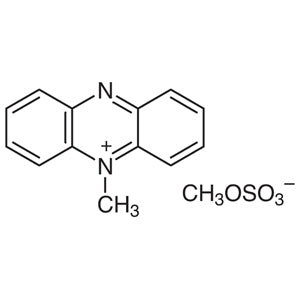
- TCI P1872 299-11-6 Phenazine Methyl Sulfate [for Biochemical Research]
- TCI P0083 299-11-6 Phenazine Methyl Sulfate
- TCI D6117 215-64-5 Dibenzo[a,c]phenazine
- TCI D6085 214-83-5 Diquinoxalino[2,3-a:2',3'-c]phenazine
- TCI D4379 19535-47-8 Dipyrido[3,2-a:2',3'-c]phenazine
- Synthesis of phenazine derivatives: the fused tricyclic core is a dependable scaffold for building dyes, functionalised heterocycles, and more complex target molecules through established reaction routes.
- Electron mediator studies: the redox-active, fully conjugated framework readily accepts and donates electrons, which makes it useful for electrochemical and electron-transfer research.
- Organic semiconductor research: its flat, conjugated structure makes phenazine a relevant component for studies of organic electronic materials and charge-transport behaviour in thin films.
- Coordination chemistry: the two opposing nitrogen atoms can bind metal ions, so phenazine works well as a ligand or ligand precursor for preparing and studying metal complexes.
- Natural product and pharmaceutical research: the phenazine framework occurs in bacterial antibiotics, so this compound suits the preparation of model compounds and analogues for biological studies.
| Brand | TCI (product code P0082) |
|---|---|
| CAS number | 92-82-0 |
| Molecular formula | — |
| Purity | refer to the TCI Certificate of Analysis for the supplied batch |
| Category | Chemistry > Building Blocks > Heterocyclic Building Blocks |
| Pack sizes | available in the TCI pack sizes listed on the product page |
| Physical form | — |
| Storage | keep tightly closed in a cool, dry, well-ventilated place away from light |
Store phenazine in its original, tightly sealed container in a cool, dry, well-ventilated area, protected from direct light and moisture. Keep it away from strong oxidising agents and incompatible chemicals. If you transfer the material, use clean, dry, clearly labelled glass or chemically resistant containers. Handle it in a fume hood or well-ventilated area, and wear suitable gloves, safety glasses, and a laboratory coat. Avoid creating dust, inhaling it, or letting it touch your skin or eyes. Before use, always read the TCI Safety Data Sheet for detailed hazard, first-aid, and disposal information, and dispose of waste according to local regulations.
—
Produk Terkait
-
Phenazine-2,3-diamine TCI D4492
Regular price From Rp 2.359.350,00Regular price -
PhenazineMethylSulfate[forBiochemicalResearch] TCI P1872
Regular price Rp 903.000,00Regular price -
PhenazineMethylSulfate TCI P0083
Regular price From Rp 795.900,00Regular price -
Dibenzo[a,c]phenazine TCI D6117
Regular price From Rp 2.889.600,00Regular price -
Diquinoxalino[2,3-a:2',3'-c]phenazine TCI D6085
Regular price From Rp 2.332.050,00Regular price -
Dipyrido[3,2-a:2',3'-c]phenazine TCI D4379
Regular price From Rp 1.881.600,00Regular price

![299-11-6 Phenazine Methyl Sulfate [for Biochemical Research] - AMI Scientific](http://amiscientific.com/cdn/shop/files/TCI2510P1872.jpg?v=1769057457&width=533)
![Dibenzo[a,c]phenazine (CAS 215-64-5) - TCI D6117 - AMI Scientific](http://amiscientific.com/cdn/shop/files/TCI2510D6117.jpg?v=1768818556&width=533)
![Diquinoxalino[2,3-a:2',3'-c]phenazine (CAS 214-83-5) - TCI D6085 - AMI Scientific](http://amiscientific.com/cdn/shop/files/TCI2510D6085.jpg?v=1769142164&width=533)
![Dipyrido[3,2-a:2',3'-c]phenazine (CAS 19535-47-8) - TCI D4379 - AMI Scientific](http://amiscientific.com/cdn/shop/files/TCI2510D4379.jpg?v=1767107483&width=533)