

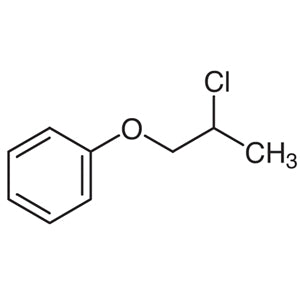
1-Phenoxy-2-chloropropane is a chemical compound widely used as a building block in the synthesis of complex organic compounds. It plays a crucial role in laboratory settings where organic chemists aim to create molecules with specific structural features. This compound is particularly valuable for its ability to participate in substitution and electrophilic reactions, making it a versatile tool in synthetic chemistry. Its chemical stability and controlled reactivity allow it to be used in a variety of experimental conditions, contributing to the development of both heterocyclic and non-heterocyclic compounds.
The compound’s molecular structure enables targeted substitution reactions, which is a key factor in its popularity among researchers. Its predictable behavior in chemical reactions ensures consistent results, making it a reliable choice for laboratory applications. The compound is also known for its compatibility with various reagents and solvents, which enhances its utility in different synthetic pathways. These properties make it an essential material for both academic and industrial research.
In Indonesian laboratories, 1-Phenoxy-2-chloropropane is commonly used in organic chemistry research, especially in pharmaceutical and materials science fields. Its solid form and ease of storage make it practical for routine use in experiments that require precise and consistent starting materials. It is a fundamental component in the development of new compounds and is frequently employed in both teaching and research environments.
- Synthesis of heterocyclic compounds requiring functional group reactivity due to its ability to undergo substitution reactions at specific positions.
- Electrophilic substitution reactions where its stable structure supports controlled chemical transformations in organic synthesis.
- Development of pharmaceutical compounds as a building block for creating complex molecular frameworks in drug design.
- Material science research for the creation of advanced polymers and functional materials through chemical modification.
- Teaching and experimental demonstrations in organic chemistry courses to illustrate substitution and electrophilic reaction mechanisms.
| Brand | TCI |
|---|---|
| CAS number | 53491-30-8 |
| Molecular formula | — |
| Purity | — |
| Category | Chemistry > Building Blocks > Non-Heterocyclic Building Blocks |
| Pack sizes | — |
| Physical form | Solid |
| Storage | Store in a cool, dry place away from light and moisture |
This compound should be stored in a cool, dry environment, away from direct sunlight and moisture to maintain its chemical stability. It is recommended to use airtight containers to prevent exposure to air and humidity, which could affect its integrity. Due to its chemical nature, it should be handled in a well-ventilated area, and appropriate personal protective equipment, such as gloves and safety goggles, should be worn. Avoid contact with incompatible substances, and ensure proper disposal according to local regulations. Regular monitoring of storage conditions is advised to ensure the compound remains suitable for use in laboratory applications.
—
Produk Terkait
-
3-Phenoxy-1-propanol TCI P2254
Regular price From Rp 1.193.850,00Regular price -
3-Phenoxy-1,2-propanediol TCI P1335
Regular price From Rp 3.287.550,00Regular price -
1-Phenoxy-2-propanol TCI P0118
Regular price From Rp 1.565.550,00Regular price -
1-(Dimethylamino)-3-[2-(3-methoxyphenethyl)phenoxy]-2-propanolHydrochloride TCI D4355
Regular price Rp 1.431.150,00Regular price -
3-ChloropropionaldehydeDimethylAcetal TCI C2458
Regular price From Rp 2.016.000,00Regular price -
2-Chloropropane TCI C0267
Regular price From Rp 505.050,00Regular price -
1-Chloropropane TCI C0266
Regular price From Rp 610.050,00Regular price -
1,1,1,3-Tetrachloropropane TCI T2426
Regular price Rp 1.856.400,00Regular price


![1-(Dimethylamino)-3-[2-(3-methoxyphenethyl)phenoxy]-2-propanol Hydrochloride (CAS 135261-74-4) - TCI D4355 - AMI Scientific](http://amiscientific.com/cdn/shop/files/TCI2510D4355.jpg?v=1768818078&width=533)


