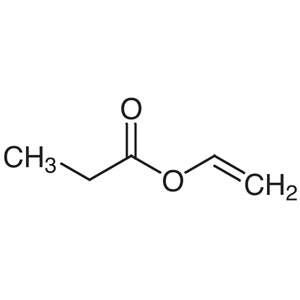
Vinyl Propionate (stabilized with MEHQ) from TCI, product code P0613, is the vinyl ester of propionic acid. It is a monomer that carries a vinyl double bond attached to the ester group. The product is stabilized with MEHQ (monomethyl ether of hydroquinone), an inhibitor that stops the monomer from polymerizing by itself during storage. In the laboratory, vinyl propionate is used as a monomer for making vinyl ester homopolymers and copolymers. It is also an effective acyl donor in enzyme-catalyzed transesterification reactions, so it serves both polymer research and synthetic chemistry.
Researchers choose this material because its vinyl group polymerizes readily by a free-radical mechanism. This lets it be copolymerized with other monomers, such as vinyl acetate, to adjust polymer properties like flexibility and water resistance. In biocatalysis, vinyl esters are valued because their acylation reactions are practically irreversible. The vinyl alcohol that is released immediately converts to acetaldehyde, which pushes the equilibrium toward the product. The propionyl chain is slightly longer than an acetyl group, so it gives researchers an alternative when they need a different acyl group or different enzyme selectivity.
In Indonesian laboratories, vinyl propionate is typically used in university polymer chemistry groups, materials science research centers, and organic synthesis laboratories. Polymer researchers use it to prepare vinyl ester polymers and to study how comonomer composition changes material behavior. Biocatalysis and pharmaceutical research teams use it as an acyl donor in lipase-catalyzed reactions, where an irreversible acylation makes reaction work-up and analysis simpler. Its well-defined identity under CAS 105-38-4 and its stabilized form also make it practical for teaching laboratories and for reproducible research projects.
- Vinyl ester homopolymer synthesis: the reactive vinyl double bond polymerizes readily through free-radical initiation, which makes it a straightforward monomer for preparing poly(vinyl propionate) in research settings.
- Copolymerization with vinyl acetate: combining vinyl propionate with vinyl acetate lets researchers adjust properties such as flexibility and water resistance by changing the ratio of comonomers.
- Enzyme-catalyzed transesterification: as a vinyl ester, it acts as an effective acyl donor whose acylation is practically irreversible, because the released vinyl alcohol converts to acetaldehyde.
- Alternative acyl group in biocatalysis: the propionyl chain is slightly longer than acetyl, giving researchers another option when a different acyl group or different enzyme selectivity is needed.
- Polymer structure–property studies: because it is a well-defined, stabilized monomer, it suits systematic experiments on how vinyl ester composition affects the final characteristics of a polymer material.
| Brand | TCI (product code P0613) |
|---|---|
| CAS number | 105-38-4 |
| Molecular formula | — |
| Purity | — |
| Category | Materials Science > Polymer/Macromolecule Reagents > Monomers |
| Pack sizes | please refer to the available options on the product listing |
| Physical form | liquid monomer, stabilized with MEHQ |
| Storage | keep tightly closed, away from heat and light, so that polymerization stays inhibited |
Store vinyl propionate in its original, tightly sealed container in a cool, dry, well-ventilated area, away from heat, sparks, open flames, and direct sunlight. The MEHQ stabilizer prevents polymerization during storage, but keeping the monomer cool and protected from light helps the inhibitor stay effective. Keep it away from oxidizing agents and free-radical initiators. Handle it in a fume hood and wear chemical-resistant gloves, safety glasses, and a lab coat. Avoid breathing the vapor and avoid contact with skin. Always read the supplier's Safety Data Sheet before use, and dispose of waste according to local regulations.
—
Produk Terkait
-
TCI B5774 5,10-Bis(4,4,5,5-tetramethyl-1,3,2-dioxaborolan-2-yl)naphtho[1,2-c:5,6-c']bis([1,2,5]oxadiazole)
Regular price Rp 10.255.350,00Regular price -
Dihydroiodide TCI B6569
Regular price From Rp 1.936.200,00Regular price -
Trifluoromethanesulfonate TCI B7003
Regular price From Rp 1.936.200,00Regular price
![5,10-Bis(4,4,5,5-tetramethyl-1,3,2-dioxaborolan-2-yl)naphtho[1,2-c:5,6-c']bis([1,2,5]oxadiazole) - TCI B5774 - AMI Scientific](http://amiscientific.com/cdn/shop/files/TCI2510B5774.jpg?v=1769180228&width=533)