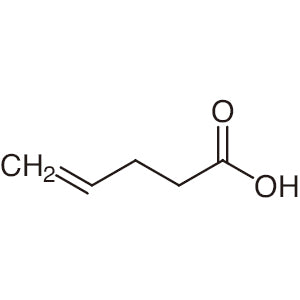
4-Pentenoic Acid from TCI (product code P0645) is a five-carbon carboxylic acid with a terminal double bond between carbons 4 and 5. Each molecule therefore carries two different functional groups: a carboxyl group and a terminal alkene. In organic chemistry laboratories it is a versatile non-heterocyclic building block. Chemists can use the two groups separately or together to build more complex molecules, including lactone rings and functional polymers, which makes it a useful intermediate in many synthetic routes.
Researchers choose 4-Pentenoic Acid because the distance between its carboxyl group and its double bond is ideal for cyclization reactions. The classic example is halolactonization, such as iodolactonization, which produces five-membered γ-lactones. The terminal double bond can also take part in thiol-ene reactions, olefin metathesis, hydroboration, and polymerization. The carboxyl group converts easily into esters or amides, so one compound gives access to many derivatives. In biochemistry, the compound is also known as an inhibitor of fatty acid oxidation in metabolic studies, which extends its value beyond synthesis.
In Indonesia, 4-Pentenoic Acid is useful for organic synthesis and polymer chemistry laboratories at universities, both for teaching practicals and for research projects. Students can use it to observe cyclization and functional group transformations in practice. Research groups developing new synthetic methods, functional materials, or metabolic studies can use it as a reliable starting material. Its well-defined structure and the TCI brand give consistent results for academic and industrial research laboratories across the country.
- Halolactonization and iodolactonization: the spacing between the carboxyl group and the terminal alkene favors ring closure, giving five-membered γ-lactones in a classic teaching and research reaction.
- Thiol-ene click chemistry: the terminal double bond reacts readily with thiols, so the acid can be used to attach carboxyl functionality to molecules, surfaces, or polymer chains.
- Olefin metathesis and hydroboration: the accessible terminal alkene suits these transformations, letting chemists extend carbon chains or add new functional groups while keeping the carboxyl group available.
- Ester and amide synthesis: the carboxyl group converts easily into esters or amides, creating alkene-bearing derivatives that can be modified further in multistep synthesis.
- Functional polymers and metabolic studies: the alkene allows polymerization into functional materials, and the compound is also known in biochemistry as an inhibitor of fatty acid oxidation.
| Brand | TCI (product code P0645) |
|---|---|
| CAS number | 591-80-0 |
| Molecular formula | — |
| Purity | see the TCI certificate of analysis and safety data sheet for this lot |
| Category | Chemistry > Building Blocks > Non-Heterocyclic Building Blocks |
| Pack sizes | available in the pack sizes offered by TCI; please confirm the size when ordering |
| Physical form | — |
| Storage | follow the storage conditions on the TCI label and safety data sheet |
Store 4-Pentenoic Acid in its original tightly closed container in a cool, dry, well-ventilated area, away from heat, ignition sources, and direct sunlight. Keep it apart from strong oxidizing agents and strong bases. Use containers made of compatible materials such as glass, and label any transferred portions clearly. As a carboxylic acid, it may irritate the skin, eyes, and respiratory tract, so handle it in a fume hood and wear chemical-resistant gloves, safety glasses, and a laboratory coat. Read the TCI safety data sheet before use and dispose of waste according to local regulations.
—
Produk Terkait
-
TCI B5774 5,10-Bis(4,4,5,5-tetramethyl-1,3,2-dioxaborolan-2-yl)naphtho[1,2-c:5,6-c']bis([1,2,5]oxadiazole)
Regular price Rp 10.255.350,00Regular price -
Dihydroiodide TCI B6569
Regular price From Rp 1.936.200,00Regular price -
Trifluoromethanesulfonate TCI B7003
Regular price From Rp 1.936.200,00Regular price
![5,10-Bis(4,4,5,5-tetramethyl-1,3,2-dioxaborolan-2-yl)naphtho[1,2-c:5,6-c']bis([1,2,5]oxadiazole) - TCI B5774 - AMI Scientific](http://amiscientific.com/cdn/shop/files/TCI2510B5774.jpg?v=1769180228&width=533)