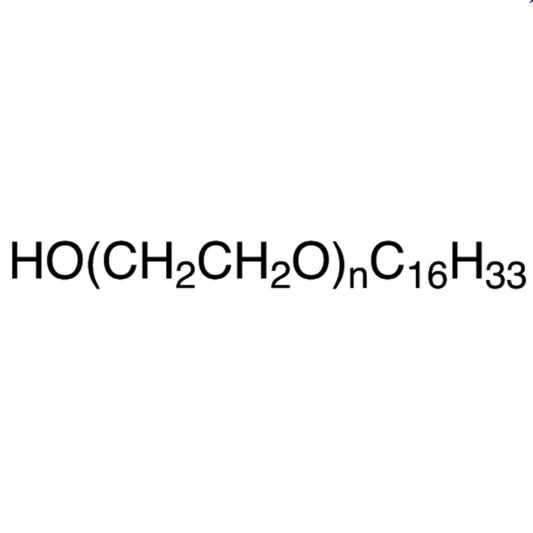
Polyethylene Glycol Monooleyl Ether (n=approx 2), with CAS number 9004-98-2, is a chemical compound widely used in laboratory settings related to materials science and chemistry. This non-ionic surfactant plays a crucial role in reducing interfacial tension between two immiscible phases, such as water and oil. Its unique molecular structure enables it to act as a versatile additive in various formulations, enhancing the stability and solubility of complex chemical systems. As a key component in polymer science, it is frequently utilized in experiments that require controlled surface interactions or emulsification processes.
The properties of Polyethylene Glycol Monooleyl Ether make it a preferred choice for laboratory applications. Its balanced hydrophilic and hydrophobic characteristics allow it to function effectively as an emulsifier, stabilizer, and solvent. The molecule consists of a polyethylene glycol chain attached to an oleyl group, which contributes to its ability to modify surface properties and improve compatibility between different substances. This dual functionality makes it suitable for a wide range of experimental setups, from polymer synthesis to formulation development.
In Indonesian laboratories, Polyethylene Glycol Monooleyl Ether is commonly used in research related to material science, industrial chemistry, and chemical product development. Its stability and availability make it a reliable choice for both academic and industrial research. The compound is particularly valuable in experiments involving polymer modification, emulsion preparation, and the creation of stable chemical formulations. Its role in enhancing the performance of various chemical systems underscores its importance in the scientific community.
TCI brochures (PDF)
- Polymer Additives 2026-04-16 · p. 13
Related TCI products
- TCI P3064 9005-00-9 Polyethylene Glycol Monostearyl Ether (n=approx. 20)
- TCI P2885 9005-08-7 Polyethylene Glycol Distearate (n=approx. 10)
- TCI P0873 9002-93-1 Polyethylene Glycol Mono-4-octylphenyl Ether (n=approx. 10)
- TCI P0872 9004-81-3 Polyethylene Glycol Monolaurate (n=approx. 10)
- TCI P0841 9004-95-9 Polyethylene Glycol Monocetyl Ether (n=approx. 23)
- TCI P0723 9004-99-3 Polyethylene Glycol Monostearate (n=approx. 55) (palmitate and stearate mixture)
- Polymer synthesis and modification experiments benefit from its ability to stabilize emulsions and improve polymer dispersion.
- Emulsion formulation processes require surfactants that can reduce interfacial tension, making this compound ideal for creating stable oil-in-water emulsions.
- Surface modification studies often use this material to alter the hydrophobicity or hydrophilicity of surfaces, enhancing their functional properties.
- Chemical product development projects utilize its dual functionality as both a stabilizer and a solubilizing agent to improve formulation performance.
- Stability testing of chemical mixtures relies on its capacity to maintain phase integrity and prevent separation in multi-component systems.
| Brand | TCI |
|---|---|
| CAS number | 9004-98-2 |
| Molecular formula | — |
| Purity | — |
| Category | Materials Science > Polymer/Macromolecule Reagents > Polymer Additives |
| Pack sizes | Available in various quantities as per supplier specifications |
| Physical form | Liquid or powder, depending on the formulation |
| Storage | Store in a cool, dry place away from direct sunlight and moisture |
This compound should be stored in a cool, dry environment, away from direct sunlight and moisture to maintain its chemical integrity. It is recommended to use airtight containers to prevent exposure to air and humidity, which could affect its performance. In laboratory settings, proper personal protective equipment (PPE) such as gloves and safety goggles should be worn when handling the material to ensure safe usage. While it is generally stable under normal storage conditions, it should be kept away from incompatible substances to avoid any potential chemical interactions. Regular inspection of storage conditions is advised to ensure the material remains in optimal condition for use in experiments.
—
Product Categories
Produk Terkait
-
PolyethyleneGlycolMonostearylEther(n=approx.20) TCI P3064
Regular price From Rp 505.050,00Regular priceRp 352.800,00Sale price From Rp 505.050,00 -
PolyethyleneGlycolDistearate(n=approx.10) TCI P2885
Regular price Rp 1.220.100,00Regular priceRp 852.600,00Sale price Rp 1.220.100,00 -
PolyethyleneGlycolMono-4-octylphenylEther(n=approx.10) TCI P0873
Regular price From Rp 610.050,00Regular priceRp 442.050,00Sale price From Rp 610.050,00 -
PolyethyleneGlycolMonolaurate(n=approx.10) TCI P0872
Regular price From Rp 530.250,00Regular priceRp 386.400,00Sale price From Rp 530.250,00 -
PolyethyleneGlycolMonocetylEther(n=approx.23) TCI P0841
Regular price From Rp 477.750,00Regular priceRp 333.900,00Sale price From Rp 477.750,00 -
PolyethyleneGlycolMonostearate(n=approx.55)(palmitateandstearatemixture) TCI P0723
Regular price From Rp 477.750,00Regular priceRp 333.900,00Sale price From Rp 477.750,00 -
PolyethyleneGlycolMonostearate(n=approx.45)(palmitateandstearatemixture) TCI P0722
Regular price From Rp 477.750,00Regular priceRp 333.900,00Sale price From Rp 477.750,00 -
PolyethyleneGlycolMonostearate(n=approx.40)(palmitateandstearatemixture) TCI P0721
Regular price From Rp 477.750,00Regular priceRp 333.900,00Sale price From Rp 477.750,00