3-(2-Pyridyl)-5,6-bis(4-sulfophenyl)-1,2,4-triazine Disodium Salt is a complex chemical compound widely used in catalytic reactions and organic synthesis. As a nitrogen-donor ligand, it plays a crucial role in the formation of transition metal complexes, enhancing the efficiency and selectivity of various chemical processes. This compound is particularly valuable in laboratory settings where precise control over reaction conditions is essential. Its unique molecular structure, incorporating sulfonate and pyridine groups, contributes to its reactivity and stability in diverse chemical environments.
The compound’s high reactivity and stability make it a preferred choice for researchers working in catalysis and inorganic chemistry. The presence of sulfonate groups provides additional stability under specific conditions, while the pyridine moiety enhances its ability to coordinate with transition metals. These properties make it an ideal ligand for applications requiring metal binding and catalytic activity. Its versatility allows it to be used in a wide range of synthetic pathways, making it a valuable tool for both academic and industrial research.
In Indonesian laboratories, this compound is extensively used in organic chemistry and catalysis research. It is commonly employed in the synthesis of complex heterocyclic compounds and in the development of new catalysts. Many research institutions and universities in Indonesia rely on this material for experimental studies aimed at advancing chemical synthesis techniques and understanding reaction mechanisms. Its reliability and effectiveness have made it a standard component in many laboratory protocols.
TCI brochures (PDF)
- Titration Reagents and TLC Stains 2026-05-07 · p. 9
Related TCI products
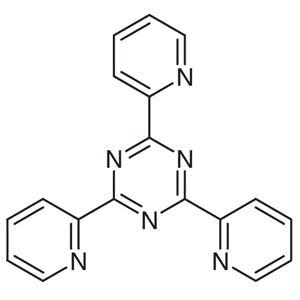
- TCI T0530 3682-35-7 2,4,6-Tri(2-pyridyl)-1,3,5-triazine
- TCI T1937 42333-78-8 2,4,6-Tri(4-pyridyl)-1,3,5-triazine (purified by sublimation)
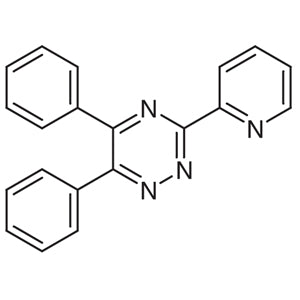
- TCI D1201 1046-56-6 5,6-Diphenyl-3-(2-pyridyl)-1,2,4-triazine
- TCI D0604 23647-14-5 Trisodium 2-(4-Sulfophenylazo)-1,8-dihydroxynaphthalene-3,6-disulfonate
- TCI B4104 117408-98-7 (S)-4-tert-Butyl-2-(2-pyridyl)oxazoline
- TCI A5020 105250-49-5 Oxo[5,10,15,20-tetra(4-pyridyl)porphyrinato]titanium(IV) [Determination of Glucose in Serum and Urine]
- Organic synthesis of complex heterocyclic compounds due to its ability to form stable transition metal complexes and enhance reaction efficiency.
- Catalytic reactions requiring nitrogen-donor ligands to improve selectivity and yield in industrial and academic settings.
- Development of new catalysts through coordination with transition metals, enabling more efficient and sustainable chemical processes.
- Structural studies of molecular compounds where precise ligand-metal interactions are essential for understanding reaction mechanisms.
- Research in inorganic chemistry focused on the behavior of nitrogen-donor ligands in various chemical environments.
| Brand | TCI |
|---|---|
| CAS number | 28048-33-1 |
| Molecular formula | — |
| Purity | — |
| Category | Chemistry > Catalysis and Inorganic Chemistry > Nitrogen-Donor Ligands [Catalysis] |
| Pack sizes | Available in various quantities as per standard laboratory supply options |
| Physical form | Solid powder |
| Storage | Store in a cool, dry place away from moisture and direct sunlight |
This compound should be stored in a cool, dry environment to maintain its chemical integrity and prevent degradation. It is recommended to use airtight containers made of materials such as glass or polyethylene to minimize exposure to moisture and air. Due to its reactivity, it should be handled with care using appropriate personal protective equipment, including gloves and safety goggles. Avoid contact with strong acids or bases to prevent unwanted chemical reactions. Keep it away from heat sources and ensure proper ventilation in the laboratory to maintain a safe working environment. Regular monitoring of storage conditions is advised to ensure long-term stability and usability.
—
Product Categories
Produk Terkait
-
2,4,6-Tri(2-pyridyl)-1,3,5-triazine TCI T0530
Regular price From Rp 984.000,00Regular priceRp 686.000,00Sale price From Rp 984.000,00 -
2,4,6-Tri(4-pyridyl)-1,3,5-triazine(purifiedbysublimation) TCI T1937
Regular price From Rp 1.971.000,00Regular priceRp 1.356.000,00Sale price From Rp 1.971.000,00 -
5,6-Diphenyl-3-(2-pyridyl)-1,2,4-triazine TCI D1201
Regular price Rp 881.000,00Regular priceRp 615.000,00Sale price Rp 881.000,00 -
Trisodium2-(4-Sulfophenylazo)-1,8-dihydroxynaphthalene-3,6-disulfonate TCI D0604
Regular price Rp 1.272.000,00Regular priceRp 865.000,00Sale price Rp 1.272.000,00 -
(S)-4-tert-Butyl-2-(2-pyridyl)oxazoline TCI B4104
Regular price From Rp 4.200.000,00Regular priceRp 2.874.000,00Sale price From Rp 4.200.000,00 -
Oxo[5,10,15,20-tetra(4-pyridyl)porphyrinato]titanium(IV)[DeterminationofGlucoseinSerumandUrine] TCI A5020
Regular price Rp 15.769.000,00Regular priceRp 10.745.000,00Sale price Rp 15.769.000,00 -
2-(2-Pyridyl)indole TCI P2142
Regular price Rp 3.164.000,00Regular priceRp 2.168.000,00Sale price Rp 3.164.000,00 -
2-(2-Pyridyl)benzoxazole TCI P2098
Regular price Rp 1.452.000,00Regular priceRp 1.003.000,00Sale price Rp 1.452.000,00