


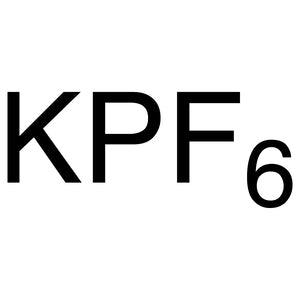
Potassium Hexafluorophosphate from TCI (product code P1023) is an inorganic salt made up of potassium cations and hexafluorophosphate anions (PF6−). Its main use in the laboratory is as a convenient source of the PF6− anion. Because PF6− is a weakly coordinating anion, chemists use KPF6 to precipitate or isolate cationic metal complexes, to prepare ionic liquids, and to make organic salts for electrochemistry and catalysis. It is a standard reagent in inorganic and coordination chemistry.
Chemists choose KPF6 because the PF6− anion is large, carries a single charge, and barely interacts with metal centres. This means the cation in solution keeps its own chemical behaviour. The PF6− salts of organic cations and metal complexes also tend to crystallise more easily than the matching halide salts. They usually dissolve better in organic solvents too. These traits make purification by anion exchange (metathesis) much easier. In battery research, hexafluorophosphate salts are widely studied as electrolyte salts, including for potassium-ion battery systems. This gives the compound a clear role in energy materials work as well.
In Indonesia, KPF6 is useful to university and research institute laboratories that work in inorganic and coordination chemistry, electrochemistry, and energy materials. Researchers use it to make cationic complexes, such as ruthenium complexes, and then isolate them as stable, easy-to-handle PF6− salts. Electrochemistry groups use it to prepare salts and electrolytes for their experiments. Teams developing battery materials can use KPF6 when they study electrolyte salts for potassium-ion systems and related energy storage technologies.
TCI brochures (PDF)
- Battery Research Reagents 2026-09-18 · p. 3
- Metallic Salts 2025-11-06 · p. 8
Related TCI products
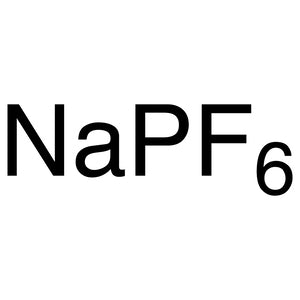
- TCI S0392 21324-39-0 Sodium Hexafluorophosphate
- TCI L0146 21324-40-3 Lithium Hexafluorophosphate
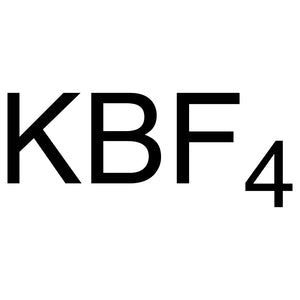
- TCI P2565 14075-53-7 Potassium Tetrafluoroborate
- TCI P2410 860653-59-4 Potassium (Fluorosulfonyl)(trifluoromethanesulfonyl)imide
- TCI S0981 26042-63-7 Silver Hexafluorophosphate
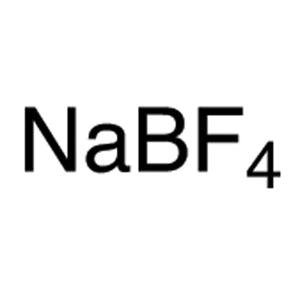
- TCI O0494 13755-29-8 Sodium Tetrafluoroborate
- Precipitating cationic metal complexes: the weakly coordinating PF6− anion lets researchers isolate cationic complexes as solid salts while the metal centre keeps its native behaviour in solution.
- Anion exchange (metathesis): swapping halide counter-ions for PF6− often gives salts that crystallise more readily and dissolve better in organic solvents, which makes purification simpler.
- Preparing ionic liquids: KPF6 is a practical source of PF6− for converting organic halide salts into hexafluorophosphate ionic liquids for solvent and materials studies.
- Electrochemistry: organic and metal-complex PF6− salts prepared with KPF6 work well in electrochemical studies because the anion is large, singly charged, and interacts very little with the species being studied.
- Battery and energy materials research: hexafluorophosphate salts are widely studied as electrolyte salts, and KPF6 is relevant for research on potassium-ion battery systems.
| Brand | TCI (product code P1023) |
|---|---|
| CAS number | 17084-13-8 |
| Molecular formula | — |
| Purity | — |
| Category | Chemistry > Catalysis and Inorganic Chemistry > Main-group Elements |
| Pack sizes | see the current TCI product listing for available pack sizes |
| Physical form | solid inorganic salt |
| Storage | keep tightly closed in a cool, dry place, away from moisture and incompatible materials |
Store Potassium Hexafluorophosphate in its original, tightly closed container in a cool, dry, well-ventilated area. Protect it from moisture and keep it away from strong acids and other incompatible substances. Once a container is opened, reseal it promptly after each use. Glass or chemically resistant plastic containers with secure caps are suitable. Handle the material in a fume hood or a well-ventilated area, and avoid creating or breathing in dust. Wear standard personal protective equipment, including safety glasses, chemical-resistant gloves, and a laboratory coat. Avoid contact with skin and eyes. Always read the supplier's Safety Data Sheet before use for detailed hazard, first-aid, and disposal information. Dispose of waste according to local regulations.
—
Product Categories
- Catalysis and Inorganic ChemistryMain-group Elements [Catalysis and Inorganic Chemistry]Potassium [Catalysis and Inorganic Chemistry]
- Catalysis and Inorganic ChemistryMetallic Salts [Catalysis and Inorganic Chemistry]Hexafluorophosphate Salts [Metallic Salts]
- Synthetic ReagentsInorganic Salts [Synthetic Reagents]
Produk Terkait
-
SodiumHexafluorophosphate TCI S0392
Regular price Rp 2.121.000,00Regular priceRp 1.482.600,00Sale price Rp 2.121.000,00 -
LithiumHexafluorophosphate TCI L0146
Regular price From Rp 2.227.050,00Regular priceRp 1.557.150,00Sale price From Rp 2.227.050,00 -
PotassiumTetrafluoroborate TCI P2565
Regular price From Rp 610.050,00Regular priceRp 426.300,00Sale price From Rp 610.050,00 -
Potassium(Fluorosulfonyl)(trifluoromethanesulfonyl)imide TCI P2410
Regular price From Rp 2.041.200,00Regular priceRp 1.442.700,00Sale price From Rp 2.041.200,00 -
SilverHexafluorophosphate TCI S0981
Regular price From Rp 1.829.100,00Regular priceRp 1.278.900,00Sale price From Rp 1.829.100,00 -
SodiumTetrafluoroborate TCI O0494
Regular price From Rp 505.050,00Regular priceRp 352.800,00Sale price From Rp 505.050,00 -
Zinc(II)Trifluoromethanesulfonate[forElectrolyte] TCI Z0057-5G
Regular price Rp 1.326.150,00Regular priceRp 927.150,00Sale price Rp 1.326.150,00 -
PotassiumBis(trifluoromethanesulfonyl)imide TCI B2543
Regular price From Rp 717.150,00Regular priceRp 516.600,00Sale price From Rp 717.150,00





![54010-75-2 Zinc(II) Trifluoromethanesulfonate [for Electrolyte] - AMI Scientific](http://amiscientific.com/cdn/shop/files/TCI2510Z0057_9ad4d559-5f76-4c77-b1e0-21de52a28b66.jpg?v=1769181390&width=533)

