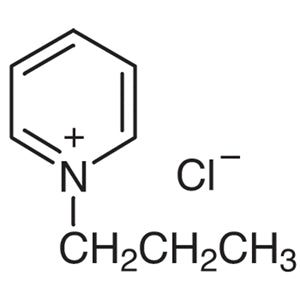
1-Propylpyridinium Chloride from TCI is a quaternary pyridinium salt. Its pyridinium cation carries a propyl group on the nitrogen atom, and its counter-anion is chloride. The compound belongs to the ionic liquids category within specialty synthesis. This group of organic salts has relatively low melting points and is studied as alternative solvents and reaction media. In the laboratory it serves as a research material for ionic liquid studies, as a precursor for preparing pyridinium salts with other anions, and as an organic electrolyte in electrochemical studies.
Pyridinium salts of this type have very low vapour pressure and good thermal stability. They can dissolve a range of polar compounds as well as some organic compounds. The length of the alkyl chain on the nitrogen affects melting point, viscosity, and solubility. This makes the propyl derivative useful as one member of a homologous series in structure–property relationship studies. The chloride anion can be exchanged for other anions, such as tetrafluoroborate or bis(trifluoromethylsulfonyl)imide, through metathesis. Researchers can use this exchange to tune the physicochemical properties of the resulting salt for a specific purpose.
In Indonesian laboratories, ionic liquid research is carried out mainly in university chemistry departments, research institutes, and industrial R&D groups working on green chemistry and alternative solvent systems. Researchers there use 1-Propylpyridinium Chloride as a starting salt for synthesising new ionic liquids, as a reference compound in comparative studies, and as an electrolyte component in electrochemical experiments. Because it comes from TCI, a recognised reagent brand, groups that need traceable material for publications and theses can rely on consistent quality from batch to batch.
- Ionic liquid research: the compound is a simple quaternary pyridinium salt, so it works well as a model ionic liquid for studying solvent behaviour, thermal stability, and dissolution of polar compounds.
- Anion metathesis precursor: the exchangeable chloride anion lets researchers prepare pyridinium salts with tetrafluoroborate, bis(trifluoromethylsulfonyl)imide, or other anions to obtain tailored physicochemical properties.
- Electrochemical studies: as an organic salt with low vapour pressure, it can serve as an organic electrolyte component when investigating conductivity and electrochemical behaviour in non-conventional media.
- Structure–property relationship studies: the propyl chain makes it a useful member of an alkylpyridinium homologous series for comparing how chain length affects melting point, viscosity, and solubility.
- Alternative reaction media: its low volatility and good thermal stability suit exploratory work on replacing volatile organic solvents in synthesis, in line with green chemistry approaches.
| Brand | TCI (product code P1393) |
|---|---|
| CAS number | 23271-47-8 |
| Molecular formula | — |
| Purity | — |
| Category | Chemistry > Specialty Synthesis > Ionic Liquids [Specialty Synthesis] |
| Pack sizes | TCI standard pack sizes; please confirm availability when enquiring |
| Physical form | — |
| Storage | keep tightly closed in a cool, dry place; refer to the TCI SDS for specific conditions |
- Chemical class: quaternary pyridinium salt (N-propylpyridinium cation, chloride anion)
Store 1-Propylpyridinium Chloride in its original tightly sealed container, in a cool, dry, well-ventilated area away from direct sunlight and incompatible materials. Many ionic liquid salts with chloride anions take up moisture from the air, so reclose containers promptly after use. Storing them under dry or inert conditions helps preserve their quality. When handling, wear standard laboratory protective equipment, including gloves, safety glasses, and a lab coat. Avoid dust formation, inhalation, and contact with skin and eyes. Always consult the Safety Data Sheet supplied by TCI for detailed hazard information, first-aid measures, and disposal requirements before use.
—
Produk Terkait
-
TCI B5774 5,10-Bis(4,4,5,5-tetramethyl-1,3,2-dioxaborolan-2-yl)naphtho[1,2-c:5,6-c']bis([1,2,5]oxadiazole)
Regular price Rp 10.255.350,00Regular price -
Dihydroiodide TCI B6569
Regular price From Rp 1.936.200,00Regular price -
Trifluoromethanesulfonate TCI B7003
Regular price From Rp 1.936.200,00Regular price
![5,10-Bis(4,4,5,5-tetramethyl-1,3,2-dioxaborolan-2-yl)naphtho[1,2-c:5,6-c']bis([1,2,5]oxadiazole) - TCI B5774 - AMI Scientific](http://amiscientific.com/cdn/shop/files/TCI2510B5774.jpg?v=1769180228&width=533)