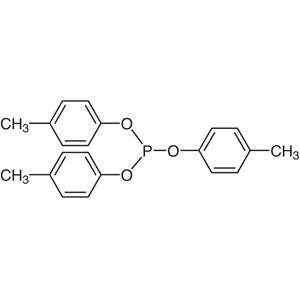
Tri-o-tolyl Phosphite from TCI (product code P1416, CAS 2622-08-4) is a triaryl phosphite ester. Its trivalent phosphorus atom is bonded through oxygen to three o-tolyl rings, which are benzene rings carrying a methyl group in the ortho position. In the TCI catalogue, it is listed among the phosphorus compounds for catalysis and inorganic chemistry. In the laboratory, it serves as a ligand for transition metals in homogeneous catalyst complexes. It is also used as a trivalent phosphorus reagent in organic synthesis and polymer chemistry.
Researchers choose this compound for its steric and electronic properties. The ortho methyl groups on all three aryl rings make the ligand fairly bulky around the phosphorus atom. The P–O bonds make it a stronger π-acceptor ligand than trialkyl or triaryl phosphines. Together, these features affect how many ligands bind to the metal centre, how fast they dissociate, and how selective the reaction is. This is why bulky triaryl phosphites are widely studied in rhodium-catalysed hydroformylation and in nickel- and palladium-catalysed reactions. Aryl phosphites are also known as secondary antioxidants that decompose hydroperoxides.
In Indonesia, Tri-o-tolyl Phosphite is relevant to research groups in inorganic and organometallic chemistry that synthesise and study transition-metal complexes for homogeneous catalysis. University chemistry departments, research institutes and industrial R&D laboratories can use it to compare how ligands perform, to explore steric and electronic effects in catalytic reactions, and to study phosphite chemistry in polymer stabilisation. Its catalogue grade from TCI helps make results reproducible from one experiment to the next.
TCI brochures (PDF)
- Polymer Additives 2026-04-16 · p. 9
- Ligands 2025-12-01 · p. 8
Related TCI products
- Homogeneous catalysis ligand: the bulky o-tolyl groups and π-acceptor P–O bonds let researchers adjust how ligands bind to transition metals and how selective catalytic reactions are.
- Rhodium-catalysed hydroformylation research: bulky triaryl phosphites are widely studied in this reaction because their steric and electronic profile affects activity and selectivity.
- Nickel- and palladium-catalysed reactions: the ligand's bulk and π-acceptor character affect how many ligands bind and how fast they dissociate, which makes it useful for studying reaction mechanisms and screening ligands.
- Trivalent phosphorus reagent in organic synthesis: the phosphite ester gives synthetic chemists a source of trivalent phosphorus for reactions that need phosphorus(III) reactivity.
- Polymer chemistry and antioxidant studies: aryl phosphites are known secondary antioxidants that decompose hydroperoxides, so this compound suits research on polymer stabilisation and oxidation.
| Brand | TCI (product code P1416) |
|---|---|
| CAS number | 2622-08-4 |
| Molecular formula | — |
| Purity | — |
| Category | Chemistry > Catalysis and Inorganic Chemistry > Phosphorous Compounds |
| Pack sizes | see the available options on the product listing |
| Physical form | — |
| Storage | follow the conditions on the TCI label and Safety Data Sheet |
- Chemical class: triaryl phosphite ester (trivalent phosphorus bonded through oxygen to three o-tolyl rings)
Keep Tri-o-tolyl Phosphite in its original tightly closed TCI container in a cool, dry, well-ventilated place, away from heat, direct sunlight and oxidising agents. Trivalent phosphorus compounds can slowly oxidise or hydrolyse when exposed to air and moisture, so reseal the container promptly after each use. Store it under inert gas if your laboratory procedures require this. Wear gloves, safety glasses and a lab coat, and handle the material in a fume hood. Avoid skin contact and do not inhale vapours or dust. Always read the TCI Safety Data Sheet before use, and dispose of waste according to local regulations.
—
Produk Terkait
-
Tri-p-tolylPhosphite TCI P1175
Regular price From Rp 980.700,00Regular priceRp 685.650,00Sale price From Rp 980.700,00 -
Tris(1,1,1,3,3,3-hexafluoro-2-propyl)Phosphite TCI T3353
Regular price From Rp 3.367.350,00Regular priceRp 2.354.100,00Sale price From Rp 3.367.350,00 -
TriphenylPhosphite TCI T0510
Regular price From Rp 530.250,00Regular priceRp 370.650,00Sale price From Rp 530.250,00 -
TributylPhosphite TCI T0362
Regular price From Rp 903.000,00Regular priceRp 631.050,00Sale price From Rp 903.000,00 -
Tris(2,4-di-tert-butylphenyl)Phosphite TCI P1421
Regular price From Rp 477.750,00Regular priceRp 333.900,00Sale price From Rp 477.750,00 -
TrihexylPhosphite TCI P1260
Regular price From Rp 1.378.650,00Regular priceRp 963.900,00Sale price From Rp 1.378.650,00 -
TriisodecylPhosphite(mixtureofisomers) TCI T0420
Regular price From Rp 795.900,00Regular priceRp 556.500,00Sale price From Rp 795.900,00 -
Tris(2-ethylhexyl)Phosphite TCI P1169
Regular price From Rp 1.035.300,00Regular priceRp 723.450,00Sale price From Rp 1.035.300,00