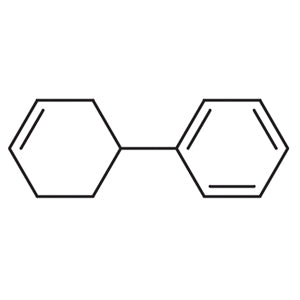
4-Phenyl-1-cyclohexene from TCI is a hydrocarbon made of a cyclohexene ring with a single phenyl substituent at the 4-position. It combines a reactive, non-aromatic C=C double bond with a relatively stable benzene ring. In the laboratory it serves as a non-heterocyclic building block for phenylcyclohexane frameworks and as a model substrate in alkene reaction studies. It is also known in environmental research as one of the volatile organic compounds that can be released from latex-backed carpet materials.
The compound's main appeal is that it carries two distinct functional regions in one molecule. The double bond in the cyclohexene ring can undergo epoxidation, hydrogenation, dihydroxylation, hydroboration, or oxidative cleavage, while the phenyl ring generally stays intact under those conditions. This difference in reactivity lets chemists modify the aliphatic part selectively. The phenyl group also acts as a chromophore, so reactions are easy to follow with UV detectors in chromatography. Plain cyclohexene lacks this advantage.
In Indonesian laboratories, 4-Phenyl-1-cyclohexene is useful for university organic chemistry research groups, synthesis laboratories that build substituted cyclohexane scaffolds, and teaching labs that demonstrate selective alkene transformations. Environmental and indoor-air research groups may also use it as a reference compound when studying volatile organic emissions from flooring and carpet materials. Because it comes from TCI, a well-known brand, researchers can work with a consistent, clearly identified material for routine experiments and method development.
Related TCI products
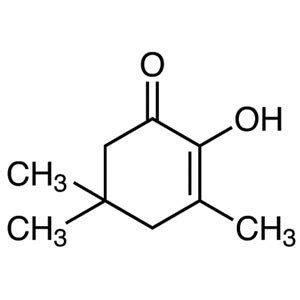
- TCI T2723 4883-60-7 2-Hydroxy-3,5,5-trimethyl-2-cyclohexen-1-one
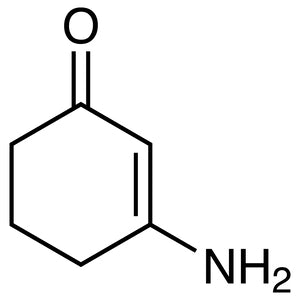
- TCI A1936 5220-49-5 3-Amino-2-cyclohexen-1-one
- TCI A1300 873-95-0 3-Amino-5,5-dimethyl-2-cyclohexen-1-one
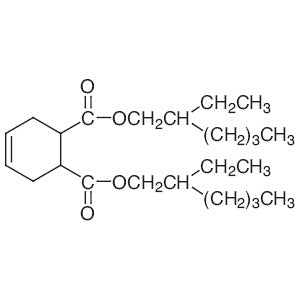
- TCI T0605 2915-49-3 Bis(2-ethylhexyl) 4-Cyclohexene-1,2-dicarboxylate
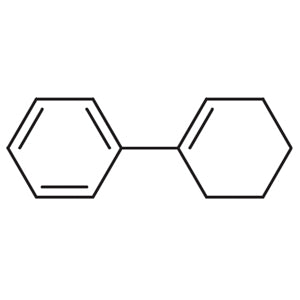
- TCI P1302 771-98-2 1-Phenyl-1-cyclohexene
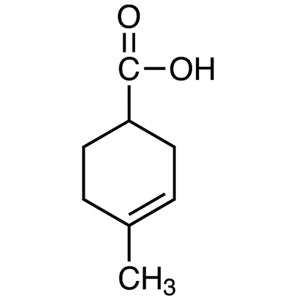
- TCI M2492 4342-60-3 4-Methyl-3-cyclohexene-1-carboxylic Acid
- Building phenylcyclohexane frameworks: the cyclohexene ring with a fixed phenyl group at the 4-position provides a ready starting skeleton for constructing substituted phenylcyclohexane derivatives.
- Model substrate for alkene reaction studies: its single, accessible C=C double bond makes it a clear test substrate for comparing epoxidation, hydrogenation, dihydroxylation, and hydroboration conditions.
- Selective modification of aliphatic rings: the phenyl ring generally stays intact while the double bond reacts, so chemists can transform the aliphatic portion without disturbing the aromatic ring.
- Oxidative cleavage experiments: the ring double bond can be cleaved oxidatively, giving researchers a way to open the cyclohexene ring and access chain-extended phenyl-containing products.
- Chromatographic reaction monitoring and VOC research: the phenyl chromophore allows convenient UV detection during chromatography, and its link to latex-backed carpet emissions supports indoor-air VOC studies.
| Brand | TCI (product code P1445) |
|---|---|
| CAS number | 4994-16-5 |
| Molecular formula | — |
| Purity | — |
| Category | Chemistry > Building Blocks > Non-Heterocyclic Building Blocks |
| Pack sizes | available in TCI's standard pack sizes; please confirm when you inquire |
| Physical form | liquid at room temperature |
| Storage | keep tightly closed in a cool, dry, well-ventilated place away from heat and oxidizers |
Store 4-Phenyl-1-cyclohexene in its original, tightly sealed TCI container in a cool, dry, well-ventilated area, away from heat, sparks, open flames, and strong oxidizing agents. Like other alkenes, it can slowly oxidize when exposed to air and light, so minimize headspace and limit how often the container is opened. If you transfer it, use clean glass containers with chemically resistant closures. Handle it in a fume hood while wearing gloves, safety glasses, and a lab coat, and avoid inhaling vapors or getting it on your skin. Always follow the current Safety Data Sheet supplied with the product for specific hazard and disposal guidance.
—
Produk Terkait
-
2-Hydroxy-3,5,5-trimethyl-2-cyclohexen-1-one TCI T2723
Regular price Rp 1.273.650,00Regular price -
3-Amino-2-cyclohexen-1-one TCI A1936
Regular price From Rp 1.510.950,00Regular price -
3-Amino-5,5-dimethyl-2-cyclohexen-1-one TCI A1300
Regular price From Rp 1.458.450,00Regular price -
Bis(2-ethylhexyl)4-Cyclohexene-1,2-dicarboxylate TCI T0605
Regular price From Rp 477.750,00Regular price -
1-Phenyl-1-cyclohexene TCI P1302
Regular price From Rp 1.298.850,00Regular price -
4-Methyl-3-cyclohexene-1-carboxylicAcid TCI M2492
Regular price From Rp 2.121.000,00Regular price -
3-Methoxycyclohexene TCI M2455
Regular price Rp 4.133.850,00Regular price -
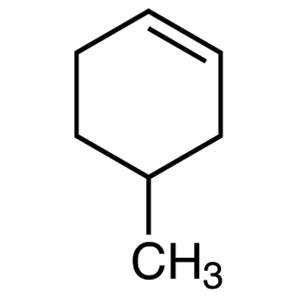
4-Methyl-1-cyclohexene TCI M2201
Regular price From Rp 1.538.250,00Regular price