


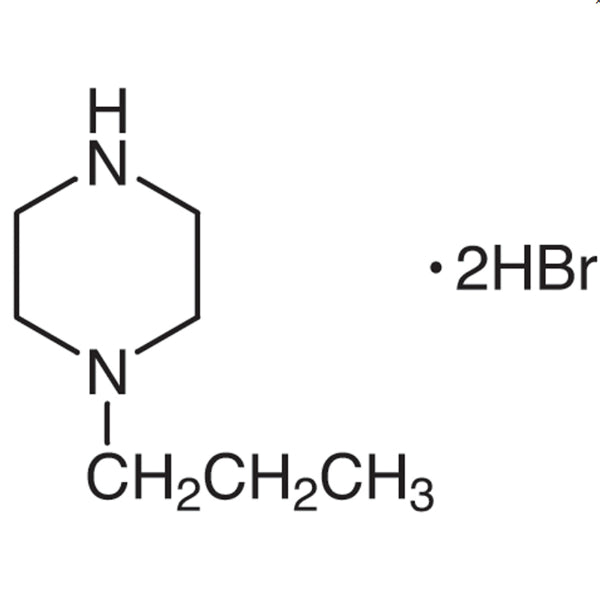
1-Propylpiperazine Dihydrobromide is a chemical compound widely used in laboratory settings for the synthesis of heterocyclic compounds and their derivatives. As a key building block in organic chemistry, it plays a crucial role in the development of new molecules with specific biological or chemical properties. This compound is commonly utilized in research laboratories for its ability to participate in various chemical reactions, making it an essential reagent for synthetic pathways. Its versatility allows chemists to create complex molecular structures with high precision and efficiency.
The compound is valued for its stable molecular structure and good reactivity, which enable it to interact effectively with a range of reagents. These properties make it a preferred choice for synthetic chemists looking to develop novel compounds. Its solubility in organic solvents further enhances its utility in laboratory processes, facilitating purification and isolation steps. This combination of stability and reactivity ensures that it remains a reliable and efficient tool in chemical synthesis.
In Indonesian laboratories, 1-Propylpiperazine Dihydrobromide is frequently used in research related to pharmaceutical development, industrial chemical production, and environmental studies. Its consistent performance and predictable behavior make it a trusted material for experiments requiring accuracy and reproducibility. Researchers rely on this compound for its role in creating complex chemical structures and exploring new applications in various scientific fields.
- Pharmaceutical research for the synthesis of bioactive compounds due to its reactivity and structural versatility.
- Organic chemistry experiments where heterocyclic compound synthesis is required for drug development and molecular design.
- Industrial chemical production processes that involve the creation of complex organic molecules with specific functional groups.
- Environmental analysis applications where organic compound synthesis is needed for pollutant detection and remediation studies.
- Academic research projects focused on exploring new chemical reactions and molecular structures in heterocyclic chemistry.
| Brand | TCI |
|---|---|
| CAS number | 64262-23-3 |
| Molecular formula | — |
| Purity | — |
| Category | Chemistry > Building Blocks > Heterocyclic Building Blocks |
| Pack sizes | Available in various quantities as per standard laboratory supply options |
| Physical form | Solid powder |
| Storage | Store in a cool, dry place away from moisture and direct sunlight |
This compound should be stored in a cool, dry environment to maintain its stability and prevent degradation. It is recommended to use airtight containers to protect it from moisture and air exposure. Due to its chemical nature, it should be handled with appropriate personal protective equipment, such as gloves and safety goggles. Proper ventilation is essential when working with this material to minimize inhalation risks. It should be kept away from incompatible substances to avoid potential chemical reactions. Regular inspection of storage conditions ensures the compound remains in optimal condition for laboratory use.
—
Produk Terkait
-
1-Isopropylpiperazine TCI I0745
Regular price From Rp 1.724.100,00Regular price -
1-Cyclopropylpiperazine TCI C2794
Regular price Rp 3.683.400,00Regular price -
1-Butylpiperazine TCI B4078
Regular price From Rp 1.565.550,00Regular price -
1-Allylpiperazine TCI A3172
Regular price From Rp 2.518.950,00Regular price -
1-Ethylpiperazine TCI E0355
Regular price From Rp 637.350,00Regular price -
tert-Butyl3-Ethylpiperazine-1-carboxylate TCI D6422
Regular price From Rp 1.485.750,00Regular price -
PiperazineDihydrobromide TCI P2490
Regular price From Rp 980.700,00Regular price -
HydrazineDihydrobromide TCI H0169
Regular price From Rp 557.550,00Regular price


