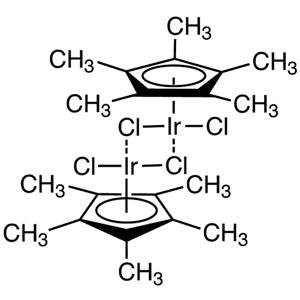
Pentamethylcyclopentadienyl Iridium(III) Dichloride Dimer is a chemical compound widely used in catalytic reactions, particularly in C-H activation processes. This material plays a crucial role in laboratory settings where efficient and selective catalytic systems are required. It is a key component in the field of organometallic chemistry, enabling the transformation of complex organic molecules through precise and controlled reactions. Its unique structure allows it to interact effectively with various substrates, making it a valuable tool for researchers working in both inorganic and organic chemistry.
The compound is known for its high catalytic efficiency and stability under a range of reaction conditions. Its ability to activate C-H bonds makes it particularly useful in reactions that require high selectivity and activity. The molecular structure of this dimer contributes to its effectiveness as a catalyst, allowing it to facilitate complex chemical transformations with minimal side reactions. Additionally, its chemical stability ensures that it remains active and reliable throughout the duration of the reaction process.
In Indonesian laboratories, this compound is commonly used in research focused on organic chemistry, catalysis, and the synthesis of complex compounds. It is a preferred choice for scientists and researchers who are working on developing more sustainable and efficient catalytic methods. Its application is widespread in academic and industrial research settings, supporting advancements in chemical synthesis and process optimization.
TCI brochures (PDF)
- C-H Bond Activation Reaction 2025-06-20 · p. 5
- Transition Metal Catalysts 2026-04-10 · p. 11
Related TCI products
- TCI T2557 15635-87-7 Tris(2,4-pentanedionato)iridium(III)
- TCI C2985 12246-51-4 Chlorobis(cyclooctene)iridium(I) Dimer
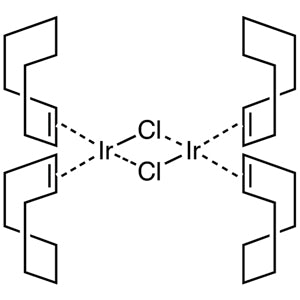
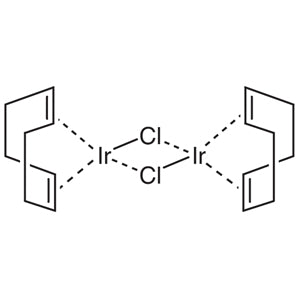
- TCI C1807 12112-67-3 Chloro(1,5-cyclooctadiene)iridium(I) Dimer
- TCI A2981 12154-84-6 (Acetylacetonato)(1,5-cyclooctadiene)iridium(I)
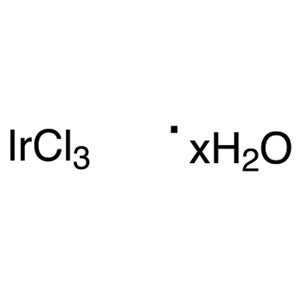
- TCI I0616 14996-61-3 Iridium(III) Chloride Hydrate
- TCI D5817 870987-63-6 (4,4'-Di-tert-butyl-2,2'-bipyridine)bis[3,5-difluoro-2-[5-trifluoromethyl-2-pyridinyl-kappaN)phenyl-kappaC]iridium(III) Hexafluorophosphate
- C-H Activation Reactions: This compound is ideal for C-H activation due to its ability to efficiently break and re-form carbon-hydrogen bonds, enabling selective functionalization of organic substrates.
- Organic Synthesis: It is widely used in the synthesis of complex organic molecules, where precise control over reaction pathways is essential.
- Catalytic Oxidation Processes: The compound’s catalytic properties make it suitable for oxidation reactions, where it facilitates the conversion of substrates with high efficiency.
- Substitution Reactions: Its role in substitution reactions is critical, allowing for the replacement of functional groups in a controlled and selective manner.
- Environmental Chemistry Research: It supports the development of greener and more sustainable catalytic methods, aligning with modern environmental research goals.
| Brand | TCI |
|---|---|
| CAS number | 12354-84-6 |
| Molecular formula | — |
| Purity | — |
| Category | Chemistry > Catalysis and Inorganic Chemistry > C-H Activation [Catalysis] |
| Pack sizes | Available in various quantities as per supplier specifications |
| Physical form | Solid (as a dimer) |
| Storage | Store in a cool, dry place away from moisture and direct sunlight |
This compound should be stored in a cool, dry environment to maintain its stability and catalytic activity. It is recommended to keep it in a sealed container to prevent exposure to moisture and air, which could degrade its properties. Due to its chemical nature, it should be handled with care, using appropriate personal protective equipment such as gloves and safety goggles. It is important to ensure that the storage area is well-ventilated to minimize any potential risks associated with its handling. Proper labeling of containers is essential to ensure safe access and usage in a laboratory setting. Always follow standard laboratory safety protocols when working with this material.
—
Product Categories
- Catalysis and Inorganic ChemistryC-H Activation [Catalysis]Iridium Compounds [C-H Activation]
- Catalysis and Inorganic ChemistryTransition Elements [Catalysis and Inorganic Chemistry]Iridium [Catalysis and Inorganic Chemistry]
- Synthetic ReagentsC-X(Non-Halogen) Bond Formation [Synthetic Reagents]C-H Bond Activation Reaction [Synthetic Reagents]
Produk Terkait
-
Tris(2,4-pentanedionato)iridium(III) TCI T2557
Regular price Rp 10.652.250,00Regular priceRp 7.464.450,00Sale price Rp 10.652.250,00 -
Chlorobis(cyclooctene)iridium(I)Dimer TCI C2985
Regular price Rp 3.207.750,00Regular priceRp 2.258.550,00Sale price Rp 3.207.750,00 -
Chloro(1,5-cyclooctadiene)iridium(I)Dimer TCI C1807
Regular price From Rp 3.074.400,00Regular priceRp 2.165.100,00Sale price From Rp 3.074.400,00 -
(Acetylacetonato)(1,5-cyclooctadiene)iridium(I) TCI A2981
Regular price From Rp 1.988.700,00Regular priceRp 1.405.950,00Sale price From Rp 1.988.700,00 -
Iridium(III)ChlorideHydrate TCI I0616
Regular price From Rp 8.558.550,00Regular priceRp 6.000.750,00Sale price From Rp 8.558.550,00 -
(4,4'-Di-tert-butyl-2,2'-bipyridine)bis[3,5-difluoro-2-[5-trifluoromethyl-2-pyridinyl-kappaN)phenyl-kappaC]iridium(III)Hexafluorophosphate TCI D5817
Regular price From Rp 3.763.200,00Regular priceRp 2.647.050,00Sale price From Rp 3.763.200,00 -
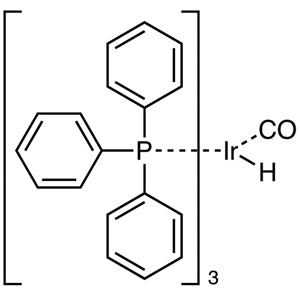
Carbonylhydridotris(triphenylphosphine)iridium(I) TCI C3040
Regular price From Rp 2.464.350,00Regular priceRp 1.738.800,00Sale price From Rp 2.464.350,00 -
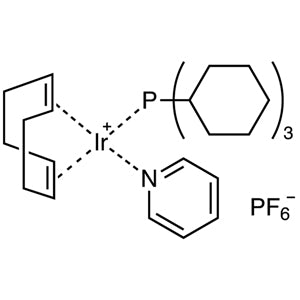
(1,5-Cyclooctadiene)(pyridine)(tricyclohexylphosphine)iridium(I)Hexafluorophosphate TCI C2824
Regular price Rp 2.252.250,00Regular priceRp 1.590.750,00Sale price Rp 2.252.250,00





![TCI D5817 870987-63-6 (4,4'-Di-tert-butyl-2,2'-bipyridine)bis[3,5-difluoro-2-[5-trifluoromethyl-2-pyridinyl-kappaN)phenyl-kappaC]iridium(III) Hexafluorophosphate](http://amiscientific.com/cdn/shop/files/TCI2510D5817_d05615af-d157-48f0-933c-1a9117cbf00e.jpg?v=1792640168&width=533)
![(4,4'-Di-tert-butyl-2,2'-bipyridine)bis[3,5-difluoro-2-[5-trifluoromethyl-2-pyridinyl-kappaN)phenyl-kappaC]iridium(III) Hexafluorophosphate (CAS 870987-63-6) - TCI D5817 - AMI Scientific](http://amiscientific.com/cdn/shop/files/TCI2510D5817.jpg?v=1767109244&width=533)