
![175224-35-8 Phenyl[4-(trimethylsilyl)thiophen-3-yl]iodonium Trifluoromethanesulfonate - AMI Scientific](http://amiscientific.com/cdn/shop/files/TCI2510P2097.jpg?v=1767135722&width=1946)
![175224-35-8 Phenyl[4-(trimethylsilyl)thiophen-3-yl]iodonium Trifluoromethanesulfonate - AMI Scientific](http://amiscientific.com/cdn/shop/files/TCI2510P2097.jpg?v=1767135722&width=1445)
Phenyl[4-(trimethylsilyl)thiophen-3-yl]iodonium Trifluoromethanesulfonate is a specialized chemical compound used in organic synthesis, particularly in reactions involving the formation of arynes or heteroarynes. This reagent plays a crucial role in synthetic chemistry by facilitating the creation of complex molecular structures with high reactivity and specificity. It is commonly found in the category of synthetic reagents and is widely utilized in laboratories for its ability to promote efficient bond formation. Its unique chemical properties make it an essential tool for chemists working on advanced synthesis projects.
The compound is valued for its stability under controlled conditions and its reactivity when triggered by specific stimuli such as elevated temperatures or catalytic influence. These properties make it highly effective in electrophilic substitution reactions, where precise control over reaction conditions is essential. Its ability to act as a powerful reagent in forming new bonds contributes to its popularity among researchers seeking reliable and reproducible results. The compound’s efficiency and selectivity make it a preferred choice for applications requiring high precision and control.
In Indonesian laboratories, this compound is used by chemists and scientists in fields such as organic synthesis, pharmacology, and materials science. Its availability and performance make it a go-to reagent for those working on complex chemical processes that demand both accuracy and reliability. The compound is particularly favored for its role in creating compounds with intricate structures, which are essential in various research and development projects.
TCI brochures (PDF)
- Hypervalent Iodine Compounds 2025-06-12 · p. 7
- Aryne/Heteroaryne Precursors 2025-09-16 · p. 8
- Thiophenes 2026-06-29 · p. 5
- Please inquire for pricing and availability of listed products to our local sales representatives. Si Si Et 2026-07-16 · p. 6
Related TCI products
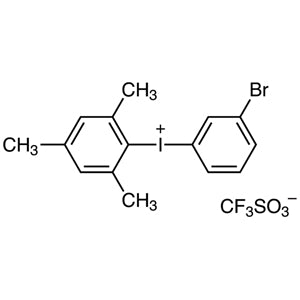
- TCI B5277 1203709-76-5 (3-Bromophenyl)(mesityl)iodonium Trifluoromethanesulfonate
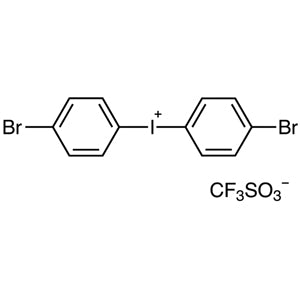
- TCI B5259 139139-81-4 Bis(4-bromophenyl)iodonium Trifluoromethanesulfonate
- TCI P2413 905718-46-9 Phenyl[3-(trifluoromethyl)phenyl]iodonium Trifluoromethanesulfonate
- TCI T3272 181934-29-2 1-[(Trimethylsilyl)ethynyl]-1,2-benziodoxol-3(1H)-one
- TCI T3597 289706-46-3 4-[2,2,2-Trifluoro-1-[(trimethylsilyl)oxy]ethyl]morpholine
- TCI T3190 130995-13-0 3-(Trimethylsilylethynyl)thiophene
- Organic synthesis applications benefit from this compound’s ability to facilitate the formation of complex molecular structures with high reactivity and specificity.
- In pharmacological research, it is used to develop new drug compounds by enabling precise bond formation and structural modification.
- Materials science laboratories rely on this reagent to synthesize advanced materials with unique chemical properties and structural complexity.
- It is ideal for heteroaryne precursor applications due to its effectiveness in promoting electrophilic substitution reactions.
- The compound is commonly used in synthetic chemistry projects requiring high precision and controlled reaction conditions.
| Brand | TCI |
|---|---|
| CAS number | 175224-35-8 |
| Molecular formula | — |
| Purity | — |
| Category | Chemistry > Synthetic Reagents > Aryne Precursors, Heteroaryne Precursors |
| Pack sizes | Available in various quantities as per supplier specifications |
| Physical form | Solid or liquid, depending on formulation |
| Storage | Store in a cool, dry place away from moisture and direct sunlight |
This compound should be stored in a cool, dry environment, away from moisture and direct sunlight to maintain its chemical stability. It is recommended to use airtight containers made of materials such as glass or polyethylene to prevent contamination and degradation. Due to its reactivity, it should be handled with care, using appropriate personal protective equipment such as gloves and safety goggles. In laboratory settings, it is important to ensure proper ventilation and to keep it away from incompatible substances. Regular monitoring of storage conditions is advised to ensure the compound remains in optimal condition for use.
—
Produk Terkait
-
(3-Bromophenyl)(mesityl)iodoniumTrifluoromethanesulfonate TCI B5277
Regular price From Rp 3.287.550,00Regular price -
Bis(4-bromophenyl)iodoniumTrifluoromethanesulfonate TCI B5259
Regular price From Rp 2.439.150,00Regular price -
Phenyl[3-(trifluoromethyl)phenyl]iodoniumTrifluoromethanesulfonate TCI P2413
Regular price From Rp 2.757.300,00Regular price -
1-[(Trimethylsilyl)ethynyl]-1,2-benziodoxol-3(1H)-one TCI T3272
Regular price From Rp 3.843.000,00Regular price -
4-[2,2,2-Trifluoro-1-[(trimethylsilyl)oxy]ethyl]morpholine TCI T3597
Regular price From Rp 2.016.000,00Regular price -
3-(Trimethylsilylethynyl)thiophene TCI T3190
Regular price From Rp 955.500,00Regular price -
2-(Trimethylsilylethynyl)thiophene TCI T3189
Regular price From Rp 2.518.950,00Regular price -
1-[2-(Trimethylsilyl)ethoxycarbonyloxy]benzotriazole TCI T2590
Regular price From Rp 2.730.000,00Regular price
![905718-46-9 Phenyl[3-(trifluoromethyl)phenyl]iodonium Trifluoromethanesulfonate - AMI Scientific](http://amiscientific.com/cdn/shop/files/TCI2510P2413.jpg?v=1767136185&width=533)
![181934-29-2 1-[(Trimethylsilyl)ethynyl]-1,2-benziodoxol-3(1H)-one - AMI Scientific](http://amiscientific.com/cdn/shop/files/TCI2510T3272.jpg?v=1767143935&width=533)
![289706-46-3 4-[2,2,2-Trifluoro-1-[(trimethylsilyl)oxy]ethyl]morpholine - AMI Scientific](http://amiscientific.com/cdn/shop/files/TCI2510T3597.jpg?v=1769058256&width=533)


![113306-55-1 1-[2-(Trimethylsilyl)ethoxycarbonyloxy]benzotriazole - AMI Scientific](http://amiscientific.com/cdn/shop/files/TCI2510T2590.jpg?v=1769143650&width=533)