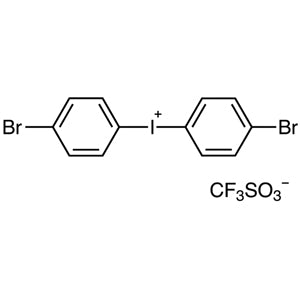
(3-Bromophenyl)(mesityl)iodonium trifluoromethanesulfonate is a synthetic reagent widely used in organic chemistry laboratories. It belongs to the class of hypervalent iodine compounds, which are known for their unique reactivity and utility in various synthetic transformations. This compound serves as an efficient initiator in reactions that require iodine activation, making it a valuable tool for chemists working on complex molecule synthesis. Its role in promoting nucleophilic substitution reactions is particularly significant, allowing for the formation of structurally diverse organic compounds.
The compound is prized for its chemical stability and high reactivity towards a wide range of organic substrates. Its ability to act as a reliable iodine source enhances the efficiency of synthetic pathways, especially in reactions where precise control over reactivity is essential. The trifluoromethanesulfonate group further contributes to its stability and reactivity, making it a preferred choice for researchers aiming to achieve high yields and selectivity in their experiments.
In Indonesian laboratories, this reagent is commonly used in organic synthesis research, particularly in the development of complex molecules and reactions that require iodine activation. Its versatility and effectiveness make it a staple in chemical research, supporting both academic and industrial applications in the field of synthetic chemistry.
TCI brochures (PDF)
- Hypervalent Iodine Compounds 2025-06-12 · p. 6
Related TCI products
- TCI B5259 139139-81-4 Bis(4-bromophenyl)iodonium Trifluoromethanesulfonate
- TCI P2413 905718-46-9 Phenyl[3-(trifluoromethyl)phenyl]iodonium Trifluoromethanesulfonate
- TCI P2097 175224-35-8 Phenyl[4-(trimethylsilyl)thiophen-3-yl]iodonium Trifluoromethanesulfonate
- TCI T4297 954-16-5 Mesityl(phenyl)methanone
- TCI M2072 1216909-33-9 9-Mesityl-2,7,10-trimethylacridinium Perchlorate
- TCI M1774 674783-97-2 9-Mesityl-10-methylacridinium Perchlorate
- Organic synthesis reactions where iodine activation is required for efficient nucleophilic substitution processes.
- Development of complex organic molecules through controlled and selective chemical transformations.
- Research in medicinal chemistry for the synthesis of bioactive compounds with specific structural features.
- Catalytic systems that benefit from the high reactivity and stability of hypervalent iodine compounds.
- Analytical chemistry applications involving the preparation of standard reagents for qualitative and quantitative analysis.
| Brand | TCI |
|---|---|
| CAS number | 1203709-76-5 |
| Molecular formula | — |
| Purity | — |
| Category | Chemistry > Synthetic Reagents > Hypervalent Iodine Compounds |
| Pack sizes | Available in various quantities as per standard laboratory supply formats |
| Physical form | Solid or liquid, depending on the specific formulation |
| Storage | Store in a cool, dry place away from light and moisture |
This compound should be stored in a cool, dry environment, away from direct sunlight and moisture to maintain its chemical stability. It is recommended to use airtight containers made of materials compatible with its chemical nature, such as glass or high-density polyethylene. Due to its reactivity, it should be handled with care, using appropriate personal protective equipment. In laboratory settings, it is important to ensure good ventilation and to avoid contact with incompatible substances. Proper labeling and storage conditions are essential to prevent accidental exposure and to maintain the integrity of the compound during use.
—
Produk Terkait
-
Bis(4-bromophenyl)iodoniumTrifluoromethanesulfonate TCI B5259
Regular price From Rp 2.439.150,00Regular priceRp 1.705.200,00Sale price From Rp 2.439.150,00 -
Phenyl[3-(trifluoromethyl)phenyl]iodoniumTrifluoromethanesulfonate TCI P2413
Regular price From Rp 2.757.300,00Regular priceRp 1.927.800,00Sale price From Rp 2.757.300,00 -
Phenyl[4-(trimethylsilyl)thiophen-3-yl]iodoniumTrifluoromethanesulfonate TCI P2097
Regular price Rp 3.524.850,00Regular priceRp 2.480.100,00Sale price Rp 3.524.850,00 -
Mesityl(phenyl)methanone TCI T4297
Regular price From Rp 955.500,00Regular priceRp 667.800,00Sale price From Rp 955.500,00 -
9-Mesityl-2,7,10-trimethylacridiniumPerchlorate TCI M2072
Regular price Rp 9.116.100,00Regular priceRp 6.390.300,00Sale price Rp 9.116.100,00 -
9-Mesityl-10-methylacridiniumPerchlorate TCI M1774
Regular price Rp 3.870.300,00Regular priceRp 2.721.600,00Sale price Rp 3.870.300,00 -
3,6-Di-tert-butyl-9-mesityl-10-phenylacridiniumTetrafluoroborate TCI D6218
Regular price Rp 4.823.700,00Regular priceRp 3.388.350,00Sale price Rp 4.823.700,00 -
MethylTrifluoromethanesulfonate TCI T2029
Regular price From Rp 1.298.850,00Regular priceRp 908.250,00Sale price From Rp 1.298.850,00