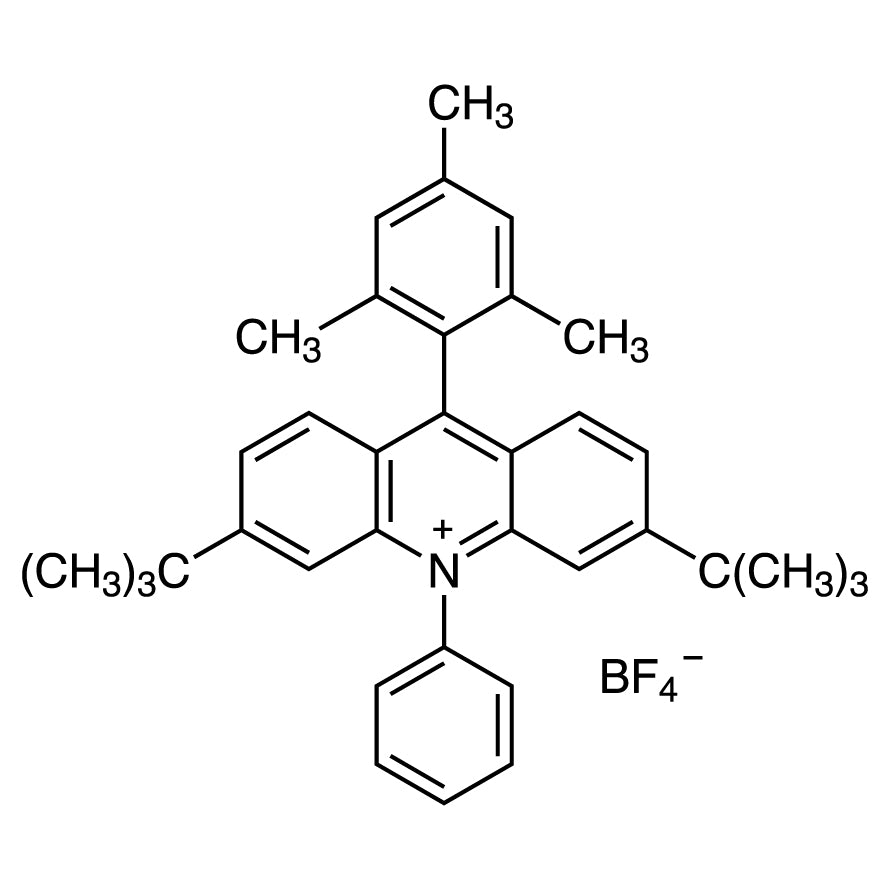
3,6-Di-tert-butyl-9-mesityl-10-phenylacridinium Tetrafluoroborate is a specialized chemical compound used as a visible light photoredox catalyst in various chemical reactions. It plays a crucial role in laboratory settings where light-driven reactions are required, offering an efficient alternative to traditional thermal or chemical catalysts. This compound is particularly valuable in materials science and photonic research, where precise control over reaction conditions is essential. Its ability to mediate electron transfer under visible light makes it a key component in developing new synthetic methodologies and functional materials.
The compound’s unique molecular structure provides high reactivity and stability, making it a preferred choice for researchers seeking reliable and efficient catalytic performance. Its tetrafluoroborate counterion enhances solubility and compatibility with different reaction media, while its photostability ensures consistent performance over multiple reaction cycles. These properties make it ideal for applications requiring long-term use and reproducibility in controlled environments. The compound’s efficiency in electron mediation and its compatibility with a wide range of solvents further contribute to its popularity in modern laboratory practices.
In Indonesian laboratories, this material is widely used in research focused on organic chemistry, optical materials, and energy technologies. Its ability to facilitate reactions without extreme conditions aligns with the goals of sustainable and cost-effective research. It is particularly relevant in academic and industrial settings where innovation in photoredox chemistry is a priority. The compound’s stability and ease of handling make it a reliable tool for both teaching and advanced research applications.
TCI brochures (PDF)
- Visible Light Photoredox Catalysts 2026-04-28 · p. 4
- Organic Photoreaction Reagents 2025-02-13 · p. 7
Related TCI products
- TCI M1775 36519-61-6 10-Methyl-9-phenylacridinium Perchlorate
- TCI M2072 1216909-33-9 9-Mesityl-2,7,10-trimethylacridinium Perchlorate
- TCI M1774 674783-97-2 9-Mesityl-10-methylacridinium Perchlorate
- TCI T3968 448-61-3 2,4,6-Triphenylpyrylium Tetrafluoroborate
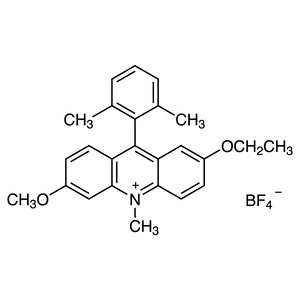
- TCI D5983 2771238-32-3 9-(2,6-Dimethylphenyl)-2-ethoxy-6-methoxy-10-methylacridinium Tetrafluoroborate
- TCI B2897 2743539-91-3 9-(2-Biphenylyl)-10-methylacridinium Perchlorate
- Visible Light Photoredox Catalysis: This compound is ideal for light-driven reactions, enabling efficient electron transfer under visible light, which is crucial for developing new synthetic methods in organic chemistry.
- Optical Material Synthesis: Its photoreactive properties make it suitable for creating advanced optical materials, such as dyes and sensors, used in photonics and nanotechnology research.
- Energy Conversion Research: It is used in studies related to solar energy and photocatalytic processes, helping to improve the efficiency of light-induced chemical transformations.
- Organic Synthesis in Green Chemistry: The compound supports sustainable chemical processes by reducing the need for harsh conditions, aligning with eco-friendly research practices.
- Academic and Industrial R&D: Its reliability and performance make it a standard tool in both academic and industrial laboratories for developing new materials and chemical processes.
| Brand | TCI |
|---|---|
| CAS number | 1810004-87-5 |
| Molecular formula | — |
| Purity | — |
| Category | Materials Science > Photonic Materials and Optical Materials > Visible Light Photoredox Catalysts |
| Pack sizes | Available in various quantities as per supplier specifications |
| Physical form | Solid powder |
| Storage | Store in a cool, dry place away from light |
This compound should be stored in a cool, dry environment, away from direct sunlight and sources of heat. It is recommended to use airtight containers to prevent moisture absorption and maintain its chemical integrity. Due to its photoreactive nature, it is essential to minimize exposure to light during handling and storage. Proper ventilation should be maintained in the laboratory to ensure safe handling. The compound is generally stable under standard laboratory conditions, making it suitable for routine use in research settings. Always follow standard safety protocols when working with chemical catalysts to ensure a safe and controlled laboratory environment.
—
Produk Terkait
-
10-Methyl-9-phenylacridiniumPerchlorate TCI M1775
Regular price From Rp 2.704.800,00Regular price -
9-Mesityl-2,7,10-trimethylacridiniumPerchlorate TCI M2072
Regular price Rp 9.063.600,00Regular price -
9-Mesityl-10-methylacridiniumPerchlorate TCI M1774
Regular price Rp 3.817.800,00Regular price -
2,4,6-TriphenylpyryliumTetrafluoroborate TCI T3968
Regular price Rp 1.829.100,00Regular price -
9-(2,6-Dimethylphenyl)-2-ethoxy-6-methoxy-10-methylacridiniumTetrafluoroborate TCI D5983
Regular price From Rp 3.367.350,00Regular price -
9-(2-Biphenylyl)-10-methylacridiniumPerchlorate TCI B2897
Regular price Rp 4.240.950,00Regular price -
10-MethylacridiniumPerchlorate TCI M1787
Regular price From Rp 1.326.150,00Regular price -
Mesityl(phenyl)methanone TCI T4297
Regular price From Rp 955.500,00Regular price