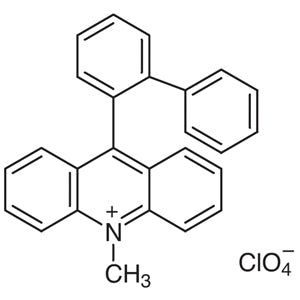
9-(2-Biphenylyl)-10-methylacridinium Perchlorate is a chemical compound widely used in catalytic and organic reactions within laboratory settings. This compound plays a crucial role in facilitating chemical transformations by acting as an organocatalyst. Its unique molecular structure enables it to participate in various reaction mechanisms, making it a valuable tool for researchers aiming to enhance reaction efficiency. The compound is particularly effective in environments where electron activation is required, allowing it to influence reaction pathways without being consumed in the process.
The compound's high reactivity and stability under specific conditions make it a preferred choice for laboratory applications. Its ability to maintain structural integrity during reactions ensures consistent performance, which is essential for reproducible results. Additionally, its compatibility with aromatic compounds enhances its utility in a range of chemical processes. The stability of this compound also contributes to its ease of storage and repeated use, making it a reliable option for long-term research projects.
In Indonesian laboratories, this compound is commonly used by chemists and researchers for various studies and development projects. Its unique properties make it a go-to material for catalytic applications, especially in substitution and oxidation reactions. The compound's effectiveness and reliability have made it a standard in both academic and industrial research settings, supporting innovation in chemical processes and product development.
TCI brochures (PDF)
- Visible Light Photoredox Catalysts 2026-04-28 · p. 4
- Organic Photoreaction Reagents 2025-02-13 · p. 7
- Oxidizing Agents 2025-06-11 · p. 9
Related TCI products
- TCI M1787 26456-05-3 10-Methylacridinium Perchlorate
- TCI M1774 674783-97-2 9-Mesityl-10-methylacridinium Perchlorate
- TCI M2072 1216909-33-9 9-Mesityl-2,7,10-trimethylacridinium Perchlorate
- TCI M1775 36519-61-6 10-Methyl-9-phenylacridinium Perchlorate
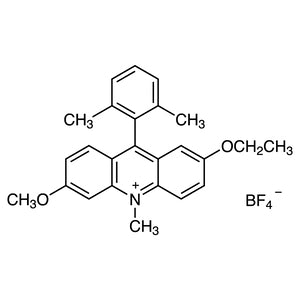
- TCI D5983 2771238-32-3 9-(2,6-Dimethylphenyl)-2-ethoxy-6-methoxy-10-methylacridinium Tetrafluoroborate
- TCI D6218 1810004-87-5 3,6-Di-tert-butyl-9-mesityl-10-phenylacridinium Tetrafluoroborate
- Catalytic Substitution Reactions: This compound is ideal for substitution reactions due to its ability to activate electron transfer, enhancing reaction efficiency in organic synthesis.
- Oxidation Processes: Its reactivity with aromatic compounds makes it suitable for oxidation reactions, where it facilitates the conversion of substrates under controlled conditions.
- Organic Reaction Activation: The compound's unique structure allows it to act as an efficient catalyst in organic reactions, promoting desired chemical transformations without being consumed.
- Electronic Activation Studies: Its role in electron activation makes it valuable for research into reaction mechanisms and electronic behavior in complex chemical systems.
- Industrial Chemical Synthesis: The compound's stability and reactivity make it a preferred choice for industrial applications requiring high-performance catalysts in large-scale chemical processes.
| Brand | TCI |
|---|---|
| CAS number | 2743539-91-3 |
| Molecular formula | — |
| Purity | — |
| Category | Chemistry > Catalysis and Inorganic Chemistry > Organocatalysts [Catalysis] |
| Pack sizes | Available in standard laboratory quantities |
| Physical form | Solid powder |
| Storage | Store in a cool, dry place away from moisture and direct sunlight |
This compound should be stored in a cool, dry environment to maintain its stability and reactivity. It is recommended to use airtight containers to prevent moisture absorption and contamination. Due to its chemical nature, it should be handled with appropriate personal protective equipment, such as gloves and safety goggles, to ensure laboratory safety. Avoid exposure to heat and direct light to preserve its chemical integrity. Regular inspection of storage conditions is advised to ensure optimal performance and safety during use. Proper labeling and storage practices help maintain the compound's effectiveness and reduce the risk of accidental exposure.
—
Product Categories
Produk Terkait
-
10-MethylacridiniumPerchlorate TCI M1787
Regular price From Rp 1.378.650,00Regular priceRp 979.650,00Sale price From Rp 1.378.650,00 -
9-Mesityl-10-methylacridiniumPerchlorate TCI M1774
Regular price Rp 3.870.300,00Regular priceRp 2.721.600,00Sale price Rp 3.870.300,00 -
9-Mesityl-2,7,10-trimethylacridiniumPerchlorate TCI M2072
Regular price Rp 9.116.100,00Regular priceRp 6.390.300,00Sale price Rp 9.116.100,00 -
10-Methyl-9-phenylacridiniumPerchlorate TCI M1775
Regular price From Rp 2.757.300,00Regular priceRp 1.943.550,00Sale price From Rp 2.757.300,00 -
9-(2,6-Dimethylphenyl)-2-ethoxy-6-methoxy-10-methylacridiniumTetrafluoroborate TCI D5983
Regular price From Rp 3.419.850,00Regular priceRp 2.406.600,00Sale price From Rp 3.419.850,00 -
3,6-Di-tert-butyl-9-mesityl-10-phenylacridiniumTetrafluoroborate TCI D6218
Regular price Rp 4.823.700,00Regular priceRp 3.388.350,00Sale price Rp 4.823.700,00 -
AcriflavineHydrochloride(mixtureof3,6-Diamino-10-methylacridiniumChlorideHydrochlorideand3,6-DiaminoacridineHydrochloride) TCI A0677
Regular price From Rp 1.856.400,00Regular priceRp 1.313.550,00Sale price From Rp 1.856.400,00 -
Acriflavine(mixtureof3,6-Diamino-10-methylacridiniumChlorideand3,6-Diaminoacridine) TCI A0134
Regular price Rp 2.173.500,00Regular priceRp 1.535.100,00Sale price Rp 2.173.500,00