9-Mesityl-2,7,10-trimethylacridinium Perchlorate is a specialized chemical compound widely used in catalytic reactions and organic synthesis within laboratory settings. This compound plays a crucial role in facilitating chemical transformations by acting as an efficient catalyst in various reactions. Its unique molecular structure enables it to participate in complex chemical processes, making it a valuable tool for researchers working in the field of organic chemistry. Due to its reactivity and specificity, it is particularly useful in applications requiring precise control over reaction pathways and outcomes.
The compound's high reactivity and molecular specificity make it a preferred choice for advanced chemical research. Its ability to participate in substitution and electrophilic reactions with high efficiency is a key factor in its popularity among laboratory professionals. The compound's chemical stability under controlled conditions further enhances its reliability in experimental settings. However, it is important to note that it is sensitive to moisture and UV light, which necessitates careful handling and storage. These properties collectively contribute to its effectiveness in a wide range of chemical applications.
In Indonesian laboratories, this compound is commonly used in organic chemistry research, the synthesis of complex compounds, and the development of new catalysts. It is a key component in many academic and industrial research projects, supporting advancements in chemical science and technology. Its availability in high purity and solid form makes it ideal for precise and reproducible experiments, ensuring consistent results in laboratory settings.
TCI brochures (PDF)
- Visible Light Photoredox Catalysts 2026-04-28 · p. 4
- Organic Photoreaction Reagents 2025-02-13 · p. 7
- Oxidizing Agents 2025-06-11 · p. 9
Related TCI products
- TCI M1774 674783-97-2 9-Mesityl-10-methylacridinium Perchlorate
- TCI B2897 2743539-91-3 9-(2-Biphenylyl)-10-methylacridinium Perchlorate
- TCI M1787 26456-05-3 10-Methylacridinium Perchlorate
- TCI M1775 36519-61-6 10-Methyl-9-phenylacridinium Perchlorate
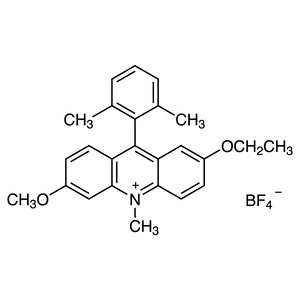
- TCI D5983 2771238-32-3 9-(2,6-Dimethylphenyl)-2-ethoxy-6-methoxy-10-methylacridinium Tetrafluoroborate
- TCI D6218 1810004-87-5 3,6-Di-tert-butyl-9-mesityl-10-phenylacridinium Tetrafluoroborate
- Electrophilic Substitution Reactions: This compound is ideal for promoting substitution reactions due to its high reactivity and ability to facilitate specific chemical transformations.
- Organic Synthesis: Its molecular structure enables it to act as a catalyst in the synthesis of complex organic molecules, supporting efficient and selective reaction pathways.
- Catalytic Research: The compound’s specificity and reactivity make it a preferred choice for studies focused on catalytic mechanisms and reaction optimization.
- Advanced Chemical Development: It is widely used in the creation of new catalysts and chemical intermediates, supporting innovation in chemical processes.
- Academic Research: Indonesian universities and research institutions utilize it to expand knowledge in organic chemistry and catalytic science.
| Brand | TCI |
|---|---|
| CAS number | 1216909-33-9 |
| Molecular formula | — |
| Purity | — |
| Category | Chemistry > Catalysis and Inorganic Chemistry > Organocatalysts [Catalysis] |
| Pack sizes | Available in various quantities as per standard laboratory supply |
| Physical form | Solid |
| Storage | Store in a cool, dry place away from moisture and UV light |
This compound should be stored in a cool, dry environment to maintain its chemical stability and prevent degradation. It is recommended to use sealed containers that protect it from moisture and UV exposure, as both factors can significantly affect its reactivity and effectiveness. Due to its sensitivity, it should be handled in a controlled laboratory setting with appropriate safety measures in place. Always ensure that the storage area is well-ventilated and free from potential contaminants. Proper labeling and storage conditions are essential to ensure the compound remains viable for use in research applications.
—
Product Categories
Produk Terkait
-
9-Mesityl-10-methylacridiniumPerchlorate TCI M1774
Regular price Rp 3.817.800,00Regular price -
9-(2-Biphenylyl)-10-methylacridiniumPerchlorate TCI B2897
Regular price Rp 4.240.950,00Regular price -
10-MethylacridiniumPerchlorate TCI M1787
Regular price From Rp 1.326.150,00Regular price -
10-Methyl-9-phenylacridiniumPerchlorate TCI M1775
Regular price From Rp 2.704.800,00Regular price -
9-(2,6-Dimethylphenyl)-2-ethoxy-6-methoxy-10-methylacridiniumTetrafluoroborate TCI D5983
Regular price From Rp 3.367.350,00Regular price -
3,6-Di-tert-butyl-9-mesityl-10-phenylacridiniumTetrafluoroborate TCI D6218
Regular price Rp 4.771.200,00Regular price -
Mesityl(phenyl)methanone TCI T4297
Regular price From Rp 955.500,00Regular price -
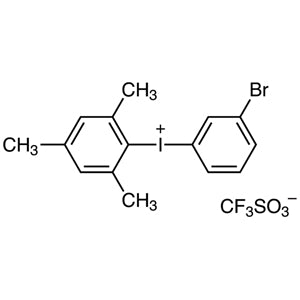
(3-Bromophenyl)(mesityl)iodoniumTrifluoromethanesulfonate TCI B5277
Regular price From Rp 3.287.550,00Regular price