


10-Methyl-9-phenylacridinium Perchlorate is an acridinium salt, a positively charged aromatic heterocyclic compound consisting of an acridinium cation bearing a methyl group on the nitrogen atom and a phenyl group at the 9-position, paired with a perchlorate anion. In the laboratory, this class of compound is known as an organocatalyst, and more specifically as an organic photocatalyst for photoredox reactions. Its role is to absorb visible light and then, in the excited state, act as a strong electron acceptor, allowing it to initiate single-electron transfer reactions without requiring an expensive noble-metal catalyst.
The property that makes this compound a preferred choice is its high photochemical oxidising power combined with the stability of the acridinium framework. The positive charge on the nitrogen atom makes the acridinium system strongly electron-deficient, while the fused three-ring aromatic system provides light absorption in the visible region, so reactions can be driven with simple blue LED lamps rather than specialised ultraviolet equipment. The phenyl substituent at the 9-position provides steric shielding and tunes the electronic character of the excited state. As an organocatalyst, the compound leaves no metal residue in the product, an important advantage for research work.
In Indonesian laboratories, this reagent is typically used in university and institutional research settings where visible-light photoredox chemistry is being developed on a synthetic scale. It suits groups that need an alternative to noble-metal photocatalysts, whether for cost reasons or because the target product must remain free of metal contamination. Because the reactions can be run with ordinary blue LED sources, the compound fits well into synthetic laboratories that are building photochemical capability without large capital investment in dedicated irradiation equipment.
TCI brochures (PDF)
- Visible Light Photoredox Catalysts 2026-04-28 · p. 4
- Organic Photoreaction Reagents 2025-02-13 · p. 7
- Oxidizing Agents 2025-06-11 · p. 9
Related TCI products
- TCI B2897 2743539-91-3 9-(2-Biphenylyl)-10-methylacridinium Perchlorate
- TCI M2072 1216909-33-9 9-Mesityl-2,7,10-trimethylacridinium Perchlorate
- TCI M1787 26456-05-3 10-Methylacridinium Perchlorate
- TCI M1774 674783-97-2 9-Mesityl-10-methylacridinium Perchlorate
- TCI D6218 1810004-87-5 3,6-Di-tert-butyl-9-mesityl-10-phenylacridinium Tetrafluoroborate
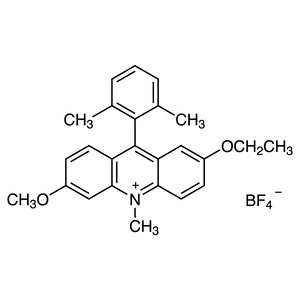
- TCI D5983 2771238-32-3 9-(2,6-Dimethylphenyl)-2-ethoxy-6-methoxy-10-methylacridinium Tetrafluoroborate
- Visible-light photoredox catalysis: the acridinium cation absorbs visible light and reaches a strongly oxidising excited state, enabling single-electron transfer chemistry to be initiated with simple blue LED illumination.
- Metal-free organocatalytic synthesis: because the catalyst contains no transition metal, reaction products are not contaminated with metal residues, which matters for studies where trace-metal interference must be excluded.
- Single-electron transfer methodology development: the electron-deficient acridinium system acts as a well-defined electron acceptor, making it useful for researchers investigating radical-based bond-forming reactions and mechanistic pathways.
- Photochemical oxidation studies: the high oxidising power of the excited acridinium species allows investigation of substrate oxidation under mild conditions, avoiding the harsh stoichiometric oxidants otherwise required.
- Academic photochemistry teaching and research: the stable acridinium framework and straightforward blue-LED activation make the compound suitable for demonstrating photoredox principles in university-level synthetic and mechanistic coursework.
| Brand | TCI |
|---|---|
| CAS number | 36519-61-6 |
| Molecular formula | — |
| Purity | — |
| Category | Chemistry > Catalysis and Inorganic Chemistry > Organocatalysts [Catalysis] |
| Pack sizes | — |
| Physical form | — |
| Storage | store according to the conditions stated on the manufacturer's label and safety data sheet; pack sizes as listed by the manufacturer |
- Product code: M1775
- Chemical name: 10-Methyl-9-phenylacridinium Perchlorate
Store the material in its original tightly closed container, kept in a cool, dry and well-ventilated area away from direct sunlight and from sources of heat or ignition. Because the compound is light-absorbing by design, protection from light during storage is advisable to preserve its performance as a photocatalyst. Keep it separated from incompatible materials, particularly reducing agents and combustible substances, as is standard practice for perchlorate salts. Handle in a fume hood using appropriate personal protective equipment, including safety glasses, gloves and a laboratory coat, and avoid generating dust. Always consult the manufacturer's safety data sheet before use, and follow institutional procedures for waste collection and disposal.
—
Product Categories
Produk Terkait
-
9-(2-Biphenylyl)-10-methylacridiniumPerchlorate TCI B2897
Regular price Rp 4.240.950,00Regular price -
9-Mesityl-2,7,10-trimethylacridiniumPerchlorate TCI M2072
Regular price Rp 9.063.600,00Regular price -
10-MethylacridiniumPerchlorate TCI M1787
Regular price From Rp 1.326.150,00Regular price -
9-Mesityl-10-methylacridiniumPerchlorate TCI M1774
Regular price Rp 3.817.800,00Regular price -
3,6-Di-tert-butyl-9-mesityl-10-phenylacridiniumTetrafluoroborate TCI D6218
Regular price Rp 4.771.200,00Regular price -
9-(2,6-Dimethylphenyl)-2-ethoxy-6-methoxy-10-methylacridiniumTetrafluoroborate TCI D5983
Regular price From Rp 3.367.350,00Regular price -
6,7-Dihydro-2-(2,4,6-trimethylphenyl)-5H-pyrrolo[2,1-c]-1,2,4-triazoliumPerchlorate TCI D3982
Regular price Rp 3.207.750,00Regular price -
Rhodamine19Perchlorate TCI R0191
Regular price From Rp 2.016.000,00Regular price


![6,7-Dihydro-2-(2,4,6-trimethylphenyl)-5H-pyrrolo[2,1-c]-1,2,4-triazolium Perchlorate (CAS 1334529-08-6) - TCI D3982 - AMI Scientific](http://amiscientific.com/cdn/shop/files/TCI2510D3982.jpg?v=1767106885&width=533)
